Algeria
 Egypt
 Libya
 Morocco
 Sudan
 Tunisia
 Benin
 Burkina Faso
 Cabo Verde
 Côte d'Ivoire
 Ghana
 Guinea
 Guinea-Bissau
 Liberia
 Mauritania
 Niger
 Nigeria
 Senegal
 Sierra Leone
 The Gambia
 Togo
 Cameroon
 Central African Republic
 Chad
 DR Congo
 Equatorial Guinea
 Gabon
 Republic of the Congo
 São Tomé and Príncipe
 Burundi
 Comoros
 Djibouti
 Eritrea
 Ethiopia
 Kenya
 Madagascar
 Malawi
 Mauritius
 Mozambique
 Rwanda
 Seychelles
 Somalia
 South Sudan
 Tanzania
 Uganda
 Angola
 Botswana
 Eswatini
 Lesotho
 Namibia
 South Africa
 Zambia
 Zimbabwe
In Bamako, a statement about Kidal can still send a journalist to prison
In today’s Mali, a simple public observation can come at a high cost. Saying that the state no longer controls Kidal is not merely commenting on a battle in the desert; it touches on sovereignty, the image of those in power and how the authorities tolerate dissent. It is precisely this fragile terrain that explains why the Malian press is under pressure.
The case is also part of a broader regional realignment. Since 29 January 2025, Mali has no longer been a member of ECOWAS, alongside Burkina Faso and Niger, while the Alliance of Sahel States has strengthened its own political and military structures. In Bamako, this shift has fuelled a discourse of sovereignty. But it has also come with a tougher domestic climate, particularly on security and public expression.
What the journalist said, and why it has become a court case
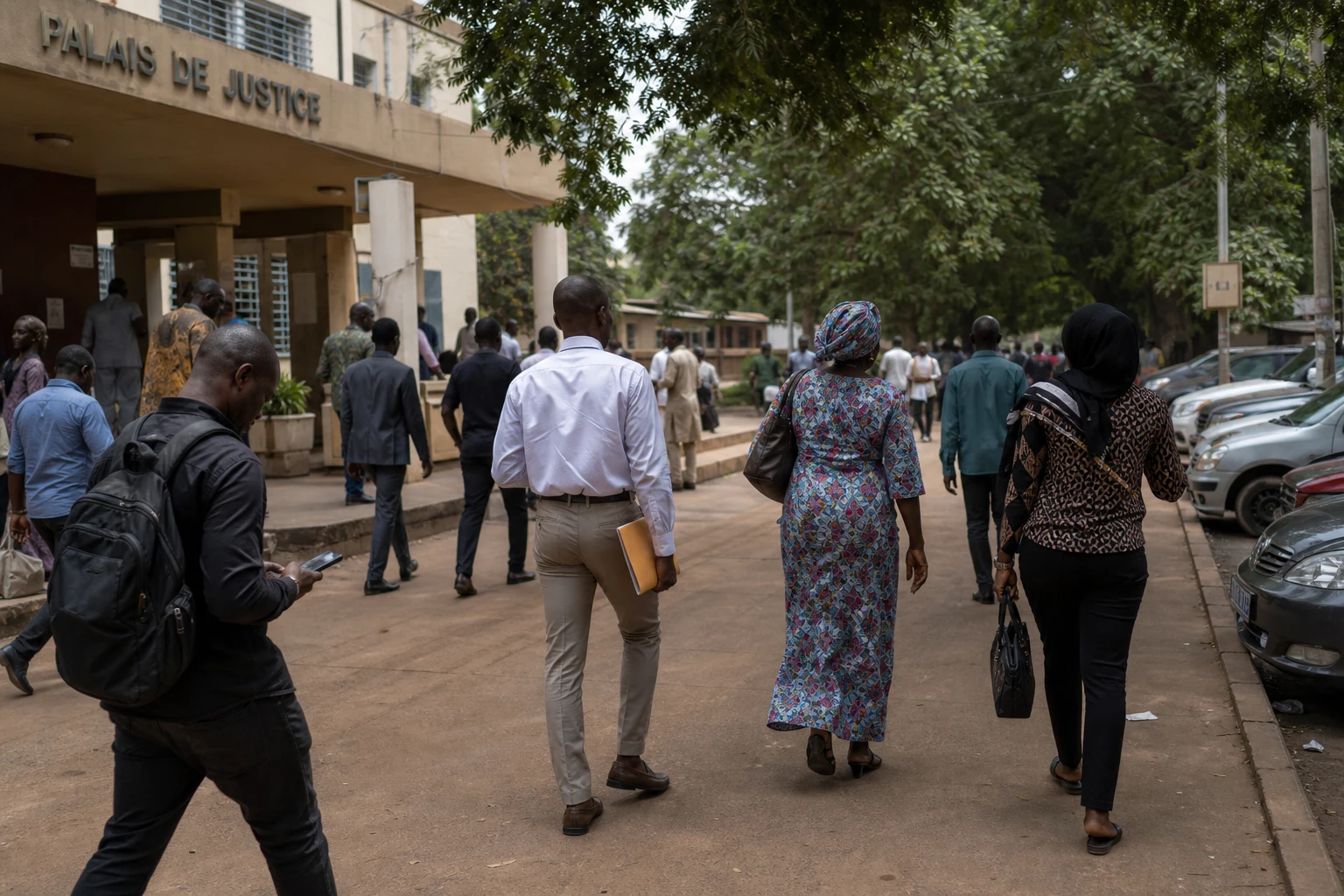
The editor of the newspaper Le Témoin, Abdrahamane Keïta, is due to appear this Monday, 7 September 2026, before the national cybercrime division in Bamako. He was remanded in custody on 9 June 2026, after remarks on television about the security situation in Kidal. Several media outlets and human rights organisations have confirmed this timeline, with variations in the spelling of his first name.
According to accounts by news agencies and press organisations, he is accused of saying that Kidal was then “administered” by Iyad Ag Ghaly, leader of JNIM, a group affiliated with al-Qaeda. The authorities have charged him with “undermining national unity” and disseminating “false and misleading information”. These are serious charges, as they shift a security debate into the criminal sphere.
The case is not an isolated one. A few weeks earlier, journalist Chahana Takiou had also been prosecuted before the same specialised court, after criticising the way the cybercrime law is used against media professionals. In August 2026, he was sentenced to prison. The message to the profession is clear: in Mali, the line between political commentary, news reporting and criminal prosecution has narrowed considerably.
Kidal, a military flashpoint and political symbol
To understand the significance of this case, it is necessary to look back at Kidal. In late April 2026, the city changed hands after clashes of unusual intensity. APA, Reuters—as reported by several international media outlets—Human Rights Watch and FEWS NET reported coordinated attacks attributed to JNIM and the Azawad Liberation Front, or FLA, formerly the CMA. The fighting affected several parts of the country, but Kidal retained a powerful symbolic charge because for years it has embodied the difficulty the Malian state has faced in reasserting its authority there over the long term.
The sources agree on one key point: after the clashes, the FLA claimed control of Kidal, while the Malian authorities said the situation was under control nationally. But information gathered on the ground at the same time showed a much more fragmented picture. The battle over the narrative therefore followed the military battle. This discrepancy explains the extreme sensitivity surrounding any public statement about Kidal.
The consequences extended beyond the country’s north. FEWS NET reported disruption to trade flows and displacement, while Human Rights Watch documented civilian casualties and abuses by all sides amid the April fighting. Kidal is therefore not just a name on a map. It is also a logistical, humanitarian and political hub for northern Mali and for the routes linking Gao, Timbuktu, the centre of the country and, beyond that, the wider Sahel.
What the case says about security, justice and the press in Mali
The use of the national cybercrime division over remarks made on air is fuelling a recurring debate in Mali: should a journalist’s words be treated as a digital offence, or as a possible press offence, and therefore under a framework offering greater protection for freedom of expression? Organisations such as FIDH, Human Rights Watch and the International Federation of Journalists believe the choice of court increases pressure on critical voices. Several Malian media professionals share this view.
The security context provides the backdrop, but it is not enough to explain everything. Since 2012, Mali has faced a succession of crises: armed insurgency, fragmentation of the north, jihadist expansion, coups, military transition and then a realignment of external alliances. In such periods, governments often seek to control the national narrative. The risk is then to conflate the state with its own interpretation of events. Yet a journalist describing a loss of territorial control is not necessarily fabricating false information; they may also be making, in blunt terms, a troubling political observation.
In Bamako and the regions alike, this has a different impact on each group. For the authorities, the issue is preserving national cohesion and the state’s credibility. For newsrooms, it is continuing to report the facts without slipping into self-censorship. For people in the north, the question is even more concrete: who actually administers the city, who protects civilians, who collects taxes, who controls the roads, who speaks for the territory? It is in this everyday reality that the significance of a word spoken on television is measured.
A local case with Sahel-wide resonance
The case of Abdrahamane Keïta therefore goes beyond the Malian justice system alone. It says something about how several Sahelian states manage public dissent amid a diffuse war. It also shows how leaving ECOWAS, the assertion of the Alliance of Sahel States and support from external military partners have neither removed the fragility of internal borders nor resolved the question of who effectively controls cities far from the capital.
This Monday, 7 September 2026, the scheduled court appearance in Bamako will therefore be watched well beyond the press corps. It will show whether Mali chooses to treat a critical statement as an opinion to be challenged, or as a threat to be punished. And it will indicate, by implication, how much space remains today to speak publicly about the reality of Kidal, the north and the country as a whole.