Algeria
 Egypt
 Libya
 Morocco
 Sudan
 Tunisia
 Benin
 Burkina Faso
 Cabo Verde
 Côte d'Ivoire
 Ghana
 Guinea-Bissau
 Liberia
 Mali
 Mauritania
 Niger
 Nigeria
 Senegal
 Sierra Leone
 The Gambia
 Togo
 Cameroon
 Central African Republic
 Chad
 DR Congo
 Equatorial Guinea
 Gabon
 Republic of the Congo
 São Tomé and Príncipe
 Burundi
 Comoros
 Djibouti
 Eritrea
 Ethiopia
 Kenya
 Madagascar
 Malawi
 Mauritius
 Mozambique
 Rwanda
 Seychelles
 Somalia
 South Sudan
 Tanzania
 Uganda
 Angola
 Botswana
 Eswatini
 Lesotho
 Namibia
 South Africa
 Zambia
 Zimbabwe
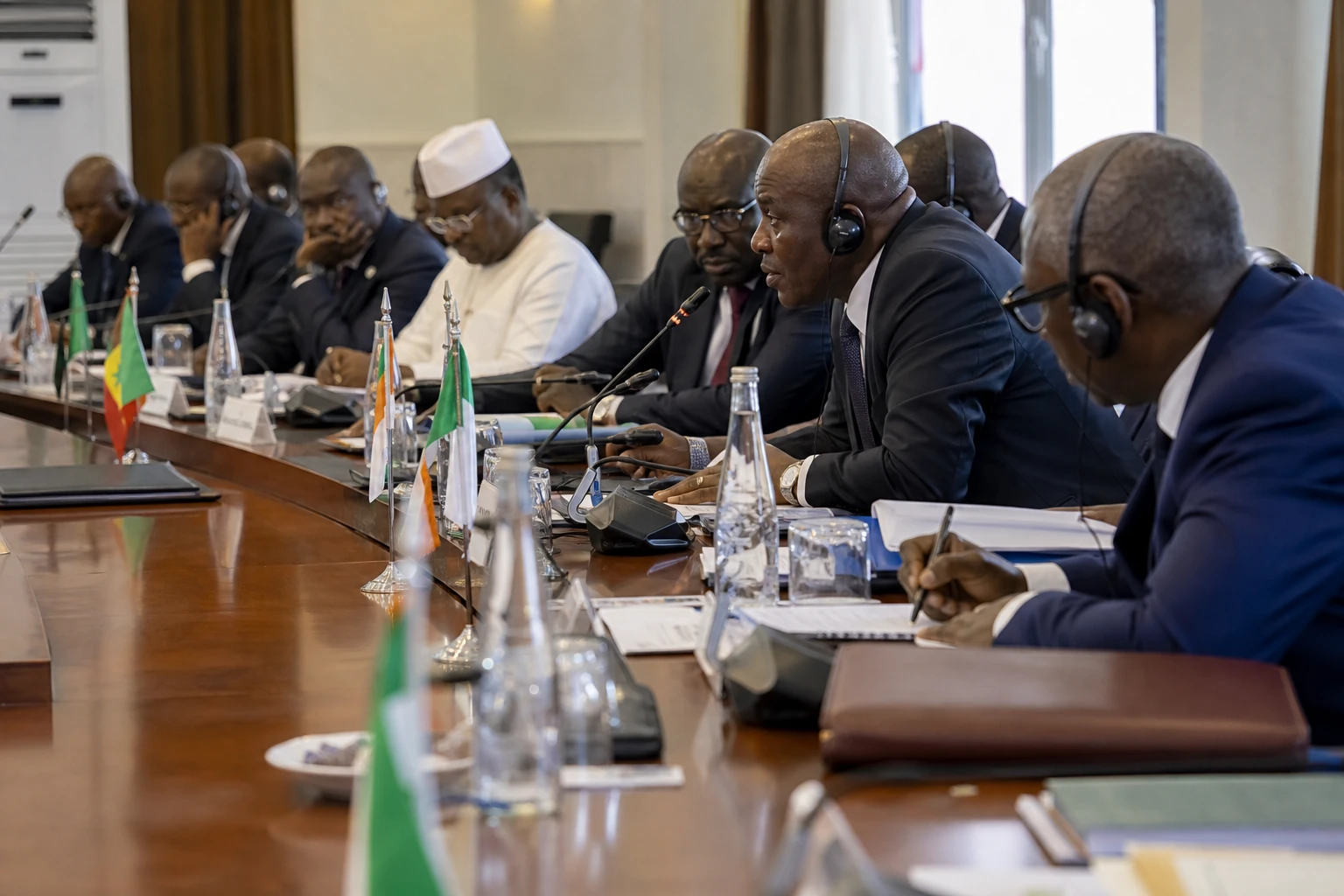
In Conakry, the chapter of 5 September 2021 is not closed
In Guinea, the coup of 5 September 2021 is no longer confined to the pages of transition manuals. It remains a lens through which to judge what the state has repaired, what it has shifted and what it has retained. Five years on, the question is no longer only whether the junta has kept its promises. It is also about measuring the cost of the promised refoundation for Guineans in Conakry and across the country.
The regional context matters. Guinea is a pivotal state in West Africa and a member of ECOWAS, where constitutional ruptures have weakened political balances in recent years. After the 2021 coup, the African Union suspended the country, as did ECOWAS within its own institutions. The message was clear: a return to constitutional order remained a condition for any easing of tensions with regional partners.
From taking power to electoral legitimacy
On 5 September 2021, Mamadi Doumbouya, then a colonel, and the special forces overthrew Alpha Condé in Conakry. The new authorities promised a “refoundation” of the state, institutional reform and a return to civilian rule. The transition was then structured around a provisional charter, a National Transitional Council and a roadmap which, for a long time, set no credible, consensual timetable for ending the state of exception.
The landscape shifted in 2025 and early 2026. The Constitutional Court validated the constitutional referendum of 21 September 2025, with 89.38% voting “yes”, according to the final results published by the Ministry of Territorial Administration. The reform paved the way for a new institutional architecture. Mamadi Doumbouya went on to win the presidential election held in December 2025 and was sworn in on 17 January 2026 in Conakry. In January 2026, the African Union said Guinea had taken a decisive step towards restoring constitutional order.
Regionally, the sequence also shifted the balance. ECOWAS eventually lifted its sanctions against Guinea as the transition moved towards elections and then the formal installation of the new authorities. Unlike in 2021-2023, Guinea no longer appeared, in early 2026, to be an indefinitely suspended case, but rather a closely watched example of a country emerging from transition, observed by its West African neighbours.
Claimed achievements, persistent blind spots
The Guinean authorities point to several initiatives: a new constitution, a new electoral code, large-scale biometric registration, the establishment of Fifth Republic institutions and a renewed grip on the mining and budget agendas. They have presented the registration of millions of voters and the holding of the 2025 elections as proof of a state that is now better organised. But political data alone cannot bring a transition to a close. It measures a process. It does not yet tell us about the quality of public debate.
This is where the record becomes more contentious. Human rights organisations documented lasting restrictions on protests, the press and party activity during the transition. Human Rights Watch recalled in 2025 the ban on protests, deaths linked to demonstrations and the arrests of opposition figures and journalists. Amnesty International also reported that a ban on gatherings remained in place, while an African human rights body noted in 2025 the suspension of political parties and restrictions on freedom of expression.
Spring 2026 has further illustrated this tension. In early March, the opposition denounced the dissolution of 40 political parties, seeing it as preparation for a system that narrows the space for competition. Even when official language speaks of stability, the perception that power is becoming concentrated remains strong among opponents of the regime and some parts of civil society. In Guinea, institutional normalisation will be credible only if it is accompanied by genuine pluralism, a more transparent justice system and a lasting open electoral framework.
What this moment says about Guinea and West Africa
Guinea occupies a distinctive place in the West African balance of power. It is rich in bauxite, coveted for its mining potential and strategically important in a region where military-led transitions have undermined trust between states, regional institutions and citizens. The Guinean case shows that a junta can turn its seizure of power into an electoral process and then into institutional legitimacy. But it also shows that emerging from a transition does not, by itself, amount to democratic consolidation.
For ECOWAS and the African Union, the stakes go beyond Conakry. The question is whether regional mechanisms for sanctions, mediation and reintegration can still influence member states when transitions drag on. It is also a question of precedent. When a military-led transition leads to an election won by its leader, the line between restoring constitutional order and capturing the process becomes thinner. Guinea is therefore a major political test for all of West Africa: how to restore the ballot box without closing down public debate.
The next stage will play out over time. Attention must now turn to the real place of political parties, the implementation of the new electoral rules, the fate of civil liberties and the practical distribution of the gains from mining growth. It is on this scale, not through institutional ceremony alone, that the legacy of 5 September 2021 will be measured for Guineans.