Algeria
 Egypt
 Libya
 Morocco
 Sudan
 Tunisia
 Benin
 Burkina Faso
 Cabo Verde
 Côte d'Ivoire
 Ghana
 Guinea-Bissau
 Liberia
 Mali
 Mauritania
 Niger
 Nigeria
 Senegal
 Sierra Leone
 The Gambia
 Togo
 Cameroon
 Central African Republic
 Chad
 DR Congo
 Equatorial Guinea
 Gabon
 Republic of the Congo
 São Tomé and Príncipe
 Burundi
 Comoros
 Djibouti
 Eritrea
 Ethiopia
 Kenya
 Madagascar
 Malawi
 Mauritius
 Mozambique
 Rwanda
 Seychelles
 Somalia
 South Sudan
 Tanzania
 Uganda
 Angola
 Botswana
 Eswatini
 Lesotho
 Namibia
 South Africa
 Zambia
 Zimbabwe
At Dar-es-Salam, a tragedy that reaches beyond the neighbourhood
In the eastern suburbs of Conakry, a rubbish dump has become a place of national mourning. The issue is no longer just waste, but the safety of families living on the edge of an area long known to be dangerous. On Friday 4 September 2026, the country buried the 36 people killed when the Dar-es-Salam dump collapsed in Bambéto, north of the capital.
The symbolism is powerful for Guinea. Conakry is grappling with urban challenges found in many West African capitals: population pressure, precarious housing, inadequate waste collection and settlement in exposed areas. The disaster struck a working-class neighbourhood, but it raises questions about the capital’s entire urban management model.
The facts: 36 dead, including 17 Sierra Leoneans
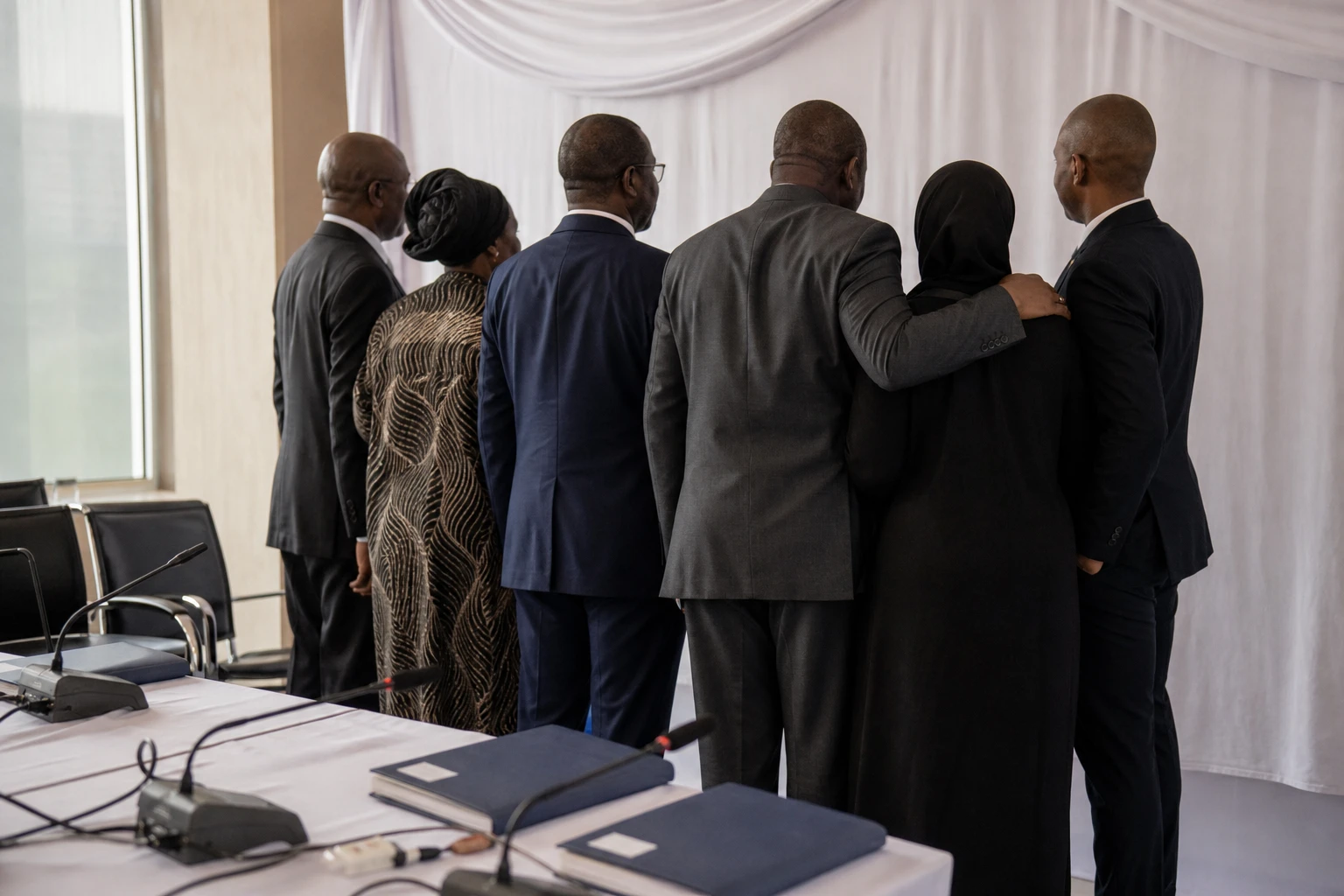
The ceremony was held at the Turkish mosque in Bambéto, before the victims were buried at the Martyrs’ Cemetery in Bambéto. The bodies were displayed to the public, covered with the Guinean flag, in the presence of Prime Minister Amadou Oury Bah, government members and diplomatic representatives. According to officials speaking at the tribute, the final death toll was 36, including 17 Sierra Leonean nationals. Two victims died after the initial disaster: one in the week before the funeral, the other at Donka Hospital, according to the National Agency for Emergency and Humanitarian Disaster Management.
The disaster occurred on the night of 22–23 August 2026, when heavy rain caused part of the Dar-es-Salam dump to collapse in the commune of Gbessia, in Conakry. At the time of the initial assessments, officials had reported at least 30 deaths and several injuries, while rescue operations were still under way.
Sierra Leone’s presence at the ceremony was no mere formality. A delegation led by Foreign Minister Mohamed Rahman Swarray attended the final tribute, a sign that the tragedy affected both sides of the border. Freetown and Conakry have longstanding human, commercial and family ties, strengthened by the framework of cooperation provided by the Mano River Union.
What Dar-es-Salam reveals about Conakry
Dar-es-Salam was not just a dump. It was also an inhabited, contested and overcrowded area, where the daily struggle to get by has often taken precedence over prevention. On 29 August, just days after the disaster, President Mamadi Doumbouya visited the site. The presidency then described it as being in the process of closure and clearance, with the stated aim of redeveloping the area.
The visit confirmed a central point: the authorities know the problem is longstanding. Waste management in Conakry, the capital of a country looking towards the Atlantic and major West African corridors, is no longer merely a technical issue. It concerns civil protection, urban planning, housing and residents’ dignity. When a neighbourhood is right next to a dump, every rainy season can become a test of survival.
For families, the immediate priorities are finding a roof, an income and stability. Several witnesses spoke of homes demolished around the site and the lack of a clear solution for displaced residents. For the state, the challenge is different: to prove that it can transform a high-risk area without simply shifting the problem to another neighbourhood. The credibility of the sanitation policy announced months ago is at stake.
A Guinean tragedy, but also a West African one
The Dar-es-Salam disaster resonates beyond Conakry because it brings together several regional realities: rapid urbanisation, climate vulnerability, cross-border migration and communities from several countries living side by side. The fact that a significant proportion of the victims were Sierra Leonean shows just how porous social, economic and family ties remain in this part of West Africa.
The crisis also comes as Guinea and its neighbours, meeting in Conakry in March 2026, pledged to strengthen cross-border cooperation and settle their disputes through diplomacy within the Mano River Union. In this context, the Dar-es-Salam disaster is a reminder that an urban crisis can quickly take on a regional dimension, affecting nationals of several countries and testing the mechanisms for protecting mobile populations.
What happens next will depend on three things: rehousing families, making the site safe for the long term and Conakry’s ability to move beyond a policy of fixing problems after the fact. This is the next test for the Guinean authorities, and more broadly for all West African capitals growing faster than their urban services.