Algeria
 Egypt
 Libya
 Morocco
 Tunisia
 Benin
 Burkina Faso
 Cabo Verde
 Côte d'Ivoire
 Ghana
 Guinea
 Guinea-Bissau
 Liberia
 Mali
 Mauritania
 Niger
 Nigeria
 Senegal
 Sierra Leone
 The Gambia
 Togo
 Cameroon
 Central African Republic
 Chad
 DR Congo
 Equatorial Guinea
 Gabon
 Republic of the Congo
 São Tomé and Príncipe
 Burundi
 Comoros
 Djibouti
 Eritrea
 Ethiopia
 Kenya
 Madagascar
 Malawi
 Mauritius
 Mozambique
 Rwanda
 Seychelles
 Somalia
 South Sudan
 Tanzania
 Uganda
 Angola
 Botswana
 Eswatini
 Lesotho
 Namibia
 South Africa
 Zambia
 Zimbabwe

Sudan’s conflict becomes increasingly regionalised
In Khartoum, as in Darfur and Kordofan, the war is no longer simply a confrontation between two armed forces. It has become a connected conflict, fuelled by recruitment, logistics and weapons networks extending far beyond Sudan’s borders. Sudanese civilians are bearing the brunt of this shift, trapped in a war that will drag on and grow more sophisticated as long as these external support networks remain active.
Sudan has been at war since April 2023, after fighting broke out between the Sudanese Armed Forces and the Rapid Support Forces, two power centres rooted in a long history of the militarisation of power and an unfinished political transition. The country belongs to the Intergovernmental Authority on Development, IGAD, a regional body in the Horn of Africa intended to facilitate mediation, while the African Union is also trying to contain a conflict that has already spilled over into neighbouring countries.
What the UN investigation says
In its report published in September 2025, the Independent International Fact-Finding Mission for the Sudan says it has “reasonable grounds to believe” that both sides received foreign support that strengthened their military capabilities. The report also concludes that the spread of drones, weapons and technical training enabled strikes further from the front line, with direct effects on residential areas and civilian infrastructure.
The most sensitive section concerns the Rapid Support Forces. The mission says it identified transnational networks operating through several countries, including the United Arab Emirates, Colombia and Chad, to recruit, train and deploy foreign personnel. It cites as many as 2,000 former Colombian military personnel who are alleged to have taken part in operations alongside the paramilitaries in Darfur and Kordofan. Other UN sources published subsequently have confirmed the UN’s interest in these recruitment and funding networks, particularly those involving Colombian fighters.
The mission also says private entities, recruiters and logistics intermediaries facilitated the movement of personnel, weapons and equipment to the Rapid Support Forces. It does not say that every transfer has been proven in detail, but considers the overall evidence sufficiently substantial to call for investigations and targeted sanctions against the networks involved.
The report does not spare the Sudanese army. Investigators say they have reasonable grounds to believe that the Sudanese Armed Forces also used drones supplied from abroad in operations that affected civilians and civilian property. In short, the report does not describe a war imported by one side alone, but a battle in which external support is fuelling both military forces.
Civilians on the front line
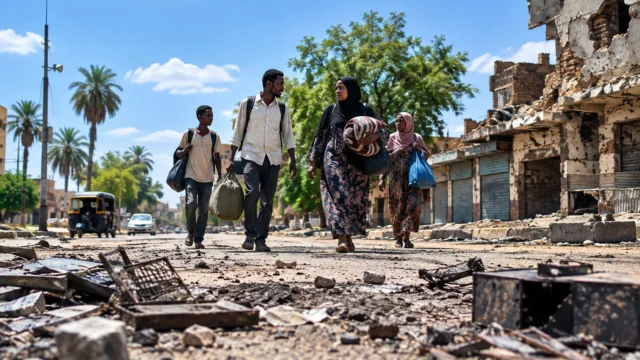
This militarisation is exacting an immediate human toll. The UN report says homes, hospitals, schools, markets and sites sheltering displaced people have been hit during the conflict. The UN and the Associated Press also reported, at the time the new report was published, that at least 59,000 people had been killed and about 13 million displaced since the start of the war — figures that convey the scale of the ongoing collapse.
Drones are changing the geography of fear. They make it possible to strike at long range, bypass shifting front lines and reach areas that had previously been less exposed. For Sudanese families, that means fewer safe places, more displacement and mounting pressure on hospitals, markets and neighbourhoods hosting displaced people. For traders, farmers and transport workers, it also means greater uncertainty over roads, harvests and access to essential goods.
The report is also part of a long-running diplomatic battle over the arms embargo. At present, the restrictions adopted by the Security Council apply fully only to Darfur. Investigators are now calling for the embargo to be extended to all of Sudan, to cut the networks that enable the fighting to be renewed. This demand echoes a recurring concern within the UN system: without controls on arms flows and intermediaries, political condemnations have no lasting effect.
The language used by the mission is cautious, but clear. It speaks of “reasonable grounds to believe”, a legal formula meaning that the evidence gathered is considered serious enough to support an investigative finding, without amounting to a criminal judgment. This standard of proof leaves room for further national or international investigations, but also holds the countries named to account.
A Sudanese issue, but an African one too
The Sudanese case extends beyond the country’s borders. It shows how an internal war can be prolonged by transnational networks, private companies, transit routes and political or logistical support from several continents. For North Africa and the Horn of Africa, the risk is twofold: the conflict could fuel instability along borders and normalise the use of foreign fighters in African wars.
The issue also has continent-wide institutional implications. The African Union, IGAD and neighbouring states face the same dilemma: how can they influence a war when regional diplomatic resources run up against globalised supply chains? The answer lies less in declarations than in judicial co-operation, oversight of ports, borders and shell companies, and coordinated pressure on suppliers of weapons and military services.
What happens next will also depend on developments on the ground. As long as fighting continues around the main military and economic centres, from Khartoum to Darfur, humanitarian needs will remain immense and the war will retain its destructive capacity. The UN report underlines one point above all: in Sudan, the war does not advance on its own. It is sustained, strengthened and professionalised by networks that will eventually have to be dismantled.