Algeria
 Egypt
 Libya
 Morocco
 Sudan
 Tunisia
 Benin
 Burkina Faso
 Cabo Verde
 Ghana
 Guinea
 Guinea-Bissau
 Liberia
 Mali
 Mauritania
 Niger
 Nigeria
 Senegal
 Sierra Leone
 The Gambia
 Togo
 Cameroon
 Central African Republic
 Chad
 DR Congo
 Equatorial Guinea
 Gabon
 Republic of the Congo
 São Tomé and Príncipe
 Burundi
 Comoros
 Djibouti
 Eritrea
 Ethiopia
 Kenya
 Madagascar
 Malawi
 Mauritius
 Mozambique
 Rwanda
 Seychelles
 Somalia
 South Sudan
 Tanzania
 Uganda
 Angola
 Botswana
 Eswatini
 Lesotho
 Namibia
 South Africa
 Zambia
 Zimbabwe
When gold attracts interest, look beyond the price fever
In Bondoukou, in the north-east of Côte d’Ivoire, a single drill rig often says more than a speech about growth. It tells a story of strategy: a country seeking to turn its resources into a driver of jobs, infrastructure and revenue, without abandoning the demand for local added value. In Côte d’Ivoire, this choice has taken on particular significance as the gold sector has grown and new junior operators have arrived to explore permits that are still at an early stage.
The regional context matters as much as the site itself. Côte d’Ivoire remains one of ECOWAS’s hubs. The Economic Community of West African States is a 15-country market in which investment, services and skills flow quickly when a country becomes legible to investors. The north-east of Côte d’Ivoire, and Bondoukou in particular, is also an area of trade with Ghana and, more broadly, a space connected to West African commercial corridors.
What Dalaroo is really launching in Bondoukou
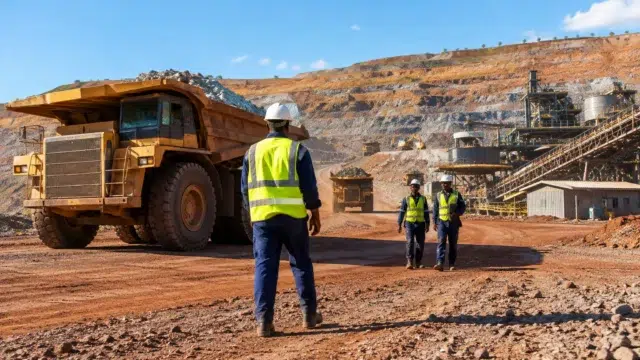
Australian junior Dalaroo Metals has announced the start of its first drilling campaign at the Bondoukou gold project. The programme covers about 12,000 metres of reverse circulation (RC) drilling, a technique that brings rock fragments to the surface to give a clearer picture of the subsoil. The first phase covers 4,200 metres and targets Wilfred, Mag and Ali. A second 7,800-metre phase is planned if the initial results are considered encouraging.
The campaign is fully funded following a A$2.5 million capital raise. It is part of a timetable already under way since the start of the year, including preparatory work, geochemical surveys and follow-up drilling along the Gold Ridge corridor. Dalaroo has also described Bondoukou as a central pillar of its strategy in Côte d’Ivoire, alongside Bongouanou, its other project in the country.
The choice of location is no accident. The project lies in the Birimian Belt, the geological formation that hosts many of West Africa’s major gold deposits. In this area, juniors are not simply trying to “find gold”. They are seeking to prove the continuity, depth and grade of mineralisation — three criteria that distinguish a surface anomaly from a genuine mining project. At this stage, Dalaroo is therefore at the riskiest point in the mining chain: investing before knowing whether the subsoil will confirm its initial hopes.
A country that has moved up a gear in exploration
Interest in Côte d’Ivoire is based on more than favourable geology. It is also supported by a regulatory environment considered more stable than that of several neighbouring countries. In 2025, the Ivorian government made reform of the mining code, a digital mining cadastre and local content explicit priorities. Local content means the share of the extractive value chain entrusted to domestic companies, workers and suppliers. The stated aim is simple: to prevent wealth from leaving the country too quickly.
This approach is having measurable effects. Official Ivorian figures show a sharp rise in gold production. The government cites 18 tonnes in 2014 and 58 tonnes in 2024. Other budget documents and public reports put production at 59.124 tonnes in 2024. The difference is small, but it is a useful reminder that in mining, it is important to distinguish between orders of magnitude, reference years and methods of measurement. The underlying trend is not in dispute: Côte d’Ivoire has multiplied its gold production several times over in a decade.
The country has also become more visible to investors. According to S&P Global Market Intelligence’s World Exploration Trends 2026 report, Africa attracted $1.44 billion in mining exploration investment in 2025, and Côte d’Ivoire ranked first on the continent, with $186 million, or about 13% of the African total. This is a strong signal for Abidjan. It shows that exploration capital is seeking jurisdictions considered more predictable, more open and less exposed to changes in the rules.
At the same time, the Ivorian government continues to issue exploration permits and prepare major operations. Recent decisions have involved several companies and gold-bearing areas, while major projects such as Koné and Doropo remain a focus of expectations in the sector. This accumulation of projects is creating a new hierarchy: large mines drive exports, but juniors are building tomorrow’s reserves.
What this means for the local economy
In Bondoukou, the issue is not simply the arrival of a geologist or a drill rig. It is the question of local benefits. An exploration campaign brings in contractors, workers, transport operators and analytical laboratories, and sometimes basic services in areas where formal economic activity remains limited. But at this stage, most of the benefits still accrue to investors. Only if drilling confirms a deposit do the major negotiations begin: resource studies, feasibility work, mining permits, financing and then the possible construction of a mine.
The contrast matters to local communities. The exploration phase promises short-term, technical jobs. An operating mine can create more positions, but it also brings greater expectations around roads, water, electricity, security and land negotiations. In the Gontougo region, whose capital is Bondoukou, public authorities are already highlighting needs in infrastructure, social services and youth employability. Mining is therefore being added to a region that is not starting from scratch, but expects tangible benefits.
Dalaroo’s bet also reflects a broader African trend: juniors explore where major companies do not want to spend time opening up areas that remain unexplored. In West Africa, this model works when the state strikes the right balance between attractiveness, environmental oversight and local content requirements. It works less well when initial promises translate neither into lasting jobs nor useful infrastructure. Côte d’Ivoire is seeking to address this by reforming its rules while leaving private companies to provide the investment.
The significance beyond Bondoukou
What is at stake in Bondoukou therefore goes beyond a single permit. If the results confirm strong potential, Côte d’Ivoire could consolidate its status as a new centre of gold exploration in West Africa. It would also be a test for ECOWAS: in a region where investors constantly compare national frameworks, the quality of institutions matters as much as the quality of the ore.
At continental level, the project says something about the competition between African states to attract mining investment without giving away the value created. The countries gaining ground today are often those that combine stability, relative transparency, infrastructure and predictable tax regimes. Côte d’Ivoire is seeking to build this advantage, with a mining sector that has become more visible, reforms presented as structural and sharply rising gold production. What happens next will depend less on announcements than on the country’s ability to turn initial discoveries into broader value chains.