Algeria
 Egypt
 Libya
 Morocco
 Sudan
 Tunisia
 Benin
 Burkina Faso
 Cabo Verde
 Côte d'Ivoire
 Ghana
 Guinea
 Guinea-Bissau
 Liberia
 Mali
 Mauritania
 Niger
 Nigeria
 Senegal
 Sierra Leone
 The Gambia
 Togo
 Cameroon
 Central African Republic
 Chad
 DR Congo
 Equatorial Guinea
 Gabon
 Republic of the Congo
 São Tomé and Príncipe
 Burundi
 Comoros
 Djibouti
 Eritrea
 Ethiopia
 Kenya
 Madagascar
 Malawi
 Mauritius
 Mozambique
 Rwanda
 Seychelles
 Somalia
 South Sudan
 Tanzania
 Angola
 Botswana
 Eswatini
 Lesotho
 Namibia
 South Africa
 Zambia
 Zimbabwe
Oil that speaks as much of expectation as delay
In Uganda, oil is no longer just a budgetary promise. It is becoming a test of credibility for the state, its partners and thousands of families living along the Albertine Graben projects in the west of the country. On 2 September 2026, at Kingfisher, the authorities sought to show that they were finally entering the home stretch before commercial production begins.
The symbolism matters. For nearly two decades, Kampala has presented this project as one of the drivers of national industrialisation. But deadlines have slipped several times. The launch announced for the end of 2026 therefore puts the timetable back at the centre of public debate, as Uganda seeks to turn its Lake Albert resources into revenue, infrastructure and local jobs.
Kingfisher, Tilenga and Uganda’s oil infrastructure
The system is centred on two upstream projects: Kingfisher, operated by CNOOC, and Tilenga, led by TotalEnergies alongside the national oil company UNOC. Capacity figures are now well established. Kingfisher is targeting 40,000 barrels a day at full capacity, from 31 wells, while Tilenga is expected to contribute to a larger national total of about 230,000 barrels a day at peak production.
The Ugandan authorities have also highlighted a gradual ramp-up. According to information reported on 2 September, Kingfisher was due to start at 28,000 barrels a day before reaching its maximum capacity. At the same time, the project remains linked to the 1,443-kilometre heated EACOP pipeline, which is intended to connect Hoima to the Tanzanian coast at Tanga for crude exports. EACOP is a regional project, not merely a national one, as it involves Uganda and Tanzania in the same logistics chain.
The 2 September ceremony also served to name Ugandan crude, now presented as “Pearl Sweet”. The expression plays on the country’s historic nickname, “Pearl of Africa”, and on the expected quality of the oil, described as low in sulphur. It is as much a commercial gesture as a political one: the aim is to establish Uganda as an identifiable supplier on the international market.
What the government hopes to gain
Beyond the ceremony, the central issue remains financial. Uganda’s executive is counting on exports to generate several hundred million dollars in annual revenue once production ramps up, and more at peak output. Estimates published in recent months put oil revenues at 2.2 trillion Ugandan shillings, or about $587 million, for the 2026/2027 financial year. Other projections highlighted by industry players point to greater potential over the medium term, depending on production levels and international prices.
For Kampala, oil is intended to fund far more than a budget. It is expected to support roads, energy, local processing and, ultimately, greater economic integration in the Great Lakes and East African region. This reasoning is in line with the East African Community (EAC), of which Uganda is a founding member and whose headquarters are in Arusha, Tanzania. The regional organisation presents integration, value-added production and intra-regional trade as drivers of growth.
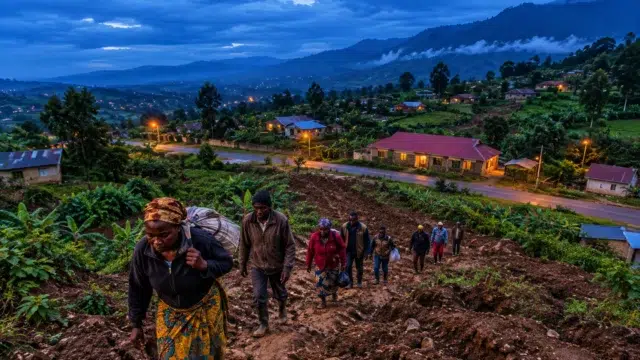
But the real economy cannot be reduced to the export curve. For rural areas crossed by the projects, the questions remain those of land, displacement and the continuity of livelihoods. EACOP’s public documents report 13,686 people affected along the route, with compensation in cash or in kind. These figures should be treated with caution, as they describe administrative procedures; on their own, they do not reveal the quality of redress or the experience of the households concerned.
Criticism: land, climate and social rights
Opposition is not limited to environmental concerns. It also targets the way the projects are reshaping land use and local power relations. Ugandan and French NGOs have pursued legal proceedings in France against TotalEnergies since 2023, invoking France’s duty of vigilance law, which requires large companies to anticipate risks to human rights and the environment in their operations. The claimants are seeking redress linked to expropriations and alleged harm to affected communities.
On the ground, opponents’ argument is straightforward: the social cost is high and is distributed unequally. Displaced households sometimes lose more than a plot of land. They lose crops, water points, local trading networks and family stability. Companies and the state, for their part, point to compensation, resettlement programmes and job creation. Both accounts coexist, but they do not carry equal weight for the populations concerned.
The climate dimension also remains central. Several organisations describe the project as a “climate bomb”, because it adds new fossil fuel capacity at a time when East Africa is already experiencing the effects of global warming. The debate goes beyond Uganda. It concerns the continent’s place in the global energy transition. For many African governments, developing available resources is first and foremost a matter of economic sovereignty. For NGOs, the challenge is to prevent environmental costs from being borne locally while profits are internationalised.
A Ugandan milestone, but an East African signal
The September 2026 announcement therefore concerns more than Kampala. It is also of interest to Nairobi, Dar es Salaam, Kigali, Juba and Bujumbura, because it affects energy corridors, ports, fuel markets and the balance within the EAC. Uganda wants to become a producer and exporter, but also a logistics player in a sub-region where energy is a source of integration as well as tension.
What happens next will depend first on the final industrial tests, the commissioning of facilities and coordination with transport infrastructure. It will also depend on ongoing legal disputes, particularly over compensation and corporate responsibility. If production starts by the end of 2026, Uganda will enter a new phase in its economic history. But it will do so under scrutiny: from markets, local residents, judges and neighbouring countries in the region.