
 Algeria
 Egypt
 Libya
 Morocco
 Sudan
 Tunisia
 Benin
 Burkina Faso
 Cabo Verde
 Côte d'Ivoire
 Ghana
 Guinea
 Guinea-Bissau
 Liberia
 Mali
 Mauritania
 Niger
 Nigeria
 Senegal
 Sierra Leone
 The Gambia
 Togo
 Cameroon
 Central African Republic
 Chad
 DR Congo
 Equatorial Guinea
 Gabon
 Republic of the Congo
 São Tomé and Príncipe
 Burundi
 Comoros
 Djibouti
 Eritrea
 Ethiopia
 Kenya
 Madagascar
 Malawi
 Mauritius
 Mozambique
 Rwanda
 Seychelles
 Somalia
 South Sudan
 Tanzania
 Uganda
 Angola
 Botswana
 Eswatini
 Lesotho
 Namibia
 Zambia
 Zimbabwe
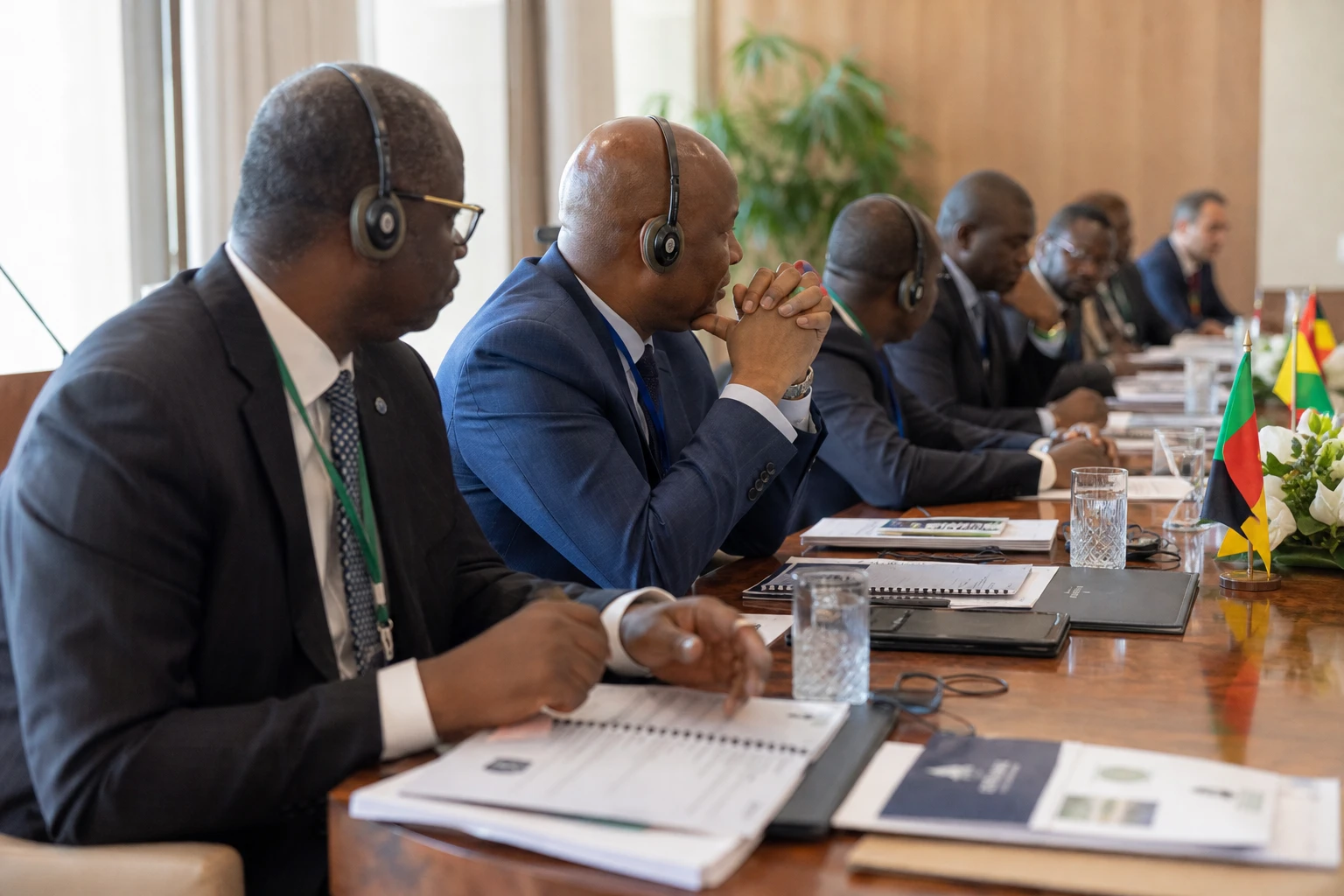
A global election also being shaped in Rabat
In world football, the balance of power is built not only in stadiums. It is also forged in federation corridors, where budgets, development programmes and political interests intersect. As the FIFA Congress election approaches, scheduled for 18 March 2027 in Rabat, the debate therefore goes beyond the name of the next president. It concerns the place of African federations in the redistribution of resources and the governance of the global game.
The Rabat gathering has already been scheduled by FIFA, and Gianni Infantino confirmed in Vancouver, at the 76th Congress, that he would seek another term in 2027. Under the voting system, each member association has one vote, giving Africa, through its 54 CAF member federations, significant numerical weight, though not an automatic advantage. If several candidates stand, FIFA’s statutes require a qualified majority in the first round, making cross-regional alliances decisive.
African continent balances institutional loyalty with national calculations
From Rabat, Infantino’s African support network is built on clearly identified allies. The Confederation of African Football announced unanimous support for his re-election on 29 April 2026 in Vancouver. Then, on 6 August, its executive committee unanimously approved FIFA’s joint update on FIFA Forward Enterprise, while stressing that transparency and good governance remained “crucial and non-negotiable”. This dual approach says much about Africa’s strategy: offer support without giving up the demand for guarantees.
Morocco occupies a central place in this landscape. The Royal Moroccan Football Federation publicly backed Infantino’s candidacy on 1 May 2026, and Moroccan authorities later confirmed that Rabat would host FIFA’s Africa office and the 2027 Congress election. This is more than a simple protocol gesture. It reflects a relationship that has become strategic, as the kingdom also prepares to host the 2025 Africa Cup of Nations and the 2030 World Cup with Spain and Portugal. Moroccan football thus serves as a continental anchor, as well as an institutional showcase.
Egypt and Mauritania are also among the visible supporters. Hany Abo Rida, president of the Egyptian federation and a member of the FIFA Council, signed a joint statement with other Arab officials in August. Egypt is also home to CAF’s headquarters, reinforcing its role in decisions affecting continental football. On the Mauritanian side, Ahmed Yahya also sits on the FIFA Council. These positions do not guarantee a uniform vote, but they point to political proximity to the incumbent president’s camp.
FIFA Forward Enterprise: the stakes are financial
The debate is not only institutional. It is financial. FIFA has said its proposed FIFA Forward Enterprise subsidiary would increase development funding from $8 million to $20 million per member association for the 2027-2030 cycle. This could be supplemented by an optional scheme, the Fast Forward programme, which would raise potential support to as much as $40 million per federation over the same cycle. FIFA has also cited more than $4 billion for all federations, with fundraising potentially reaching $4.2 billion.
For many African federations, these sums would change the scale of what they can do. Several leaders across the continent point out that their budgets remain small compared with the needs for infrastructure, coaching and talent identification. Samuel Eto’o’s Cameroon illustrates this tension. His argument is straightforward: if African federations had resources comparable to those of football’s leading powers, they could invest more in training centres, pitches and retaining players from the diaspora. The argument is debatable in its formulation, but it reflects a familiar reality: in Africa, the question of funding often carries more weight than the abstract debate over governance.
The support of Patrice Motsepe, South African president of CAF, reflects this strategy of calculated caution. On 6 August, he endorsed the confederation’s position while stressing that FIFA’s future should be decided by its 211 members, not by outside pressure. Motsepe thus defended the principle of a vote while avoiding an outright break with Infantino. For CAF, the wager remains clear: protect funding streams and development programmes, and preserve African influence within the global governing body.
Secret ballot, shifting alliances and continental significance
FIFA’s history nevertheless shows that an announced bloc is never a guaranteed one. African associations have voted against the declared line in previous elections, particularly when geopolitical or regional issues complicated instructions. The 2027 ballot will be secret if several candidates are in the running, leaving each federation room to manoeuvre. In other words, the position announced by the confederations is not enough to predict the result.
This situation also highlights differences among the players. Federation leaders see alignment with Infantino as a promise of resources and access to the centre of decision-making. National teams are waiting for pitches, competitions and training structures. Supporters want visible results. Host countries, such as Morocco or Egypt, are also seeking to consolidate their diplomatic standing in the global football ecosystem. The same show of support therefore reflects different interests and different horizons.
For the continent, the stakes ultimately extend beyond Infantino himself. They concern how Africa can influence major reforms in world football, the distribution of revenue and the selection of hosts. On 23 November 2026, an extraordinary FIFA Congress is already due to decide the hosts of the 2031 and 2035 Women’s World Cups. Between that event and the Rabat vote, African federations will have the chance to assess whether their collective support translates into lasting influence, or remains a sum of national loyalties, reversible at the first disagreement.



