Algeria
 Egypt
 Libya
 Morocco
 Sudan
 Benin
 Burkina Faso
 Cabo Verde
 Côte d'Ivoire
 Ghana
 Guinea
 Guinea-Bissau
 Liberia
 Mali
 Mauritania
 Niger
 Nigeria
 Senegal
 Sierra Leone
 The Gambia
 Togo
 Cameroon
 Central African Republic
 Chad
 DR Congo
 Equatorial Guinea
 Gabon
 Republic of the Congo
 São Tomé and Príncipe
 Burundi
 Comoros
 Djibouti
 Eritrea
 Ethiopia
 Kenya
 Madagascar
 Malawi
 Mauritius
 Mozambique
 Rwanda
 Seychelles
 Somalia
 South Sudan
 Tanzania
 Uganda
 Angola
 Botswana
 Eswatini
 Lesotho
 Namibia
 South Africa
 Zambia
 Zimbabwe

A hearing that goes beyond the court case
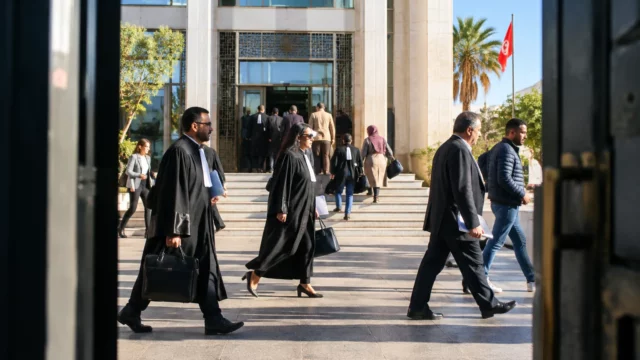
In Tunis, the Court of Cassation is not simply retrying a criminal case. It is also arbitrating a moment of truth for Tunisian political life. On 3 September 2026, the country’s highest court is examining the appeal in the case known as the “conspiracy against state security”, a case that has become one of the symbols of tensions between the executive, the opposition and fair-trial guarantees.
Tunisia is experiencing this period amid an already highly charged institutional climate. Since power was concentrated around President Kaïs Saïed in 2021, the role of political parties, parliament and checks and balances has diminished. At the same time, human rights organisations have denounced the repeated use of criminal prosecutions, state security laws and Decree-Law 54 on cybercrime to silence critical voices.
What the Court of Cassation must examine
The case dates back to February 2023, when a series of arrests targeted political opponents, lawyers, activists and businesspeople. It then followed a lengthy judicial path, marked by the defence’s persistent challenges to the conduct of the investigation, pre-trial detention and access to the case file. The court of first instance had already handed down very heavy sentences in spring 2025, and the Tunis Court of Appeal upheld the convictions of 34 people on 27 November 2025, with sentences ranging from five to 45 years in prison.
On 3 September 2026, the Court of Cassation is not ruling on the facts as a third court of first instance. Under Tunisian law, it primarily reviews the proper application of the law and the regularity of the procedure. This is precisely the point the defence has put at the centre of the debate: it believes the rights of the defence were undermined at several stages, from the investigation timetable to the organisation of hearings. The Tunisian Human Rights League and several Tunisian associations have also raised this criticism, calling for cassation review to correct irregularities rather than endorse them.
The detainees’ families have also raised concerns about the preparations for the hearing. They say the time allowed for lawyers to review the files and meet the people concerned was very short. This haste fuels a sense of inequality of arms. It also reinforces the idea that the trial is being played out as much in the courtroom as in the structure of the judicial timetable.
Heavy sentences, a strong political signal
The upholding of the convictions on appeal had an immediate impact. Among the best-known figures in the case are the jurist and opposition figure Ahmed Nejib Chebbi, lawyer and activist Ayachi Hammami, and other political figures such as Ghazi Chaouachi, Issam Chebbi, Ridha Belhaj, Abdelhamid Jelassi and business leader Kamel Ltaief. Amnesty International says six of them had been detained since the investigation began in February 2023, and that some were later arrested following the appeal rulings.
For their relatives, the case is therefore both personal and political. It affects families, but it also sends a message to Tunisia’s entire public sphere: directly opposing the authorities can expose people to lengthy prosecutions, severe sentences and lasting exclusion from national debate. This is where the case goes beyond the 34 convicted people. It maps the practical limits of civic space in Tunisia, with the capital, Tunis, on the front line, but with effects felt far beyond the capital’s political circles.
The authorities, for their part, regularly defend a security-based interpretation of the case. In their view, the prosecutions are part of the fight against threats to the state and the preservation of public order. But this approach faces criticism from Tunisian and international actors, who see the case less as a security matter than as a test of the judiciary’s real independence. This difference in interpretation lies at the heart of Tunisia’s current crisis.
Why this case matters beyond Tunisia
The case has regional significance. Tunisia remains a point of reference in North Africa, including for observers from the African Union and the African human rights system. In this context, Tunis’s announced decision to withdraw its declaration allowing individual applications to the African Court on Human and Peoples’ Rights was interpreted by Amnesty International as a further setback for access to continental justice. This development gives the conspiracy case broader institutional resonance.
It is also worth considering what this episode says about governance in North Africa. In a region marked by unfinished transitions, strengthened executives and sometimes weakened institutions, Tunisia is becoming a case study: how does a state treat the opposition when checks and balances are shrinking? How does justice function when politics weighs heavily on the judiciary? These are not theoretical questions. They concern institutional stability, citizens’ trust and the credibility of oversight mechanisms.
The next step now depends on the Court of Cassation. If it quashes the appeal ruling, it will open the way to a review and give greater weight to procedural safeguards. If it upholds it, it will reinforce a case already seen by part of Tunisian society as a turning point in the restriction of pluralism. Either way, the decision of 3 September 2026 will carry weight far beyond the courtroom. It will say something about the real balance of power in Tunis, and about the degree of tolerance in the Tunisian system for organised political dissent.