Algeria
 Egypt
 Libya
 Morocco
 Tunisia
 Benin
 Burkina Faso
 Cabo Verde
 Côte d'Ivoire
 Ghana
 Guinea
 Guinea-Bissau
 Liberia
 Mali
 Mauritania
 Niger
 Nigeria
 Senegal
 Sierra Leone
 The Gambia
 Togo
 Cameroon
 Central African Republic
 Chad
 DR Congo
 Equatorial Guinea
 Gabon
 Republic of the Congo
 São Tomé and Príncipe
 Burundi
 Comoros
 Djibouti
 Eritrea
 Ethiopia
 Kenya
 Madagascar
 Malawi
 Mauritius
 Mozambique
 Rwanda
 Seychelles
 Somalia
 South Sudan
 Tanzania
 Uganda
 Angola
 Botswana
 Eswatini
 Lesotho
 Namibia
 South Africa
 Zambia
 Zimbabwe
A dialogue searching for a way in
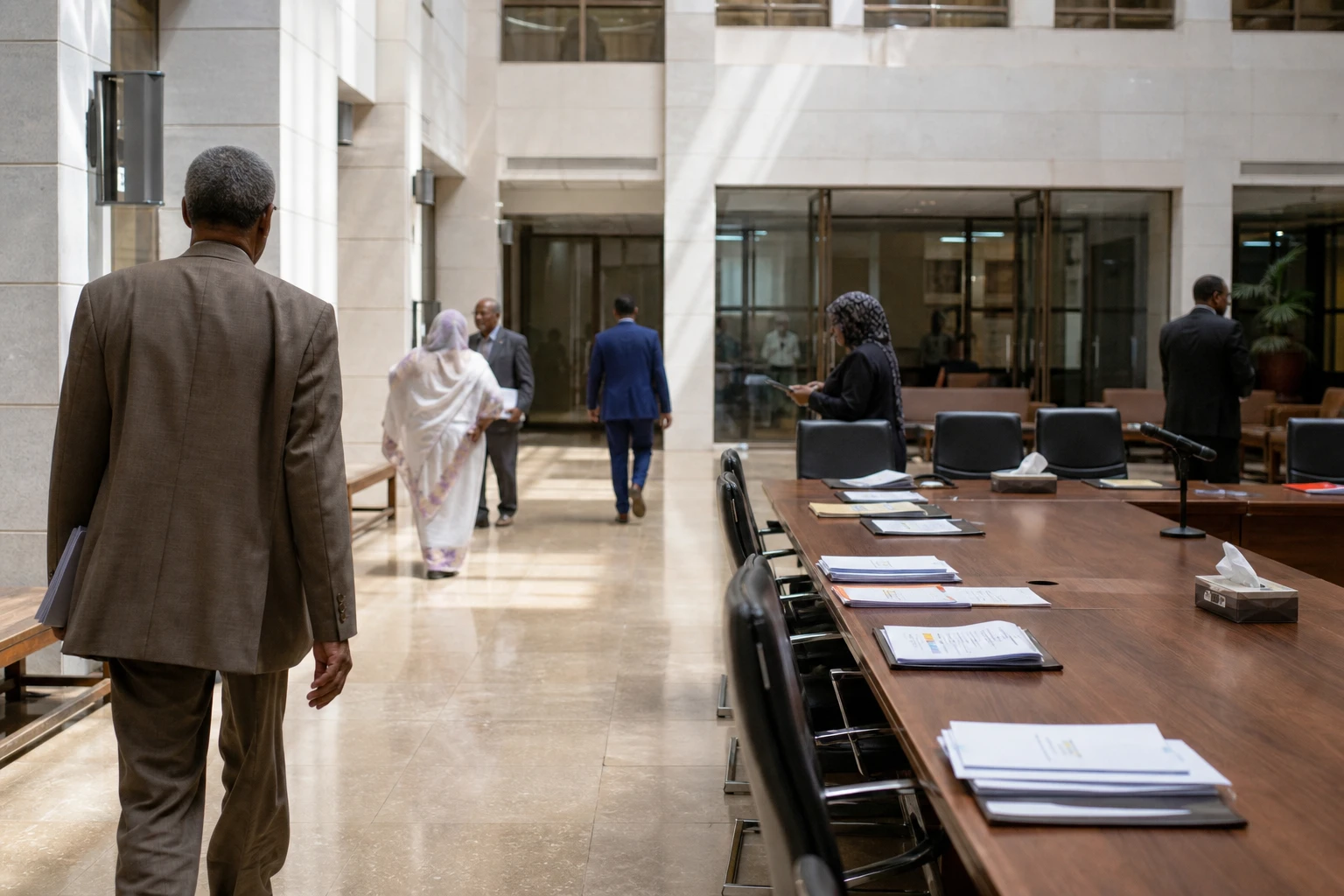
In Sudan, talking about national dialogue while weapons continue to decide events on the ground is a fragile exercise. In Khartoum, however, a preparatory committee has begun work on a framework for discussions presented as “Sudanese” and intended to open a political path out of a war that has already devastated the country since April 2023. On paper, the idea is simple: bring together civilians, lawyers, academics, journalists and political leaders to set a common agenda. In reality, it is far less straightforward. The heart of the problem is one of legitimacy: who speaks for Sudan, and who is still willing to sit at the table?
This comes as Khartoum remains at the centre of an interrupted transition, while Port Sudan serves as the base for the de facto authority aligned with the army. Since the conflict began, mediation efforts have multiplied without producing a lasting ceasefire. Regional and international efforts include the diplomatic quintet comprising the African Union, IGAD, the UN, the Arab League and the European Union, which supported consultations among Sudanese actors in Addis Ababa in early June 2026. The challenge, then, is not simply to organise another forum, but to determine whether it can influence the war or merely reflect a balance of forces that has already hardened.
What the new initiative involves
The preparatory committee has begun its work in Khartoum, aiming to open consultations with political actors, civil society and regional or international partners. Its stated mandate is to define the framework for a “serious, independent and inclusive dialogue”. In principle, the formula is intended to offer a political way forward for a country exhausted by war. In practice, the method immediately raises a problem: the Rapid Support Forces, the army’s adversaries in the conflict, are not among those invited. This exclusion changes everything, turning a project intended to bring Sudanese people together into a partial exercise, at least in its launch phase.
General Abdel Fattah al-Burhan announced the initiative in mid-August, presenting it as a means of achieving lasting peace. But from the moment it was announced, several actors argued that the proposed framework failed to meet the minimum requirements for a credible process. Former prime minister Abdallah Hamdok and civilian groups gathered in Addis Ababa rejected the invitation. Abdel Wahid Al Nur, leader of the Sudan Liberation Movement, also refused to take part, arguing that the project mainly served to give a political veneer to the status quo imposed by the army since the 2021 coup. Officials from the civilian Somoud bloc, for their part, warned that a dialogue conducted under military control risked cementing the country’s fragmentation rather than reducing it.
Why civilians and anti-war groups have so many reservations
The rejection is not merely ideological. It reflects a very practical reading of the balance of power. For civilian opponents, a dialogue organised without a prior ceasefire, safe access for humanitarian aid or guarantees for participants’ security looks less like a transition than a staging of continued military rule. A coalition of political forces and civil society groups that met in Addis Ababa also set out an alternative vision for a peace and transition process in early June. The African Union welcomed these consultations as an opportunity to build a credible and inclusive process, showing that the dispute is not only about who is invited, but also about the very structure of future political talks.
Criticism also focuses on the lack of genuine inclusivity. In a country divided along military, regional, social and political lines, a dialogue limited to forces compatible with those in power quickly loses its value as a national mediation effort. Researcher Tsega’ab Amare, quoted by the Sudanese press, sums up this limitation, arguing that it is difficult to present a military outcome as a political transition. The remark says much about the current moment: actors opposed to the war do not reject the idea of dialogue, but they do reject the attempt to separate it from the minimum conditions for a settlement.
A political struggle that extends beyond Sudan
The Sudanese issue extends far beyond Khartoum. It affects the balance of the Horn of Africa, relations between neighbouring states and the African Union’s ability to impose a regional approach to resolving the continent’s crises. The talks facilitated in Addis Ababa by the quintet show that Sudan remains a theatre where African diplomacy, UN mediation and rival claims to legitimacy between civilians and the military intersect. The UN, for its part, continues to call for fully inclusive dialogue, while its envoys have held numerous discussions with Abdel Fattah al-Burhan and other actors to prevent another period of deadlock.
For the population, the stakes are even more immediate. A credible dialogue could eventually reopen a path out of war, improve humanitarian access and restore a framework for political life. A contested dialogue, by contrast, risks entrenching the division between areas controlled by the army, contested spaces and territories beyond the reach of the state. This is where the issue’s continental significance lies: if African and Sudanese mediation cannot produce a framework accepted by the main actors, confidence in regional mechanisms for resolving crises will be further weakened. Conversely, if a broader political process eventually emerges, it could serve as a reference point for the rest of the continent, where several transitions remain suspended between security, legitimacy and reconciliation.
The calendar remains full. Consultations launched by regional mediators, the positions of civilian coalitions and the army’s approach will show whether the Khartoum committee can become a starting point or will remain a body with no influence over the war. For now, Sudan is grappling with a central contradiction: seeking to discuss the country’s political future while violence continues to sweep across it, even as some of the decisive forces refuse to recognise the proposed framework.