Algeria
 Egypt
 Libya
 Morocco
 Sudan
 Tunisia
 Benin
 Burkina Faso
 Cabo Verde
 Côte d'Ivoire
 Ghana
 Guinea
 Liberia
 Mali
 Mauritania
 Niger
 Nigeria
 Senegal
 Sierra Leone
 The Gambia
 Togo
 Cameroon
 Central African Republic
 Chad
 DR Congo
 Equatorial Guinea
 Gabon
 Republic of the Congo
 São Tomé and Príncipe
 Burundi
 Comoros
 Djibouti
 Eritrea
 Ethiopia
 Kenya
 Madagascar
 Malawi
 Mauritius
 Mozambique
 Rwanda
 Seychelles
 Somalia
 South Sudan
 Tanzania
 Uganda
 Angola
 Botswana
 Eswatini
 Lesotho
 Namibia
 South Africa
 Zambia
 Zimbabwe
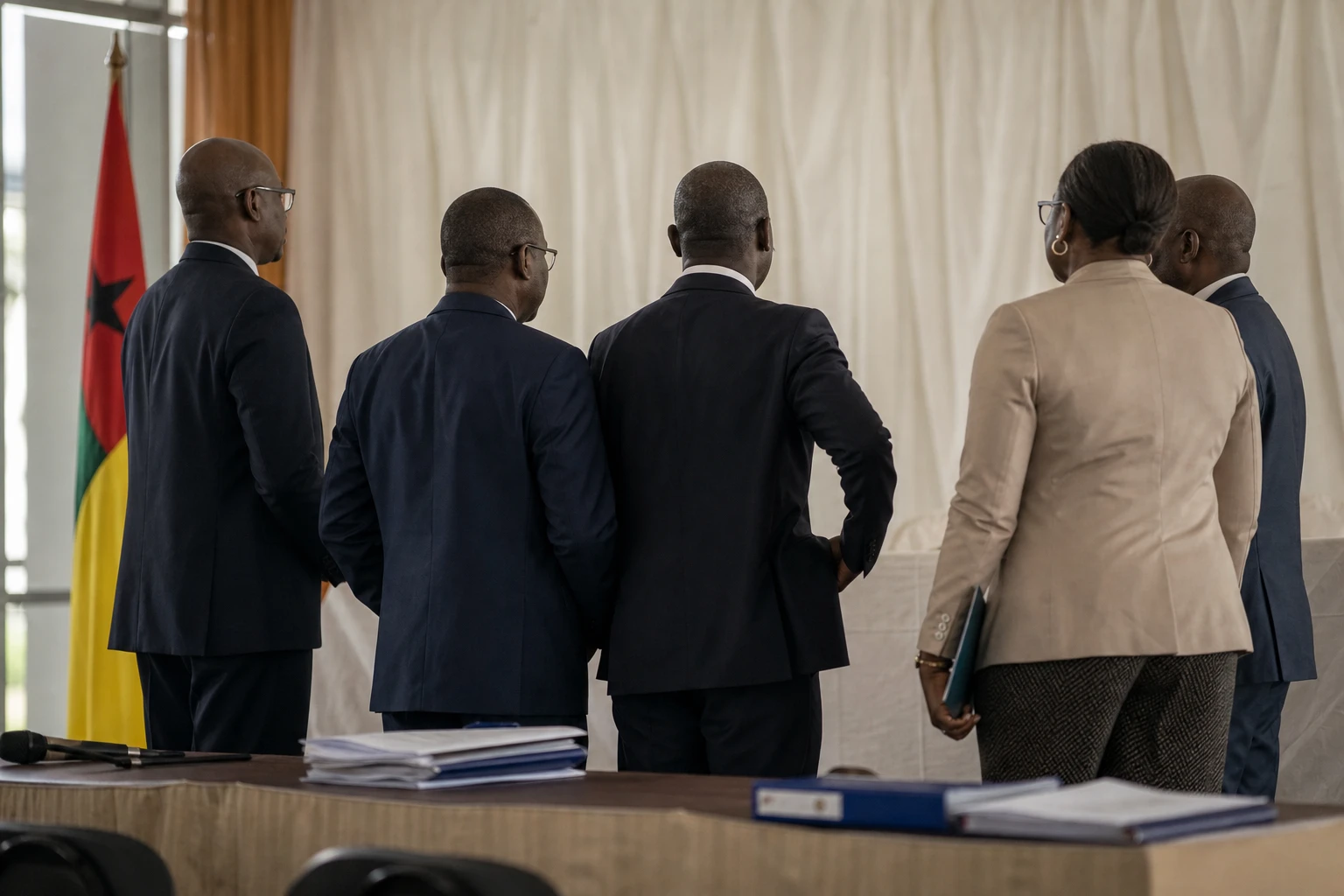
Another vote in Bissau amid state fragility
In Guinea-Bissau, every ballot involves more than a simple technical question. It also tests the country’s ability to emerge from a cycle in which institutions make fitful progress, amid coups, dissolutions and unfinished transitions. On Sunday 30 August 2026, people in Bissau and across the country voted on a new constitution that could strengthen the executive, at a time when the capital remains under tight security surveillance.
The regional context matters as much as the text put to the vote. Guinea-Bissau remains committed to the path towards a return to constitutional order expected by ECOWAS, while the African Union has already condemned the November 2025 coup and suspended the country from its proceedings after the military seized power. In a West Africa already marked by military transitions in the Sahel, Bissau is being watched as another test of the credibility of military-led exits from crisis.
What the reform proposes
The text put to the referendum seeks to shift the country from a semi-parliamentary to a presidential system. In practical terms, it would give the head of state the power to appoint and dismiss the prime minister and government members, as well as dissolve Parliament. It also provides for a reduction in the size of the National Assembly, from 102 to 65 seats, according to arguments put forward by the transitional authorities.
For the junta, the stated aim is stability. The authorities argue that a clearer executive would limit deadlock between the president and the prime minister, a recurring conflict in Guinea-Bissau’s political history. General Tomás Djassi, chief of staff, defended this position, saying that the country needed to avoid having “two leaders” at the top of the state. Meanwhile, transitional president Horta N’Tam, installed after the November 2025 coup, cannot stand as a candidate under the transition charter.
The opposition, however, sees the reform as an inadequately regulated transfer of power. The PAIGC, the country’s main historic party, has denounced a text that would weaken the government, reduce Parliament’s role and marginalise the will expressed at the ballot box. The Guinea-Bissau Human Rights League has also criticised a process conducted without genuine public consultation, while supporters of the “no” vote were unable to campaign freely, according to statements reported in Bissau.
Decent turnout, but political doubts remain
For now, the most visible signal is turnout. The National Electoral Commission said participation had exceeded 55%, with no major incident that could call the credibility of the vote into question. The first provisional results were expected on Tuesday. In Bissau, however, attendance was uneven at several polling stations, held back by morning rain and the opposition’s call for a boycott.
The situation says much about the relationship between the state and the population. For some voters, constitutional revision could open a period of institutional clarity after years of stand-offs between the presidency, government and Parliament. For others, it looks above all like a top-down reform in a country where democratic experience is often cut short before lasting stability can be achieved. In Bissau’s working-class neighbourhoods and in rural areas, the issue is not just the text. It also concerns everyday security, incomes, access to public services and the predictability of the rules of the political game.
The referendum comes less than a year after the military seizure of power in November 2025, following a disputed election in which both Umaro Sissoco Embaló and Fernando Dias claimed victory. Since independence in 1973, Guinea-Bissau has experienced several coups and attempted putsches. This history continues to weigh heavily on political life, as well as on the formal economy, small-scale commercial activity and investor confidence.
A closely watched moment for West Africa
The significance of the vote therefore extends far beyond Guinea-Bissau. In West Africa, ECOWAS is seeking to defend a return to constitutional order, as several countries in the region have experienced institutional ruptures in recent years. For neighbouring countries and African partners, the question is simple: is this reform preparing an exit from transition or consolidating a new centre of power born of the coup?
The next steps will be decisive. If the results confirm the referendum, Guinea-Bissau will still have to hold the presidential and legislative elections announced for 6 December 2026. That is where the substance will lie: not only in the promised return of civilians, but also in the country’s ability to establish stable rules that are recognised and accepted beyond the narrow circle of the transition.