Algeria
 Egypt
 Libya
 Morocco
 Sudan
 Tunisia
 Benin
 Burkina Faso
 Cabo Verde
 Côte d'Ivoire
 Ghana
 Guinea
 Guinea-Bissau
 Liberia
 Mali
 Mauritania
 Niger
 Nigeria
 Senegal
 Sierra Leone
 The Gambia
 Togo
 Cameroon
 Central African Republic
 Chad
 DR Congo
 Equatorial Guinea
 Gabon
 Republic of the Congo
 Burundi
 Comoros
 Djibouti
 Eritrea
 Ethiopia
 Kenya
 Madagascar
 Malawi
 Mauritius
 Mozambique
 Rwanda
 Seychelles
 Somalia
 South Sudan
 Tanzania
 Uganda
 Angola
 Botswana
 Eswatini
 Lesotho
 Namibia
 South Africa
 Zambia
 Zimbabwe
When colonial memory becomes a development issue
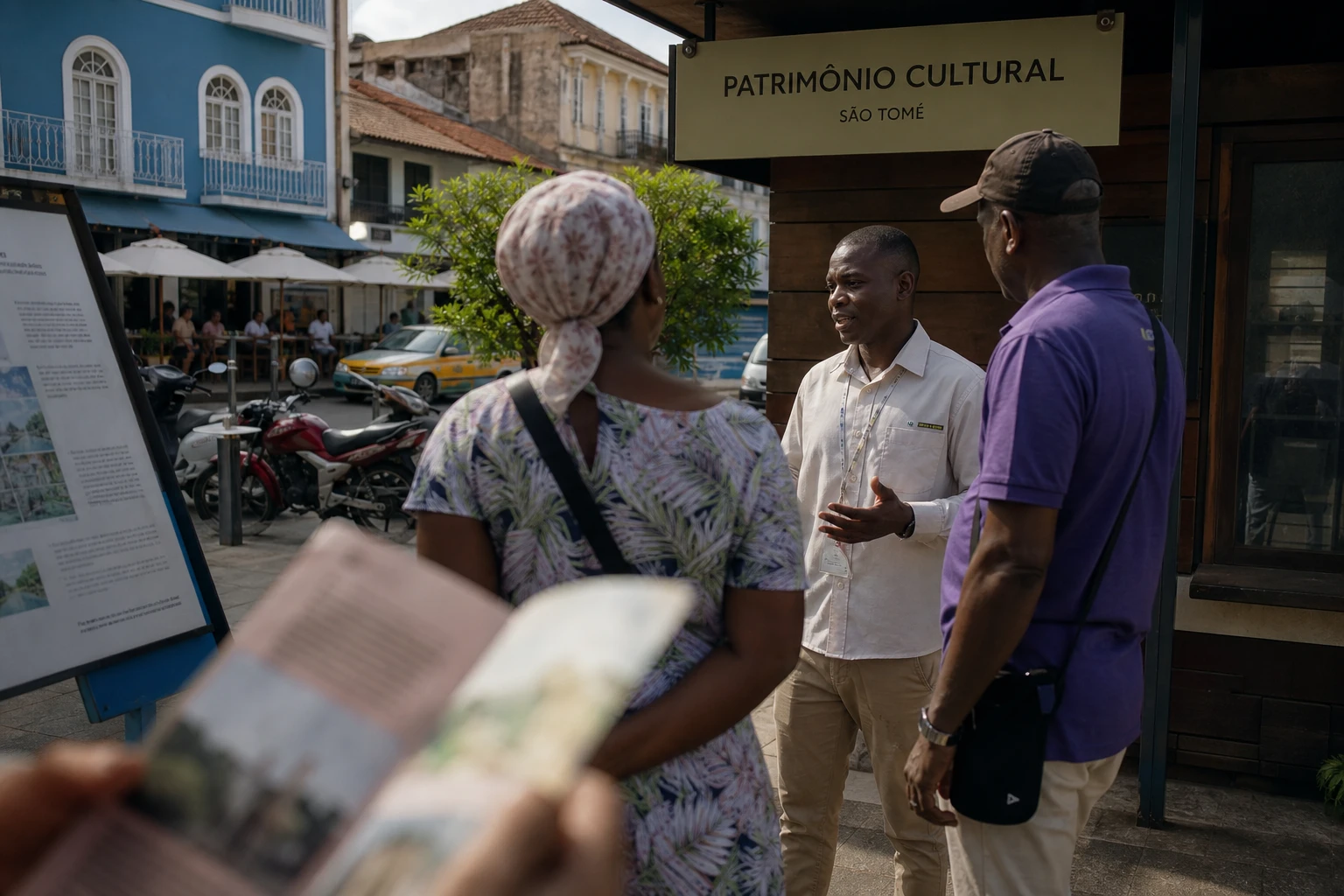
In São Tomé, the question is not simply how to preserve old buildings. It is how to turn a painful history, shaped by forced labour and the coerced movement of people, into a resource for remembrance, research and local income. In an archipelago as small and as exposed to economic shocks as São Tomé and Príncipe, heritage is never just scenery: it can become a lever for development, provided it is protected methodically.
The country is navigating a narrow path. Its economy remains dominated by agriculture, particularly cocoa, fishing and still-fragile services, while tourism is growing. International institutions also note that the archipelago, an island state in the Gulf of Guinea, suffers from isolation, a limited productive base and high climate vulnerability. In this context, the listing of São Tomé and Príncipe’s roças as UNESCO World Heritage sites has very practical significance.
Six roças, a shared history across São Tomé and Príncipe
On 28 July 2026, UNESCO added the roças of São Tomé and Príncipe to the World Heritage List. The site is presented as a group of six Portuguese colonial plantations: Monte Café, Água Izé, Diogo Vaz, São João, Sundy and Belo Monte. Four are on the island of São Tomé and two on Príncipe. The organisation describes a planned agro-industrial system, organised around cultivated land, production buildings, living quarters and social facilities.
The nomination also offers an unvarnished historical account. UNESCO says that from the late 19th century to the mid-20th century, these plantations operated on the basis of forced migration and coerced labour, in a world where the abolition of slavery did not put an end to systems of labour domination. This perspective matters to the country because it places the roças within Atlantic history, rather than reducing them to a simple tourist narrative.
On the same date, Africanews confirmed the listing and recalled that the plantations had shaped the colonial economy around coffee and cocoa, while bearing the traces of a painful history for thousands of workers displaced under Portuguese rule. This convergence between a UN source and an African media outlet lends solid support to the central fact.
The country’s geography also helps explain UNESCO’s choice. The São Toméan government already promotes Monte Café as one of the archipelago’s oldest plantations, founded in 1858, with a coffee museum and visitor routes. In the south, the Água Izé roça is presented as a pioneering cocoa plantation, once equipped with an export wharf and a railway network, while part of the São João roça has been repurposed as artists’ residences and a gallery. In other words, the roças are not merely ruins: they are also places where the economy, culture and contemporary uses intersect.
Preservation, but for whom, and with what resources?
UNESCO listing opens a window of opportunity. It can attract more visitors, more funding and greater international attention. But it also brings obligations: restoration, regulation of uses, signage, historical documentation and protection of the most fragile sites. In a country with little room in its budget, the equation is delicate. Investment projects will need to avoid reducing the roças to mere tourist commodities.
The main risk is familiar in small heritage sites: as buildings deteriorate and uses become fragmented, collective memory fades. This is particularly true of former plantations, where workers’ housing, warehouses, courtyards and water infrastructure are often more vulnerable than the most visible façades. World Heritage status can help slow this erosion, but it is no substitute for maintenance, local expertise or the participation of communities that still live in these places or nearby.
There is also a social dimension. The roças carry the memory of workers from Cape Verde, Angola, Mozambique, Gabon and Congo, often under contract but in harsh conditions. This history belongs not only to the colonial archives; it has shaped families, villages and local identities. The accounts of descendants, such as one recorded at Sundy by the media, are a reminder that heritage is not abstract: it is passed down through places, names and family stories.
From São Tomé’s perspective, the value of the listing will therefore depend on how its benefits are shared. If the gains are concentrated in a few hotels or among a handful of private operators, the benefits will remain limited. If, instead, the roças help build local supply chains and create jobs in guiding, conservation, restoration and cultural interpretation, they could strengthen local economies, particularly in rural districts and areas less connected to the capital, São Tomé. That is when heritage stops being symbolic and becomes public policy.
A significance that reaches beyond the archipelago
The listing resonates beyond São Tomé and Príncipe. First, it adds an African site to a World Heritage List on which the continent remains under-represented. UNESCO itself has framed the recognition as part of a broader effort to promote African heritage. It also serves as a reminder that Africa’s small islands are not merely vulnerable places: they hold major material records of Atlantic history, slavery and forced migration.
The São Toméan case also matters to the Gulf of Guinea region. It speaks to countries whose landscapes, too, have been shaped by plantations, slave-trading ports, forced migration and difficult heritage repurposing. Finally, it speaks to the African diaspora, for whom the memory of slavery and coerced labour is not confined to commemorations but is tied to tangible places that must be preserved and interpreted. The next test is straightforward: whether São Tomé and Príncipe can keep these roças alive without freezing them in time.