Algeria
 Egypt
 Libya
 Morocco
 Sudan
 Tunisia
 Benin
 Burkina Faso
 Cabo Verde
 Côte d'Ivoire
 Ghana
 Guinea
 Guinea-Bissau
 Liberia
 Mali
 Mauritania
 Niger
 Nigeria
 Senegal
 Sierra Leone
 The Gambia
 Togo
 Cameroon
 Central African Republic
 Chad
 DR Congo
 Equatorial Guinea
 Gabon
 Republic of the Congo
 São Tomé and Príncipe
 Burundi
 Comoros
 Djibouti
 Eritrea
 Ethiopia
 Kenya
 Malawi
 Mauritius
 Mozambique
 Rwanda
 Seychelles
 Somalia
 South Sudan
 Tanzania
 Uganda
 Angola
 Botswana
 Eswatini
 Lesotho
 Namibia
 South Africa
 Zambia
 Zimbabwe
A land dispute that extends beyond a mine’s boundaries
In Tolagnaro, in south-eastern Madagascar, the temporary shutdown of QIT Madagascar Minerals, better known as QMM, has brought a simple question back to the fore: how can a strategic mining operation coexist with farmland still under dispute, families seeking compensation and traffic that has, in recent weeks, become a means of pressure? The case touches on employment, land, water and the credibility of judicial decisions.
QMM is Rio Tinto’s subsidiary near Fort-Dauphin, in the Anosy region. It extracts ilmenite, an ore used notably to make titanium dioxide, which is found in paints, plastics and several everyday products. The site is one of the country’s few major mining projects. On an island where the extractive sector looms large in expectations of revenue, any tension around Mandena quickly spills beyond the local area.
What the courts say, and what local residents dispute
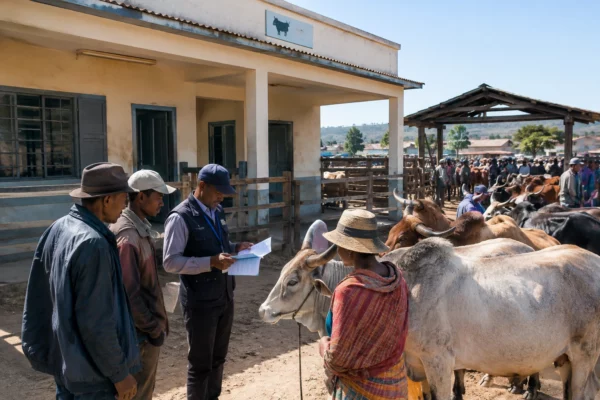
On 18 February 2026, the Fort-Dauphin Court of First Instance ordered QMM to pay 9.9 billion ariary, or nearly €2m, to 27 farming families, according to information corroborated by several media outlets and Transparency International Initiative Madagascar. The ruling concerns fields and rice paddies rendered unusable after a water-retention dam was built to meet the needs of the mining site. The decision also cites significant effects on the landowners’ livelihoods and the lack of local consultation during construction of the infrastructure.
The same case took a new turn in early August. On 4 August 2026, Madagascar’s Supreme Court dismissed the company’s appeal, according to Transparency International Initiative Madagascar, which is closely following the dispute. The NGO then denounced the gap between a court ruling that had become enforceable and the situation of families who say they are still waiting for the sums owed to be paid. Rio Tinto, for its part, says on its page about QMM that it remains committed to dialogue and reiterates that operations will resume only once people’s safety and freedom of movement are guaranteed.
The impasse is not new. QMM itself acknowledges that tensions over water, infrastructure and access to the site have previously disrupted its activities. The group also notes that after the episodes in 2022, it had to review its water management and strengthen certain measures. But for local residents, the core problem is broader: lost agricultural income, slow compensation and the sense that the balance of power is too heavily weighted in favour of a major company.
Why Mandena is a focus of so much tension
Mandena is not merely an industrial site. It is a place where very different interests intersect. On one side is a company that exports a strategic ore, employs workers, hires contractors and promises local benefits. On the other are rural communities that depend on the land, rice farming and local activities, and thus on an economy highly sensitive to flooding, access restrictions and environmental disruption. In this kind of conflict, the loss of cultivable land is not measured only in hectares. It translates into missed harvests, extra costs and greater vulnerability for households already at risk.
QMM’s site is also in a region where relations between mines and communities have often been marked by high expectations. Since 2023, Rio Tinto says it has extended its fiscal partnership with the Malagasy state and increased its contribution to communities, to $4m a year for 25 years, with part of it earmarked for the region. On paper, the arrangement is meant to link production, public revenue and local development. In practice, the Tolagnaro dispute shows that a financial framework is not enough to quell a protest if questions of land, water and compensation remain unresolved.
The suspension announced on 27 August 2026 fits this pattern. After several blockades of the access road to the site over three weeks, QMM chose to halt its mining operations, maintaining only essential services related to safety and the protection of facilities. Malagasy media covering the case report that a third blockade took place on 27 August near Tolagnaro, and that residents of Andranokana were demanding payment of compensation relating to farmland affected by the mine’s infrastructure.
For employees, contractors and the local economic ecosystem, every shutdown has an immediate impact. For farmers, however, the suspension does not erase the original harm. It mainly opens a more visible window for negotiations. This is where the issue becomes political: if the court rules but enforcement is delayed, trust in the judicial system is undermined, as is the credibility of mediation mechanisms.
A Malagasy case with regional implications
Madagascar is a member of SADC, the Southern African Development Community, and its capital is Antananarivo. In a region where states are seeking to attract mining, energy and logistics investment, the QMM case is a test. It shows that the appeal of mining is not simply a matter of what lies underground. It also depends on the quality of social dialogue, the enforcement of court decisions and environmental management.
The 46th ordinary SADC summit, held in mid-August 2026, specifically highlighted the importance of governance, public accountability and citizen participation in Madagascar’s trajectory. In this context, the QMM case goes beyond a dispute between a mining company and local residents. It raises questions about institutions’ ability to protect investment, cultivated land and community rights at the same time. This balance, rather than the volume of ore exported alone, will determine whether Mandena remains a symbol of extraction or becomes an example of peaceful governance.