Algeria
 Egypt
 Libya
 Morocco
 Sudan
 Tunisia
 Benin
 Burkina Faso
 Cabo Verde
 Côte d'Ivoire
 Ghana
 Guinea
 Guinea-Bissau
 Liberia
 Mali
 Mauritania
 Niger
 Nigeria
 Senegal
 Sierra Leone
 The Gambia
 Togo
 Cameroon
 Central African Republic
 Chad
 DR Congo
 Equatorial Guinea
 Gabon
 Republic of the Congo
 São Tomé and Príncipe
 Burundi
 Comoros
 Djibouti
 Eritrea
 Ethiopia
 Kenya
 Malawi
 Mauritius
 Mozambique
 Rwanda
 Seychelles
 Somalia
 South Sudan
 Tanzania
 Uganda
 Angola
 Botswana
 Eswatini
 Lesotho
 Namibia
 South Africa
 Zambia
 Zimbabwe
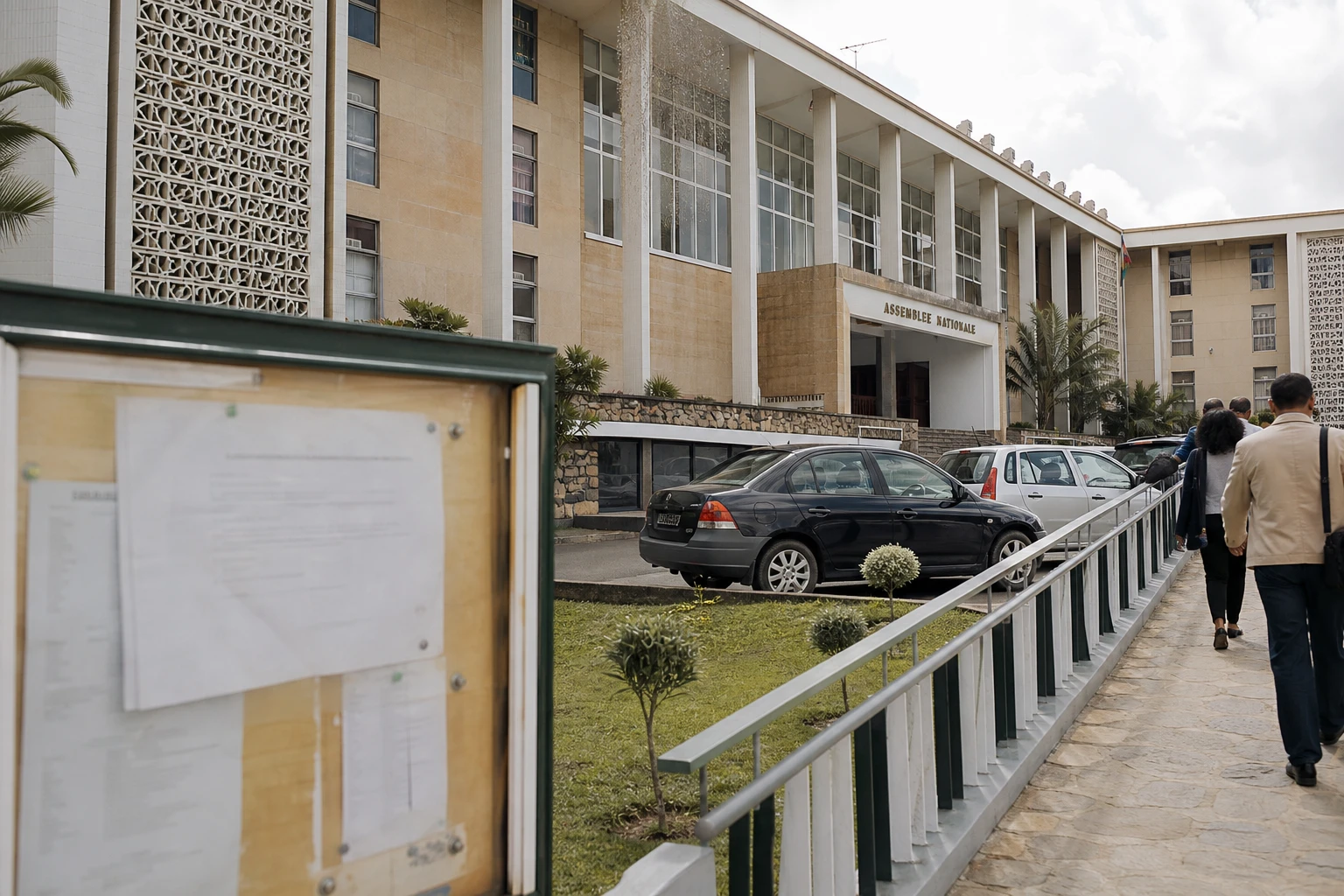
In Antananarivo, the divide is no longer just between the government and the opposition
In Madagascar, protests are no longer targeting only one figure or one government. They are now taking aim at the heart of the institutional system. For some young people, the National Assembly no longer represents a check on power, but a chamber that simply supports it. This criticism strikes a sensitive nerve: when Parliament loses credibility, the entire democratic machinery seizes up.
The debate comes as the country is still marked by the political crisis that began in September 2025, followed by the vacancy in the presidency declared by the High Constitutional Court on 14 October 2025, before Michaël Randrianirina took office as head of state during the transition. In this context, the lower house, based in Tsimbazaza, is being watched as a test of the renewal promised by the authorities. Madagascar is also a member of SADC, the Southern African Development Community, which recently called on Malagasy actors to prioritise dialogue and calm.
An assembly under pressure as the transition seeks its path
Since 25 August 2026, the National Assembly has been holding an extraordinary session devoted to considering seven bills. At its opening, the speaker, Siteny Randrianasoloniaiko, defended the legislative work of the lower house. He cited two parliamentary initiatives in particular: one commission on the use of public funds under the previous regime and another on Jirama, the state-owned water and electricity production and distribution company. In a country where power cuts and the quality of public services weigh heavily on daily life, the issue is far from abstract.
The session is taking place as some young Malagasy people, who identify with Gen Z, call for the National Assembly to be dissolved before 25 September 2026. The date was not chosen at random: it marks the first anniversary of the start of the mobilisation that shook the government of former president Andry Rajoelina in September 2025. The call has been taken up by organised students, including Assedu-Mada, a sign that discontent extends beyond the most visible activist circles.
The young protesters accuse MPs of no longer representing the population. They also challenge the political U-turns seen since the May 2024 legislative elections, when 84 of the 163 MPs were elected under the banner of the Irmar coalition, which was close to Andry Rajoelina. Some of them later backed the motion to impeach the former head of state, passed on 14 October 2025, after joining a platform supporting the transitional regime two weeks earlier. For the Assembly’s critics, these successive realignments show an institution too susceptible to the balance of power at any given moment.
Dissolution remains a constitutional power, not a street slogan
As pressure mounted, a legal route was attempted. The KINTANA party petitioned the High Constitutional Court to declare an institutional deadlock and recommend the dissolution of the National Assembly. But on 26 August 2026, the court declared the petition inadmissible. It cited a lack of standing and found that the situation did not, as things stood, warrant such a dissolution. The legal framework is therefore clear: in Madagascar, this power belongs to the head of state, not to a party or the street.
This legal point matters in the current balance of power. Siteny Randrianasoloniaiko knows that his legitimacy depends in part on the parliamentary networks around him. Conversely, supporters of dissolution are banking on a simple idea: if the lower house no longer performs its oversight role, it is time to start from scratch. Between the two, the executive still controls the institutional agenda, but it must contend with a young electorate that is more politically engaged than a year ago, and a Parliament whose loyalties can no longer be easily read through old party divisions.
The emerging rivalry between the speaker of the Assembly and the head of state also raises a broader question: who is steering the transition? The official renewal programme refers to national consultations, a revision of institutional rules and the prospect of a new constitution. In other words, the debate over the lower house is not just about MPs’ discipline. It concerns how Madagascar wants to rebuild its institutions after the rupture of 2025.
What the Malagasy episode reveals about the region
Across SADC, Madagascar is being watched as a transition that needs stabilising. At its summit in Durban on 17 August 2026, the regional organisation underscored the importance of dialogue in Madagascar and the need to preserve calm. This reminder is not insignificant. It reflects a shared concern in southern Africa: when representative institutions lose their credibility, political crises become longer, less predictable and more costly for the real economy.
The continental significance is also clear. The protests led by Madagascar’s Gen Z are part of a transnational political generation, attentive to movements seen elsewhere in Africa and beyond. But the Malagasy case has its own logic: here, the question is not simply the street versus the government. It is also about intermediary institutions, from Parliament and the constitutional courts to the most tangible public services. In a transition, credibility cannot be decreed. It is built through clear decisions, transparent procedures and representation that is not seen as a mere rubber stamp.
The next milestone will be political as well as legal. Until the transition clarifies the timetable, the balance between the executive, the National Assembly and social forces will remain fragile. In Antananarivo, the battle over the lower house is already saying something broader: in Madagascar’s renewal, the central question is not only who governs, but how power is held to account.