Algeria
 Egypt
 Libya
 Morocco
 Sudan
 Tunisia
 Benin
 Burkina Faso
 Cabo Verde
 Côte d'Ivoire
 Ghana
 Guinea
 Guinea-Bissau
 Liberia
 Mali
 Mauritania
 Niger
 Nigeria
 Senegal
 Sierra Leone
 The Gambia
 Togo
 Cameroon
 Central African Republic
 Chad
 DR Congo
 Equatorial Guinea
 Gabon
 Republic of the Congo
 São Tomé and Príncipe
 Burundi
 Comoros
 Djibouti
 Eritrea
 Ethiopia
 Kenya
 Madagascar
 Malawi
 Mauritius
 Mozambique
 Rwanda
 Seychelles
 Somalia
 South Sudan
 Tanzania
 Angola
 Botswana
 Eswatini
 Lesotho
 Namibia
 South Africa
 Zambia
 Zimbabwe
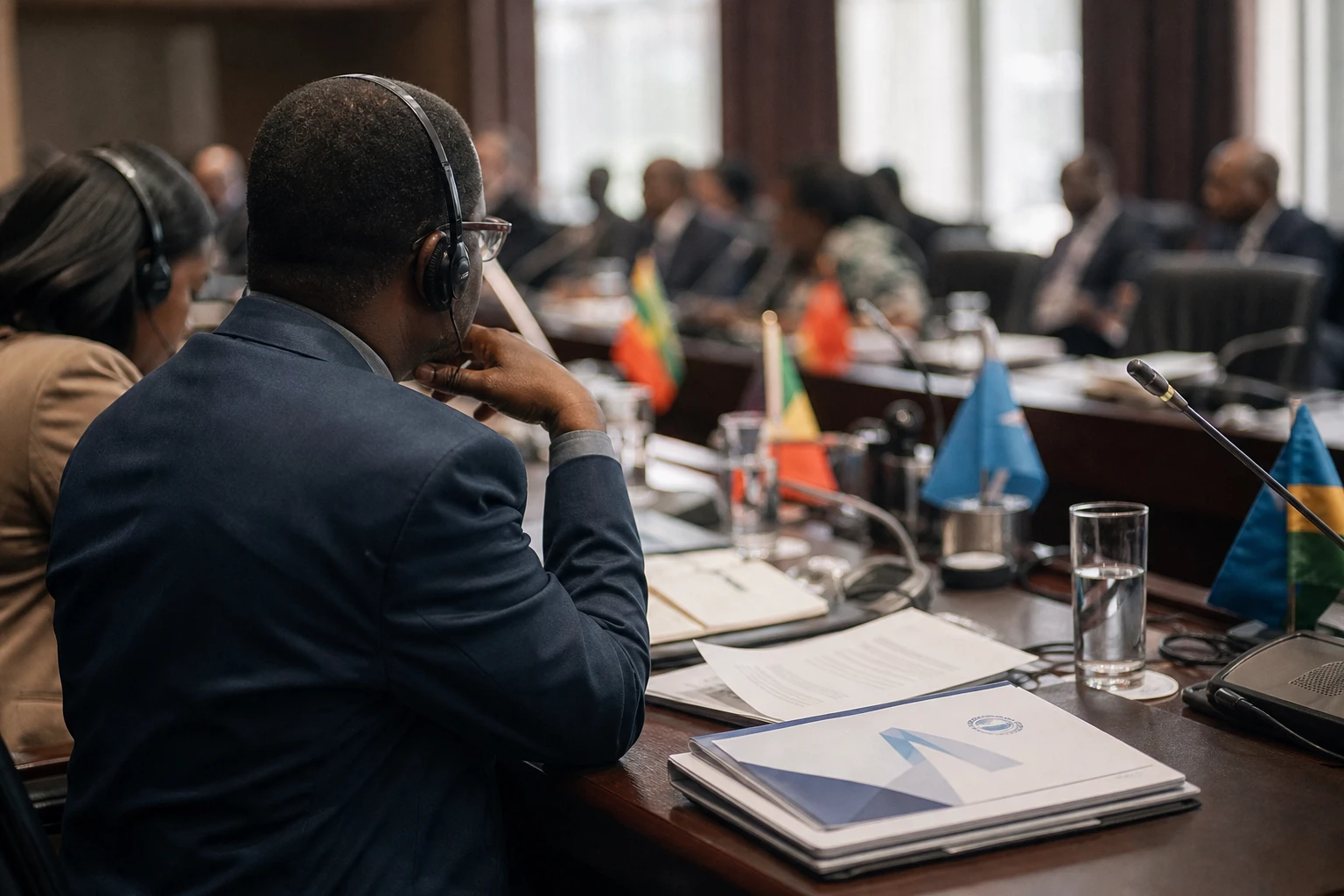
A succession being prepared in the open
In Uganda, the question is no longer simply when Yoweri Museveni will leave power. It is also who, in a system shaped by four decades of political continuity, can truly succeed him without upsetting the institutional balance built around him. In this landscape, every statement about 2031 already carries more weight than a mere personal ambition.
The country is entering a sensitive period. Kampala remains the political centre of gravity, but decisions that matter are also made through the National Resistance Movement, the security apparatus and the networks of loyalty built around the head of state. Uganda, a member of the East African Community, is also part of a regional space where the political stability of each capital directly affects trade, security and diplomatic balances.
Muhoozi Kainerugaba sets his sights on 2031
On 25 August, Muhoozi Kainerugaba announced that he would seek the presidency in 2031. The 52-year-old head of Uganda’s armed forces presented the date as a contest he intends to win, positioning himself as a continuation of the presidential camp. The announcement has put back in the spotlight a scenario long discussed in Kampala: the transfer of power within the regime’s family and political inner circle.
The announcement did not come out of the blue. In May 2026, Yoweri Museveni was sworn in for a seventh term after winning January’s election with 71.65% of the vote, according to official results. The president, who has been in power since 1986, has thus extended an exceptional political tenure in the region. At 81, he remains the system’s central figure, and, at this stage, there is no public indication that he has given up influence over the post-2026 era.
This is not Muhoozi’s first statement on the subject. In 2023, he had already mentioned standing in the 2026 election before backtracking and urging his supporters to rally behind his father. That U-turn fuelled the idea of a step-by-step strategy: test the limits, gauge resistance, then return at what is judged to be the right moment.
A man at the heart of the state apparatus
General Kainerugaba is no outsider. He currently leads Uganda’s armed forces and also chairs the Patriotic League of Uganda, a political pressure group that has grown in prominence. His institutional clout gives him a visibility few contenders can match. It also gives him direct access to the levers of command in a country where the boundary between civilian power, security and the presidential majority remains narrow.
His profile is divisive. His social media posts have repeatedly caused controversy, particularly when he made threats against opposition figure Bobi Wine. Comments deemed inappropriate have also fuelled tensions with neighbouring Kenya. This blunt communication reinforces his image as a hardliner in power, but also adds an element of unpredictability to an already highly charged political succession.
His influence grew further in 2026. Reuters reports that he played an important role in maintaining the balance of power in favour of the presidential camp during January’s election, notably through crackdowns on opponents and an internet shutdown. At the same time, Ugandan media describe the rise of his political league as an attempt to build, well beyond the presidential family alone, a bloc capable of lasting beyond Museveni.
A weakened opposition, a closed debate
The announcement comes as the opposition emerges weakened from the latest presidential election. Bobi Wine left Uganda early in the year, saying he feared for his safety. Kizza Besigye, a veteran opposition figure, remains in detention and is facing treason charges. These developments weigh heavily on the political climate, as they shrink the space for public debate and reinforce the perception of a highly uneven electoral contest.
The government, for its part, rejects recurring allegations of torture, abductions and arbitrary detention. But the repeated complaints, in Kampala and abroad, have crystallised a simple question: who really arbitrates the succession in a system where the head of state still commands most of the political, security and symbolic resources? In this context, Muhoozi’s announced candidacy clarifies nothing. Above all, it confirms that the battle over the post-Museveni era has already begun.
What Uganda’s succession says to the region
For East Africa, the stakes go beyond Muhoozi Kainerugaba himself. Uganda holds a strategic position in the East African Community: it is an important market, a transit corridor and a security actor involved in several regional issues. When the succession struggle intensifies in Kampala, the EAC’s own balances may also come under strain, particularly in security cooperation, investment and the movement of people.
The local political timetable will therefore have regional implications. The next test will be less the announcement of 2031 itself than how the presidential camp handles that prospect in the meantime: by maintaining the status quo, preparing a controlled transition, or further closing down political space. In a Uganda profoundly shaped by the longevity of its government, the question of succession is no longer theoretical. It has become an instrument of government in its own right.