Egypt
 Libya
 Morocco
 Sudan
 Tunisia
 Benin
 Burkina Faso
 Cabo Verde
 Côte d'Ivoire
 Ghana
 Guinea
 Guinea-Bissau
 Liberia
 Mali
 Mauritania
 Niger
 Nigeria
 Senegal
 Sierra Leone
 The Gambia
 Togo
 Cameroon
 Central African Republic
 Chad
 DR Congo
 Equatorial Guinea
 Gabon
 Republic of the Congo
 São Tomé and Príncipe
 Burundi
 Comoros
 Djibouti
 Eritrea
 Ethiopia
 Kenya
 Madagascar
 Malawi
 Mauritius
 Mozambique
 Rwanda
 Seychelles
 Somalia
 South Sudan
 Tanzania
 Uganda
 Angola
 Botswana
 Eswatini
 Lesotho
 Namibia
 South Africa
 Zambia
 Zimbabwe
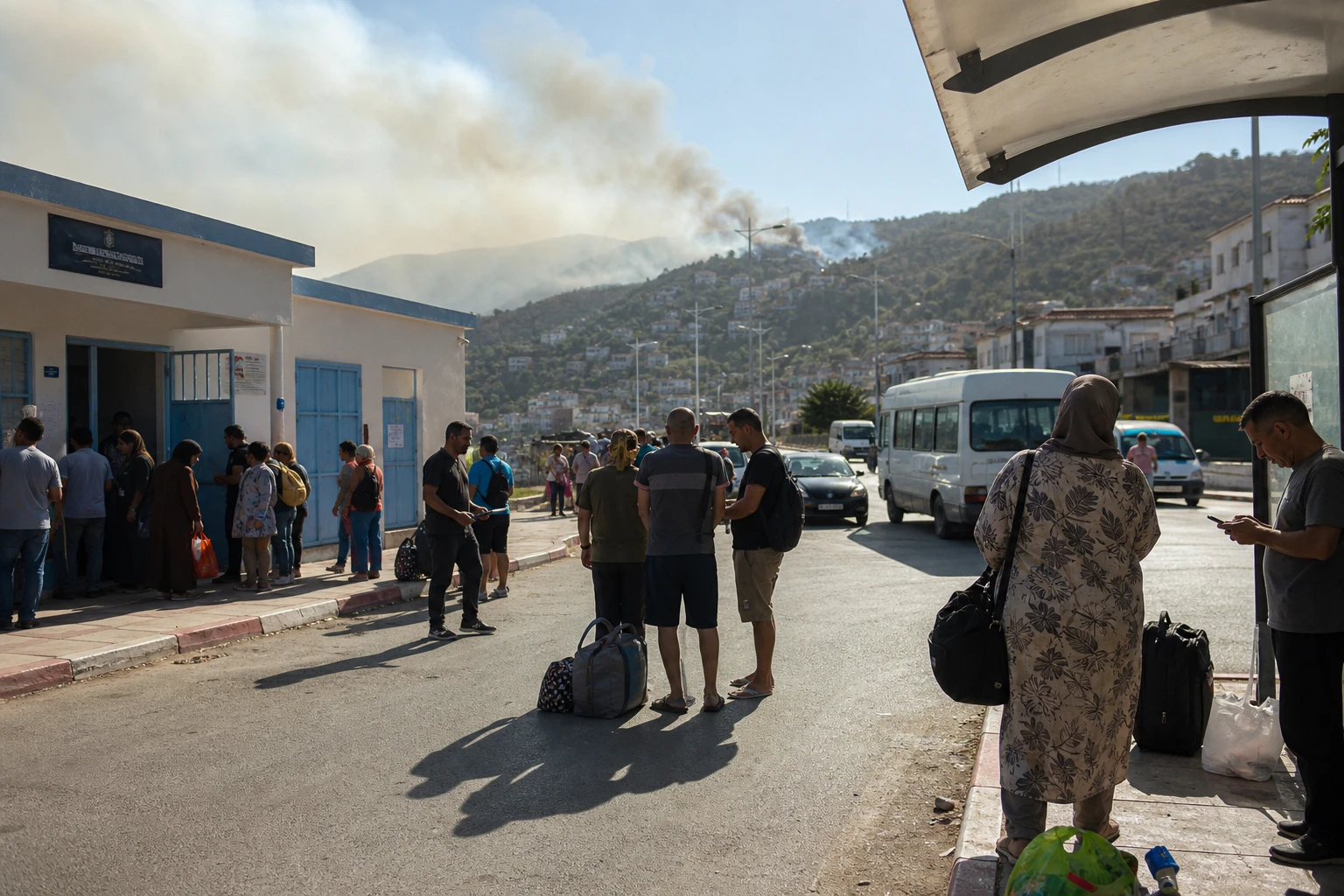
As the heat advances, villages retreat
In Algeria, the end of August does not merely mark the return of calm after the summer. It also highlights the vulnerability of eastern municipalities to vegetation fires, especially when wind drives the flames towards homes and roads. In Béjaïa, the events of 26 August once again showed how a forest fire can turn within hours into a civil protection, transport and public health crisis.
The phenomenon is not isolated. In the north of the country, along Algeria’s Mediterranean coast, drought, intense heat and strong winds create conditions conducive to fires. Algerian institutions have already described these fires as a major risk, exacerbated by climate change and by human behaviour that can sometimes cause outbreaks.
Heavy toll and successive evacuations in Béjaïa
On Wednesday 26 August, two people died in fires near Béjaïa, in eastern Algeria. The victims included an 8-year-old boy and a 22-year-old young woman, according to local media reports corroborated by several online news outlets. Other people were injured, but the authorities’ initial reports did not give a consistent exact figure.
Rescue services also carried out precautionary evacuations in several localities. Families left villages and neighbourhoods exposed to the flames, particularly in municipalities affected by the most active fires around Béjaïa and Jijel. In the evening, the Civil Protection service was still reporting 69 fires in progress across the country, including 18 in Béjaïa and 7 in Jijel, while an earlier report cited 58 fires recorded during the day, with 37 still active.
The authorities also reported road closures. At least three national roads in the east of the country were closed to traffic, complicating residents’ movements and the deployment of rescue teams. In this kind of crisis, roads often become the first point of vulnerability: they make evacuation possible, but smoke or flames can also cut off access and trap neighbourhoods.
Interior Minister Saïd Sayoud and Health Minister Mohamed Seddik Ait Messaoudene travelled to Béjaïa to monitor firefighting operations and the condition of the injured, according to Algeria’s official news agency. Their visit signals a shift from purely operational management to a broader crisis response involving civil protection, medical care and control of strategic routes.
What the fires reveal about eastern Algeria
The situation highlights a reality familiar to the Algerian authorities. The country has strengthened its national system for preventing and fighting forest fires, with a dedicated commission for 2026 and increased aerial resources. But the recurrence of fires shows that the response cannot be limited to putting them out. It also requires monitoring, rapid alerts, forest management and control of the areas where forests, farmland and homes meet.
Geography works against emergency services in eastern Algeria. Béjaïa, Jijel, El Tarf, Skikda and Annaba have extensive forested areas, towns perched on hillsides and narrow roads. When a fire breaks out, smoke hampers operations, wind accelerates its spread and evacuations sometimes have to be carried out in a hurry. Residents of rural areas and outlying districts are the first to pay the price, long before damage is measured in hectares or public spending.
The climate context adds to the burden. IPCC analyses for Africa indicate an increase in heatwaves and drought risk in North Africa, while the World Meteorological Organization describes heat and drought episodes across the Mediterranean that heighten the likelihood of fires. In other words, Algeria’s late-summer fires are no longer simply a seasonal news story. They are part of a broader trend affecting the entire Mediterranean basin, from the Maghreb to southern Europe.
The impact on the local economy is immediate. Displaced families lose a night, sometimes longer, as they wait to return safely. Small businesses close. Transport operators fall behind schedule. Farmers watch crops, orchards or hay stocks go up in smoke. In a region where informal activity remains significant, the least protected households often bear the shock without insurance or a financial safety net.
A national warning in a Mediterranean region under strain
This episode therefore extends beyond Béjaïa province alone. It raises questions about the preparedness of Algeria’s coastal region for fires that are faster, hotter and less predictable. It also serves as a reminder that forest fires are not a marginal problem in North Africa. They affect food security, infrastructure, public health and the continuity of essential services.
At the regional level, Algeria shares this vulnerability with several Mediterranean and North African countries. Weather services, forestry commissions and early warning systems are now central to the response. In the coming days, the question will be whether the fires still active can be brought under control quickly and whether the most exposed municipalities can avoid further loss of life.
The country is therefore walking a narrow line: protecting its forests, villages and roads while adapting to a fire season that is growing longer. For Algeria, as for parts of the continent along the Mediterranean, the fight against fires is no longer confined to the height of summer. It begins well before the first flames.