Algeria
 Libya
 Morocco
 Sudan
 Tunisia
 Benin
 Burkina Faso
 Cabo Verde
 Côte d'Ivoire
 Ghana
 Guinea
 Guinea-Bissau
 Liberia
 Mali
 Mauritania
 Niger
 Nigeria
 Senegal
 Sierra Leone
 The Gambia
 Togo
 Cameroon
 Central African Republic
 Chad
 DR Congo
 Equatorial Guinea
 Gabon
 Republic of the Congo
 São Tomé and Príncipe
 Burundi
 Comoros
 Djibouti
 Eritrea
 Ethiopia
 Kenya
 Madagascar
 Malawi
 Mauritius
 Mozambique
 Rwanda
 Seychelles
 Somalia
 South Sudan
 Tanzania
 Uganda
 Angola
 Botswana
 Eswatini
 Lesotho
 Namibia
 South Africa
 Zambia
 Zimbabwe
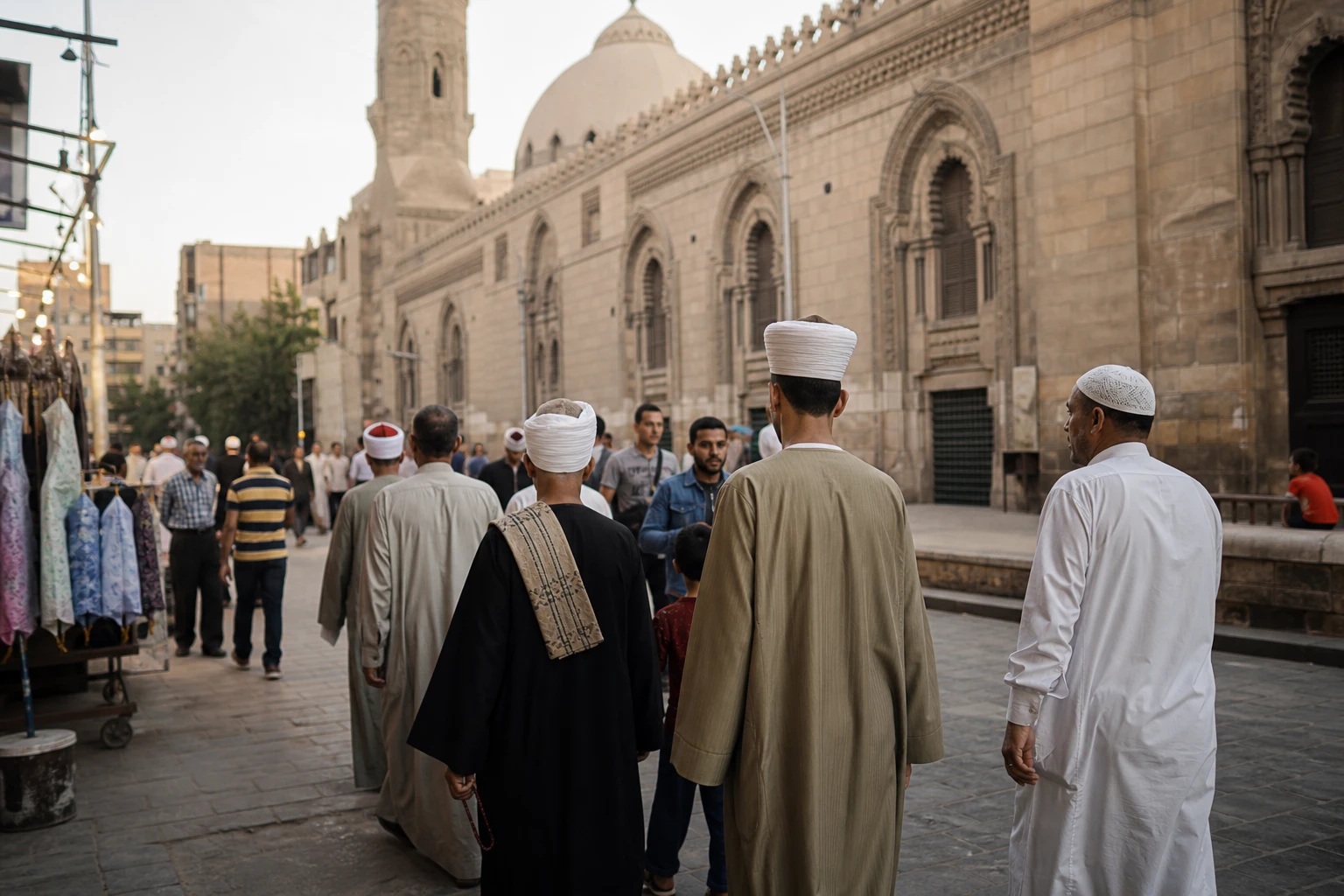
In Cairo, the Mawlid remains a moment of faith, street life and memory
In the Al-Azhar district, one of Cairo’s religious and popular centres, the celebration of Mawlid al-Nabawi is more than a date on the calendar. It takes the form of a collective presence. Worshippers, often linked to Sufi orders, gather around the great historic mosques, amid invocations, devotional songs and processions. This year again, the ritual recalled that Egypt does not simply celebrate a religious birth: it brings to life an urban tradition deeply rooted in its old districts, shrines and spiritual networks.
The festival holds a distinctive place in the country. The Mawlid is commemorated on 12 Rabi al-Awwal, the third month of the Hijri calendar, and in Egypt it remains associated with public gatherings, sweets prepared for the occasion and ceremonies held around Cairo’s landmark mosques, such as al-Hussein, Sayyida Zaynab and Sayyida Nafissa. State religious institutions, foremost among them Al-Azhar and the Ministry of Awqaf, also frame the celebrations with programmes of sermons, lessons and moral instruction.
A Sufi procession along the Al-Azhar–al-Hussein route
The gathering observed in Cairo followed a route familiar from religious celebrations in the Egyptian capital. Participants walked between Sidi Saleh Al-Jaafari Mosque and the mausoleum of al-Hussein, in an atmosphere set to the rhythm of drums, praise and collective prayers. This kind of procession is no mere footnote in Egyptian religious life. It is part of a culture of public devotion in which singing, the repetition of invocations and physical presence in sacred space matter as much as the sermon.
Sufi orders have a visible place in this landscape. In Egypt, they have long organised moulids, popular celebrations associated with holy figures or the Prophet, featuring open gatherings, recitations and songs. Egyptian official sources note that these practices have been linked to the country’s history since the Fatimid era and remain centred today around the great mosques of historic Cairo. This continuity explains the appeal of these ceremonies, which extends well beyond the circle of initiates.
For Sufi leaders, the commemoration is first and foremost an experience of inner renewal. The idea is not merely to “honour” an event in the past, but to put the Prophet’s spiritual example and the moral discipline it inspires back at the centre. This interpretation, common in Egyptian Sufi orders, helps explain why the Mawlid is often presented as a festival of peace, tolerance and solidarity, rather than simply a commemorative ceremony.
Between religious tradition and the presence of the state
In Egypt, the Mawlid also plays out in the institutional sphere. This year, the Ministry of Awqaf announced a religious and academic programme for the entire month of Rabi al-Awwal, with hundreds of evenings, lessons and meetings in mosques across the republic. In Cairo, the mosques of al-Hussein, Sayyida Zaynab and Sayyida Nafissa are highlighted as places of transmission, with readings of spiritual texts and public recitations. The message is clear: popular celebration continues, but within a religious framework largely set out by the state.
This combination of popular fervour and official oversight is not unique to Egypt, but it takes on particular significance there. The country is home to one of the world’s highest concentrations of religious institutions, with Al-Azhar at the centre of the system. This gives the Mawlid a significance beyond individual piety. The festival also becomes a marker of social continuity in a city where historic mosques, mausoleums and Sufi orders remain part of the living landscape.
At the same time, this visibility does not erase internal debates within Egyptian Islam. Sufism retains a popular foothold, but coexists with other, more reserved religious sensibilities, sometimes critical of the Mawlid’s collective forms. Without exaggerating this tension, it is worth noting that in Egypt the celebration also serves as a symbolic marker: it shows which version of public religiosity the country chooses to foreground, between popular ritual, scholarly authority and the staging of consensus.
A signal that resonates far beyond Cairo
The Egyptian case is of interest beyond its borders because it illustrates an African and Mediterranean way of bringing religion into public space. In North Africa, as well as in several countries in West Africa and the Horn of Africa, Sufi orders remain major social actors. They organise festivals, foster local solidarity and promote an understanding of religion often centred on moderation and transmission. Egypt, with its major institutions and large-scale celebrations, offers one of the most visible showcases of this tradition.
The continental significance of Egypt’s Mawlid also lies in its urban dimension. In a capital such as Cairo, the festival brings together a historic district, popular pilgrimage, the economy of small shops and cultural activity. Around the mosques and mausoleums, it provides work for vendors, artisans, reciters, religious musicians and organisers. This understated network shows how a spiritual celebration can also support a local economy deeply rooted in Africa’s old cities.
The question remains what comes next. Egypt’s religious calendar continues with more evenings, gatherings and public readings throughout Rabi al-Awwal. But the essential point is already clear: in Cairo, the Mawlid continues to link the country’s Fatimid history, the strength of Sufi orders and the state’s religious oversight. It is this combination, rather than the ritual alone, that gives the festival its depth and regional resonance.