Algeria
 Egypt
 Libya
 Morocco
 Sudan
 Tunisia
 Benin
 Burkina Faso
 Cabo Verde
 Côte d'Ivoire
 Ghana
 Guinea
 Guinea-Bissau
 Liberia
 Mali
 Mauritania
 Niger
 Nigeria
 Senegal
 Sierra Leone
 The Gambia
 Togo
 Cameroon
 Central African Republic
 Chad
 Equatorial Guinea
 Gabon
 Republic of the Congo
 São Tomé and Príncipe
 Burundi
 Comoros
 Djibouti
 Eritrea
 Ethiopia
 Kenya
 Madagascar
 Malawi
 Mauritius
 Mozambique
 Rwanda
 Seychelles
 Somalia
 South Sudan
 Tanzania
 Uganda
 Angola
 Botswana
 Eswatini
 Lesotho
 Namibia
 South Africa
 Zambia
 Zimbabwe
In the east, peace advances in stages, not slogans
In the east of the Democratic Republic of the Congo, every diplomatic gain is measured by one very simple thing: whether civilians become safer. After months of scattered contacts between Doha, Washington and several regional capitals, Kinshasa and AFC/M23 have taken a new step in Switzerland with a roadmap intended to organise the next negotiations.
This new milestone does not start from scratch. It is part of the Doha process, already underpinned by the framework agreement signed in Doha on 15 November 2025, itself presented as complementary to the peace agreement between the DRC and Rwanda signed in Washington on 27 June 2025. The African Union, for its part, endorsed the idea in 2026 of coordinating the Doha and Washington tracks with African mediation to avoid parallel agendas.
What was agreed in Switzerland
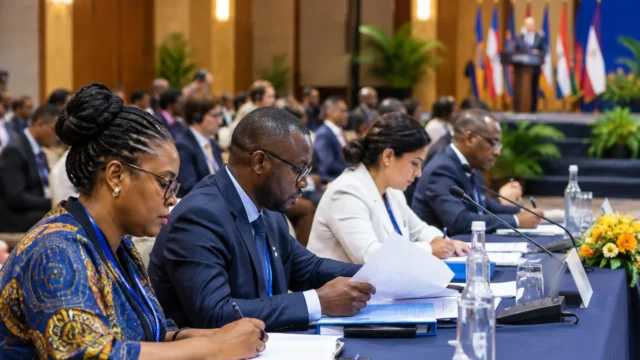
According to the joint statement circulated by several participants, discussions held from 17 to 21 August 2026 resulted in a roadmap setting out the successive stages and timetable for negotiations under the Doha framework agreement. Both parties also reaffirmed their commitment to continuing talks towards a comprehensive peace.
The text also refers to a mechanism for monitoring commitments and a standardised method for reporting alleged ceasefire violations. An initial verification mission is scheduled for Minembwe, in South Kivu, an area where front lines remain fluid and accusations of military repositioning have multiplied for months.
This diplomatic sequence was prepared by a group of mediators and external supporters. Qatar is leading the process from Doha, with the support of the United States, Switzerland, the African Union and Togo, which has been designated the AU mediator. The United Nations, through MONUSCO, is also monitoring the ceasefire verification mechanisms.
A useful but still fragile step forward
For Kinshasa, the roadmap is first and foremost of political value: it keeps a channel of negotiation open even as the war in the east has already reshaped the security, humanitarian and administrative balance in several areas of North Kivu and South Kivu. For AFC/M23, it offers procedural recognition, without resolving the central question of the armed presence on the ground.
The underlying problem is well known. In recent months, the UN Security Council has noted that fighting continues in the east of the DRC and that verification mechanisms have yet to produce lasting de-escalation. In its 2026 decision, the African Union also stressed the need for credible coordination and an end to external support for armed groups, while condemning the illegal exploitation of resources and parallel administrations.
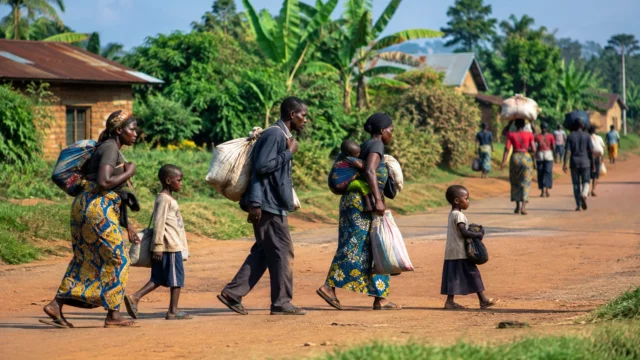
On the ground, the stakes are concrete. A roadmap does not feed a displaced family, reopen a closed school or, by itself, revive trade between Bukavu, Goma, Minembwe and the surrounding rural areas. But it can create a framework to limit incidents, document violations and prepare verifiable withdrawals if commitments are followed through. That is where the process’s credibility will be tested.
That credibility also depends on the Congolese political context. In Kinshasa, President Félix Tshisekedi has recently reaffirmed the priority given to security sovereignty and a more autonomous defence doctrine, while highlighting the support of African partners, notably Tanzania and South Africa, for peace efforts in the east. The Congolese capital is therefore seeking to combine military pressure, regional diplomacy and engagement in negotiation formats.
What this sequence says about Central Africa
The Congolese issue extends far beyond the DRC alone. It affects the stability of the Great Lakes region, cross-border movement, the balance between Central, East and Southern Africa, and the role of regional organisations such as ECCAS, SADC, the EAC and the AU. The peace architecture is intended precisely to prevent a localised conflict from becoming a permanent regional dispute.
The precedent is clear: Luanda, Nairobi, Doha, Washington and now Switzerland form a chain of mediation efforts that matters only if it produces verifiable results on the ground. Otherwise, the risk is that texts multiply without changing military realities. The AU has also called for greater complementarity between the processes to reduce overlap and ambiguity.
The immediate next steps will depend on the implementation of the first verification missions announced for Minembwe, the maintenance of the ceasefire and the mediators’ ability to enforce a clear timetable. In Central Africa, peace cannot simply be decreed. It is measured by the discipline of the parties, the protection of civilians and the coherence of regional guarantees.