Algeria
 Egypt
 Libya
 Morocco
 Sudan
 Tunisia
 Benin
 Burkina Faso
 Cabo Verde
 Côte d'Ivoire
 Ghana
 Guinea
 Guinea-Bissau
 Liberia
 Mali
 Mauritania
 Niger
 Nigeria
 Senegal
 Sierra Leone
 The Gambia
 Togo
 Cameroon
 Chad
 DR Congo
 Equatorial Guinea
 Gabon
 Republic of the Congo
 São Tomé and Príncipe
 Burundi
 Comoros
 Djibouti
 Eritrea
 Ethiopia
 Kenya
 Madagascar
 Malawi
 Mauritius
 Mozambique
 Rwanda
 Seychelles
 Somalia
 South Sudan
 Tanzania
 Uganda
 Angola
 Botswana
 Eswatini
 Lesotho
 Namibia
 South Africa
 Zambia
 Zimbabwe

Along a border of forests, smuggling routes and areas of armed nomadic herding, security is not decided only in capital cities. It also depends on the ability of two neighbouring states to share reliable information swiftly, train officers and speak with one voice when armed groups move from one country to another. It is precisely with this in mind that the Democratic Republic of the Congo and the Central African Republic have formalised a new stage in their security cooperation in Kinshasa.
A pressured neighbourhood, from the Ubangi to the fringes of the Uele
The DRC and the CAR share a long border, estimated at about 1,577 kilometres in commonly used geographical sources, and this line is not merely an administrative boundary. It crosses areas of movement where refugees, traders, nomadic herders, trafficking networks and armed groups intersect. In north-western DRC, Bas-Uele and Nord-Ubangi are regularly cited among the areas most exposed to these sensitive movements.
This reality is part of a wider regional context. In Central Africa, the CAR has for several years sought to strengthen its armed forces and stabilise relations with its neighbours. The DRC, meanwhile, continues to face multifaceted security pressures in the east and north of the country, involving sovereignty, territorial control and coordination with neighbouring countries. Across Central Africa, bilateral cooperation is therefore becoming a practical tool, sometimes faster to deploy than broader regional frameworks.
Two memorandums to give cooperation an operational focus
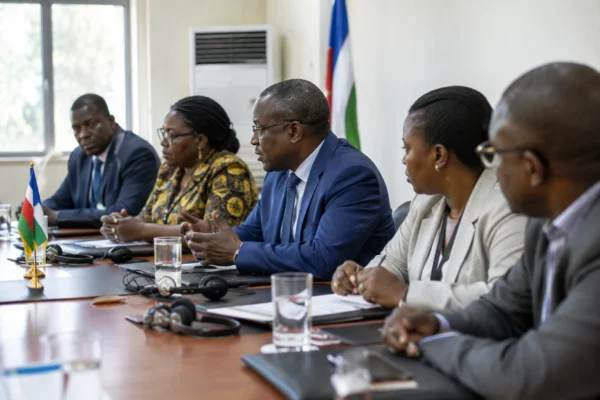
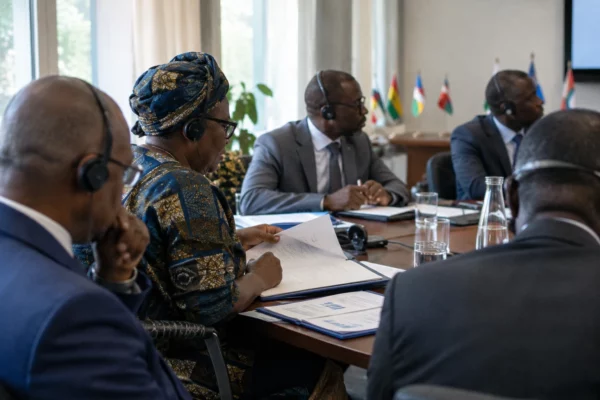
On Friday 21 August 2026 in Kinshasa, Congolese Defence Minister Guy Kabombo Muadiamvita and his Central African counterpart, Rameaux-Claude Bireau, signed two memorandums of understanding. The first concerns military training. The second covers intelligence. The stated aim is clear: to improve coordination between the two armies, speed up information-sharing and prevent border areas from serving as rear bases for armed actors or criminal networks.
The signing does not start from scratch. The two countries had already concluded a military cooperation agreement in Kinshasa on 18 October 2024, establishing a joint commission to coordinate and assess joint activities. The texts signed in August 2026 therefore extend an existing framework, specifying two concrete areas: developing personnel’s skills and speeding up the flow of military intelligence.
The authorities of both countries present this step as a move from intentions to mechanisms. On the Central African side, training officers abroad, particularly in the DRC, is already an established practice. For the Congolese side, cooperation with a direct neighbour is part of a broader strategy to diversify military partnerships and strengthen border security. In other words, the agreement does not create a new alliance; it aims above all to make existing cooperation clearer and more useful.
What the agreement changes for people living along the border
On the ground, the issue is not abstract. In Bas-Uele and Nord-Ubangi, Congolese authorities have long cited the movement of Mbororo herders, tensions over livestock, incursions by armed bands and smuggling networks that exploit weak border controls. In March 2026, ACP reported that the presence of 3,000 Mbororo herders and more than 30,000 cattle had again been discussed at the DRC’s Defence Ministry. This figure illustrates the level of attention given to these areas.
For residents, better intelligence-sharing could, in theory, reduce response times to suspicious movements. This applies to roads, remote villages, checkpoints and transhumance corridors. But such an agreement will have an effect only if shared information arrives in time, local forces have the necessary resources and chains of command remain coordinated. Otherwise, the memorandums will remain useful texts that are only partially implemented. This view is also consistent with United Nations analyses, which stress that the crises in the Great Lakes region cannot be resolved by force alone, but also require institutional stability and regional cooperation.
The differing effects also need to be considered. For governments, the agreement helps demonstrate their ability to control borders and show that sovereignty is more than a diplomatic term. For the armed forces, it creates scope for training, exchanges and coordination. For rural communities, however, the issue is more immediate: being able to travel, farm, trade and move livestock without fear of clashes, extortion or reprisals. Border security is therefore not just a matter for military headquarters; it affects the local economy, often informal, that sustains areas far from the capitals.
Bilateral cooperation under close scrutiny in Central Africa
This latest development between Kinshasa and Bangui comes amid other security realignments in the region. In recent years, the CAR has pursued several forms of cooperation with its neighbours, while the DRC has also expanded exchanges with other regional and extra-regional partners. In an area marked by cross-border conflicts, the success of a bilateral agreement could inspire other initiatives, but it could also run up against rivalries for influence, divergent priorities and a lack of resources on the ground.
The continental significance of this rapprochement lies precisely in this: it is a reminder that African security is often built through simple, practical and adaptable mechanisms rather than grand slogans. The next step will be less about signing than implementation: information-sharing, joint meetings, training and, possibly, coordinated patrols. In a region where threats move faster than decisions, the partnership between Kinshasa and Bangui will be judged on its ability to deliver.