Algeria
 Egypt
 Libya
 Morocco
 Sudan
 Tunisia
 Benin
 Burkina Faso
 Cabo Verde
 Côte d'Ivoire
 Ghana
 Guinea
 Guinea-Bissau
 Liberia
 Mali
 Mauritania
 Niger
 Senegal
 Sierra Leone
 The Gambia
 Togo
 Cameroon
 Central African Republic
 Chad
 DR Congo
 Equatorial Guinea
 Gabon
 Republic of the Congo
 São Tomé and Príncipe
 Burundi
 Comoros
 Djibouti
 Eritrea
 Ethiopia
 Kenya
 Madagascar
 Malawi
 Mauritius
 Mozambique
 Rwanda
 Seychelles
 Somalia
 South Sudan
 Tanzania
 Uganda
 Angola
 Botswana
 Eswatini
 Lesotho
 Namibia
 South Africa
 Zambia
 Zimbabwe
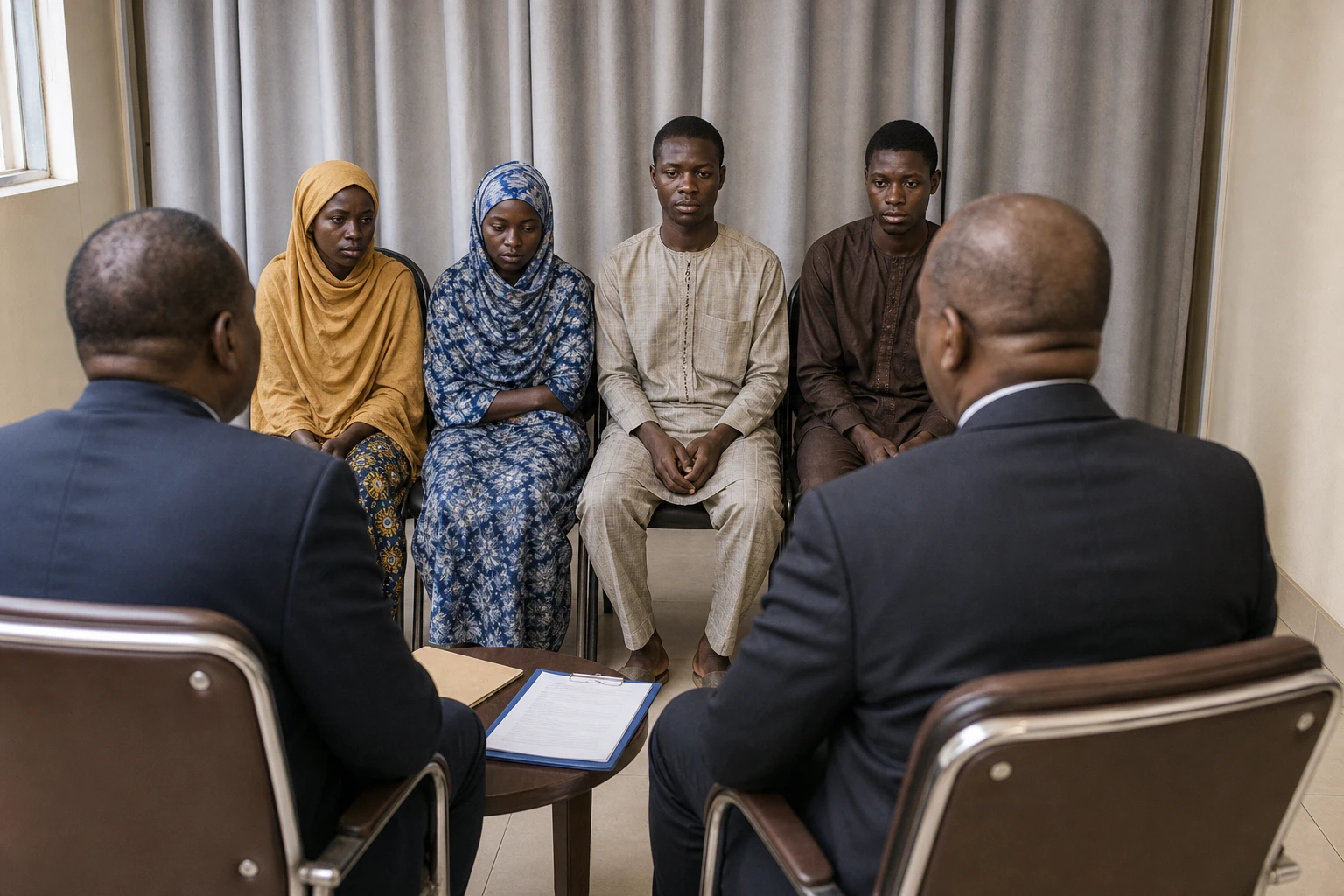
In north-east Nigeria, every release tells of a war that drags on
In Borno, a rescue does not close a case. Above all, it is a reminder of the length of captivity, the insecurity of rural roads and the way Boko Haram and its rival branch, ISWAP, continue to weigh on entire communities. In north-east Nigeria, a military operation can restore freedom to a handful of civilians without lifting the threat that still hangs over villages, roads and the island areas of the Lake Chad basin.
It was against this backdrop that the Nigerian army said it had found four people held for about three years in the Kukawa area, in eastern Borno State. The announcement comes as operations multiply in the north-east theatre, led by the command of Operation Hadin Kai, the military campaign against the insurgency in this part of the country. The Nigerian Ministry of Defence says the command coordinates joint operations by the armed forces in the region.
What the army says it found in Kukawa
According to information released by Nigerian forces, soldiers from the 123rd Special Forces Battalion conducted a search-and-rescue operation on Friday 21 August 2026 around the village of Kauwa, in Kukawa local government area, after receiving intelligence about suspicious movements. Four civilians were found: two women, a teenager and another minor.
The army says the four are from Mafa local government area, also in Borno State. They are believed to have been abducted nearly three years ago and then taken to the Dogon Chuku camp, an area already mentioned in several accounts by former captives and repentant fighters in north-east Nigeria. After finding them, the soldiers gave them food, identified them and transferred them to the 19th Brigade medical centre for treatment. Their names have not been made public, and no details of their health have been disclosed.
The location is significant. Kukawa lies in the Lake Chad area, a landscape of marshes, islands and tracks that are difficult to control. It is a territory where armed groups move quickly, civilians have less freedom of movement and intelligence matters as much as firepower. In the week of 21 August, operations in the north-east had already led to the announcement of other releases and several arrests, signalling sustained military pressure on armed networks.
A local conflict with regional effects
The events in Kukawa are part of a wider war. The UN says Boko Haram has spread beyond Nigeria across the Lake Chad basin, affecting Cameroon, Chad and Niger as well. ISWAP, which emerged from a split within Boko Haram, has established a lasting presence in this cross-border area. The UN Security Council says these groups exploit governance gaps, porous borders and socioeconomic tensions in the region.
The humanitarian impact remains considerable. According to the United Nations High Commissioner for Refugees, the Lake Chad basin is at a “critical tipping point” and Borno remains the epicentre of the crisis. Since January 2026, more than 77,500 people have been displaced in the four countries bordering the lake, including more than 16,000 refugees who have left north-east Nigeria for Niger’s Diffa region. The organisation also says it needs $29 million through December 2026 to maintain protection and emergency assistance.
In this context, the release of civilians has tangible value for families, but also political value for Abuja. It shows that Nigerian forces retain the ability to operate in contested areas. It also highlights the limits of the security response, as every operation reveals just how exposed residents remain to abduction, forced displacement and prolonged captivity.
In recent days, the military command has also reported a series of wider operations across several northern states. On 1 August 2026, troops freed two women and two children who had been held since the 2023 farming season in a terrorist enclave near Amuda Bridge, in Gwoza, also in Borno State. A few days later, Defence Headquarters announced the release of dozens of people in different theatres of operation, evidence that abduction networks remain active despite military pressure.
What this case says about Nigeria and West Africa
For Nigeria, the issue goes beyond the military sphere. The north-east is grappling with insurgency, a subsistence economy, repeated displacement and pressure on public services. Local markets, displaced families, farmers and transport workers experience the crisis very differently from federal authorities in Abuja. A release such as the one in Kukawa first brings relief to the victims and their relatives. It also serves as an indicator: it shows where armed groups are still hiding, and where the state is struggling to secure rural routes in the long term.
At the regional level, the issue remains tied to the stability of ECOWAS, the Lake Chad Basin Commission and the Multinational Joint Task Force, which brings together countries bordering the lake to fight armed groups. The challenge is twofold: to prevent fighters from crossing from one country to another, and to stop insecurity from driving further displacement to Niger, Cameroon and Chad. In its latest assessment, the UN also links insecurity in the north-east to humanitarian needs across the Sahel.
The next test for Abuja and its regional partners will therefore be their ability to turn these tactical successes into lasting protection. As long as villages in Borno remain isolated, roads remain vulnerable and civilians remain bargaining chips in the war waged by Boko Haram and ISWAP, every release will be both a victory and a reminder of the scale of the task.