Algeria
 Egypt
 Libya
 Morocco
 Sudan
 Tunisia
 Benin
 Burkina Faso
 Cabo Verde
 Côte d'Ivoire
 Ghana
 Guinea-Bissau
 Liberia
 Mali
 Mauritania
 Niger
 Nigeria
 Senegal
 Sierra Leone
 The Gambia
 Togo
 Cameroon
 Central African Republic
 Chad
 DR Congo
 Equatorial Guinea
 Gabon
 Republic of the Congo
 São Tomé and Príncipe
 Burundi
 Comoros
 Djibouti
 Eritrea
 Ethiopia
 Kenya
 Madagascar
 Malawi
 Mauritius
 Mozambique
 Rwanda
 Seychelles
 Somalia
 South Sudan
 Tanzania
 Uganda
 Angola
 Botswana
 Eswatini
 Lesotho
 Namibia
 South Africa
 Zambia
 Zimbabwe
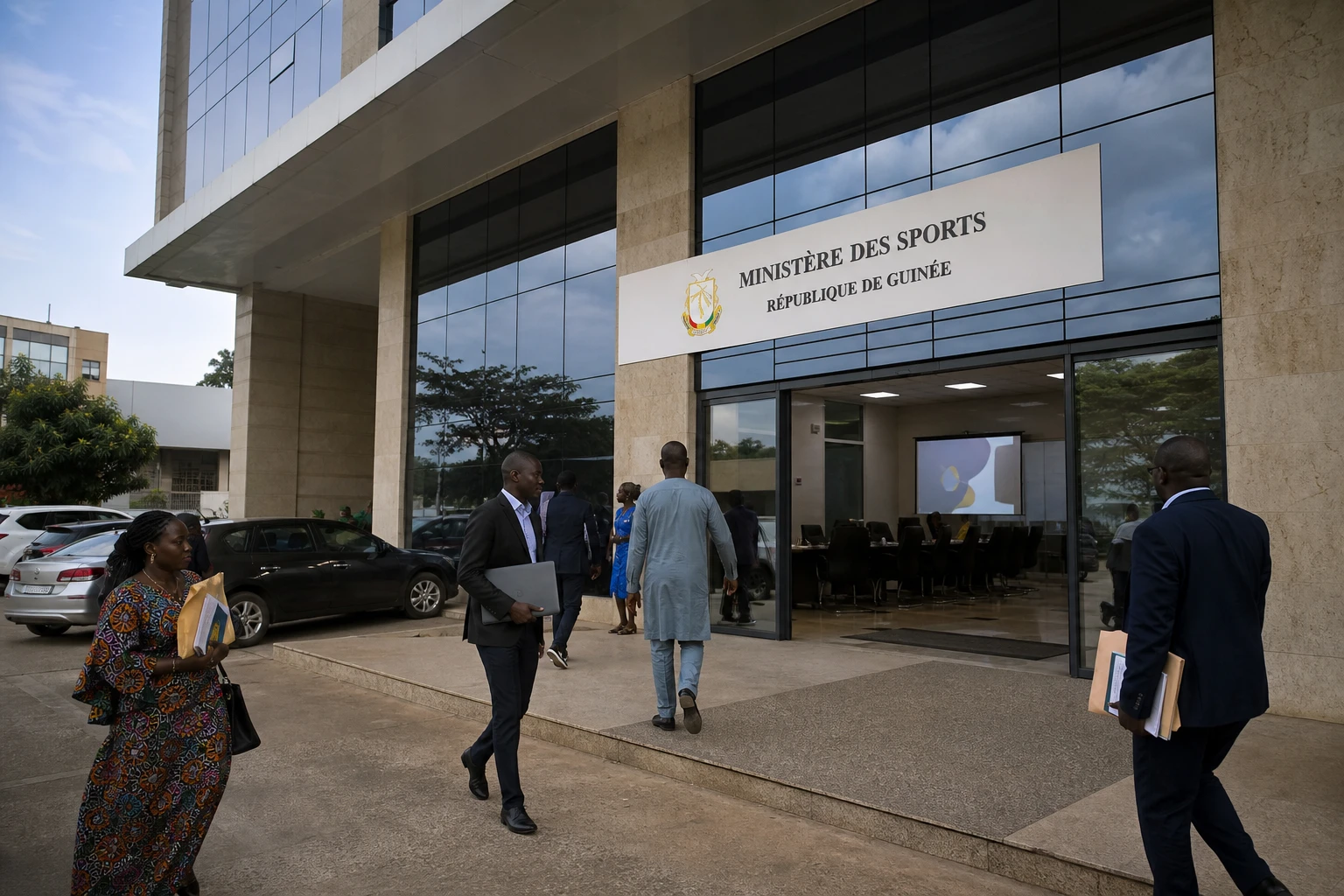
Guinea seeks a return to the game as African football takes shape
In Conakry, a bid to host the Africa Cup of Nations is about more than sport. It touches on the country’s image, the credibility of its infrastructure and its ability to meet a public timetable. For Guinea, the challenge is straightforward: turn a long delay into a demonstration of sound planning.
The timing is significant. On 3 July 2026, the Confederation of African Football opened the bidding process for the 2028, 2032 and 2036 editions of AFCON, under a framework described as more transparent and demanding. At the same time, the continental calendar was reorganised, with AFCON 2027 awarded to Kenya, Tanzania and Uganda.
In Guinea, this window has revived a longstanding bid. The sports minister said the country could not target 2028 and was now looking to 2032, or even 2036, given the level of preparation still required. He also set out a roadmap based on stadiums, airports, healthcare and roads, with the aim of using a longer lead time to secure the organisation of the tournament.
Conakry makes progress, but its safety margin remains narrow
The most tangible signal came from the 28 September Stadium in Conakry. On 15 August 2026, the Guinean Football Federation announced that CAF had granted the venue temporary Category 3 approval for September 2026. The decision paves the way for the return of international matches on home soil, after nearly five years of sporting exile outside Guinea.
The progress is nevertheless partial. Approval is time-limited, and FEGUIFOOT itself stressed the need for work to continue in order to achieve lasting compliance. In other words, Conakry has regained a playing field, but not yet a stadium that is fully fit for the long term.
It was against this backdrop that Prime Minister Amadou Oury Bah formally submitted the country’s bid, according to information released by the Ministry of Sports and the Prime Minister’s Office. The move follows a period in which the authorities made a series of announcements about infrastructure and administrative reform, as Guinea seeks to show that it can complete major projects.
The political significance is clear. National football remains a source of popular pride, but it is also a test of governance. When clubs and the Syli National play away from home, the impact goes beyond the stadium: lost local revenue, supporters kept at a distance, reduced visibility for host cities and greater logistical dependence. A return to home soil is therefore as much a matter of practical sovereignty as it is of sport.
A wider regional race, with the AES as a direct rival
Guinea’s bid is not being made in a vacuum. In the west of the continent, Burkina Faso, Mali and Niger, united in the Alliance of Sahel States, have already had their declaration of interest in AFCON 2032 approved in a stage recognised by CAF. Their move has been presented as a joint bid, backed by their football federations, with a meeting held in New York on 18 July 2026 in the presence of CAF president Patrice Motsepe.
The competition is revealing. Guinea is banking on the gradual development of its infrastructure and on its position at the centre of the sub-region. The AES, meanwhile, is advancing a bid rooted in collective assertion. In both cases, CAF now expects far more than political rhetoric: compliant stadiums, accommodation capacity, an efficient road network, operational airports and a credible security plan.
For the candidate states, the exercise goes beyond the competition itself. AFCON can accelerate projects that have been stalled for years, but it also lays bare the gaps between announcements and delivery. This is particularly true in Guinea, where several stadiums, airport expansions and new regional hospitals are already being discussed. The sports minister named Kankan, Kindia, Nzérékoré, Labé and Boké as pieces of the puzzle. The rationale is sound. The timetable remains the real constraint.
The fundamental question, then, is less about prestige than the country’s capacity to absorb the demands of the tournament. A well-prepared AFCON can stimulate the formal and informal economy, from construction to hospitality, urban transport and small businesses. But a poorly calibrated bid can also send the opposite message: that the state makes promises faster than it delivers. For Guinea, the shift will take place between 2026 and 2032, with particular scrutiny of the pace of construction, stadium compliance and budgetary choices.
At continental level, this case says something broader about African football. CAF wants hosts able to accommodate competitions that are more professionalised, better commercialised and more closely aligned with international standards. Guinea, a country with a strong football culture but still rebuilding its infrastructure, is seeking to show that it can join this cycle. If it succeeds, Conakry could once again become a sporting hub for West Africa. If it fails, the bid will chiefly highlight the persistent gap between political ambition and the real capacity to organise.