Algeria
 Egypt
 Libya
 Morocco
 Sudan
 Tunisia
 Benin
 Burkina Faso
 Cabo Verde
 Côte d'Ivoire
 Ghana
 Guinea
 Guinea-Bissau
 Liberia
 Mali
 Mauritania
 Niger
 Nigeria
 Senegal
 Sierra Leone
 The Gambia
 Cameroon
 Central African Republic
 Chad
 DR Congo
 Equatorial Guinea
 Gabon
 Republic of the Congo
 São Tomé and Príncipe
 Burundi
 Comoros
 Djibouti
 Eritrea
 Ethiopia
 Kenya
 Madagascar
 Malawi
 Mauritius
 Mozambique
 Rwanda
 Seychelles
 Somalia
 South Sudan
 Tanzania
 Uganda
 Angola
 Botswana
 Eswatini
 Lesotho
 Namibia
 South Africa
 Zambia
 Zimbabwe
A press case that goes beyond two names
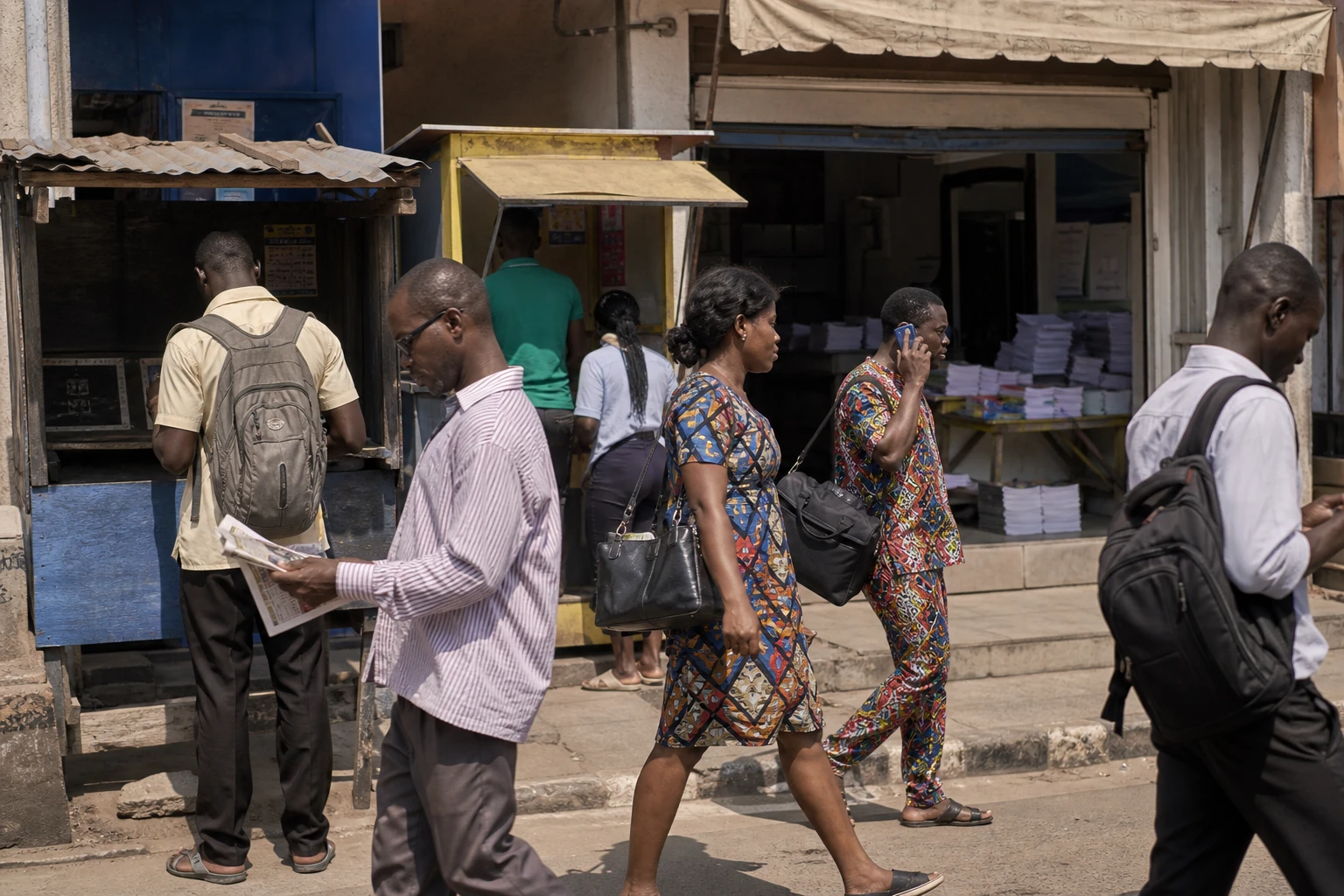
In Togo, an arrest rarely remains a simple procedural matter when it involves journalists or camera operators. In a country where the flow of information is closely monitored, the fate of two French filmmakers held since 27 July 2026 has quickly taken on political, diplomatic and symbolic significance. The case raises questions both about the methods of the Togolese authorities and about the space left for independent reporting in an already tense public sphere.
Togo is governed from Lomé by Faure Gnassingbé, who has been in power since 2005. The country belongs to ECOWAS, the Economic Community of West African States, which provides a regional framework for free movement, cooperation and, at times, the management of political crises. Since 2024, and even more so in 2025, however, the Togolese political scene has grown more tense around institutional reforms, protests and restrictions targeting several media outlets.
Against this backdrop, the case of the two French professionals is not an isolated one. It is part of a broader period in which the Togolese authorities have sent increasingly firm signals to critical voices, both local and foreign. It also serves as a reminder that in Togo, control of information has become a power issue in its own right.
What is known about the case
The two filmmakers were arrested on 27 July 2026 while working in the north of the country on a documentary for Les Routes de l’impossible, broadcast on France 5. According to information made public by their professional contacts, the shoot had been prepared and the journalists had visas matching their assignment. Paris said on 19 August that they were still being held and were the subject of a judicial investigation.
The initial allegations concerned suspected espionage, before a second charge, relating to their visas, was raised after several days in detention in Kara. This succession of grounds has fuelled doubts. A serious procedure should, in principle, rest on precise, consistent and verifiable facts. When the grounds change, political suspicion grows. This is a cautious interpretation, but one that is warranted by the information available.
Another sensitive element is the possibility, reported in several media and diplomatic circles, that the release of the two French nationals could be linked to the case of Togolese journalist Ferdinand Ayité, now living in exile in France. This information had not been confirmed by public official sources at the time of writing. It must therefore be treated as a possibility, not an established fact. But the fact that it is being discussed shows how much the case is seen as a possible instrument of pressure.
Ferdinand Ayité, a major precedent for press freedom
To understand the political weight of the case, it is necessary to look back at Ferdinand Ayité. The investigative journalist, founder of L’Alternative, has faced several legal proceedings following investigations and public comments critical of the Togolese authorities. In 2021, he and fellow journalist Joël Egah were arrested after an online broadcast. Reporters Without Borders denounced renewed pressure on their newspaper, which had already been sanctioned. The Committee to Protect Journalists, for its part, honoured Ayité in 2023 for his commitment to press freedom.
This precedent matters greatly. It shows that the Togolese authorities do not always treat criticism as an ordinary part of public debate, but at times as a threat to be contained. In this context, Ayité’s name has become a focal point for those who fear an informal prisoner swap, or a link being made between two cases with no direct legal connection. Here again, nothing allows this to be presented as a confirmed reality. The climate of mistrust, however, is undeniable.
Togo is not an isolated case in West Africa, where several states have recently tightened media controls in the name of security, stability or the fight against disinformation. But the repetition of these practices weighs on one essential point: whether journalists, be they Togolese, African or foreign, can work without being treated as hostile actors. This is no technical detail. It is a condition of the right to information.
A political signal in a country under strain
Since June 2025, the High Authority for Audiovisual and Communication has suspended RFI and France 24 for three months, citing breaches of impartiality and rigour. Several media outlets later reported that the sanction had not been clearly lifted within the announced timeframe. At the same time, the country has experienced significant political tensions, with protests and opposition to the constitutional reform that strengthened Faure Gnassingbé’s position.
This timeline sheds light on the case. When a state tightens its grip on international media, the arrest of reporters or filmmakers takes on particular significance. It sends a message to foreign newsrooms, but also to Togolese journalists: certain areas, subjects and images are becoming harder to cover. The effects are not limited to major news organisations. They also reach local crews, fixers, technicians, freelancers and journalists outside the capital.
The balance of power is also diplomatic. Paris is following the case closely, but with the caution required by a bilateral relationship already marked by tensions. In 2025, the two countries continued to cooperate on sensitive issues, particularly security, even as France reviewed its position in several West African countries. Togo, for its part, is seeking to establish itself as a useful regional partner, including as a foothold on Sahel-related issues. This dual logic explains a degree of public restraint, without dispelling the underlying tensions.
What this case says about Togo and the region
At the national level, the case exposes a recurring problem: the blurred boundary between state security, administrative control and political pressure. If the authorities have serious evidence, they should set it out clearly. If the case rests on a visa violation, they should explain why two professionals already authorised to film were initially accused of espionage. And if a link to Ferdinand Ayité exists, that would mean detention was being used for political purposes, representing a serious breach of the basic safeguards of the rule of law.
At the regional level, the episode concerns all of West Africa. ECOWAS is undergoing a period of realignment, amid the departure of some states, shifting alliances and the rise of security-focused rhetoric. In this context, press freedom has become a measure of governance. When a West African state tightens its media environment, it affects its neighbours by helping to normalise a harsher model of control. Conversely, swift and well-documented transparency could ease the crisis.
The next phase will be decisive. It will depend on procedural steps, the position of the Togolese prosecutor’s office, Paris’s stance and what happens next in the Ayité case, if a link is or is not confirmed. In the meantime, this case says something broader about Togo: a country where the authorities want to control the image they project, at the risk of turning information professionals into bargaining chips in a power struggle that is bigger than them.