Algeria
 Egypt
 Libya
 Morocco
 Tunisia
 Benin
 Burkina Faso
 Cabo Verde
 Côte d'Ivoire
 Ghana
 Guinea
 Guinea-Bissau
 Liberia
 Mali
 Mauritania
 Niger
 Nigeria
 Senegal
 Sierra Leone
 The Gambia
 Togo
 Cameroon
 Central African Republic
 Chad
 DR Congo
 Equatorial Guinea
 Gabon
 Republic of the Congo
 São Tomé and Príncipe
 Burundi
 Comoros
 Djibouti
 Eritrea
 Ethiopia
 Kenya
 Madagascar
 Malawi
 Mauritius
 Mozambique
 Rwanda
 Seychelles
 Somalia
 South Sudan
 Tanzania
 Uganda
 Angola
 Botswana
 Eswatini
 Lesotho
 Namibia
 South Africa
 Zambia
 Zimbabwe
A rapprochement built to last
In Khartoum, alliances are no longer measured solely on the battlefield. They are also forged through agreements, joint councils and diplomatic channels seeking to preserve what remains of the Sudanese state. In a country at war since April 2023, every bilateral mechanism is also a political signal: who supports stability, who stays in contact, and according to which priorities.
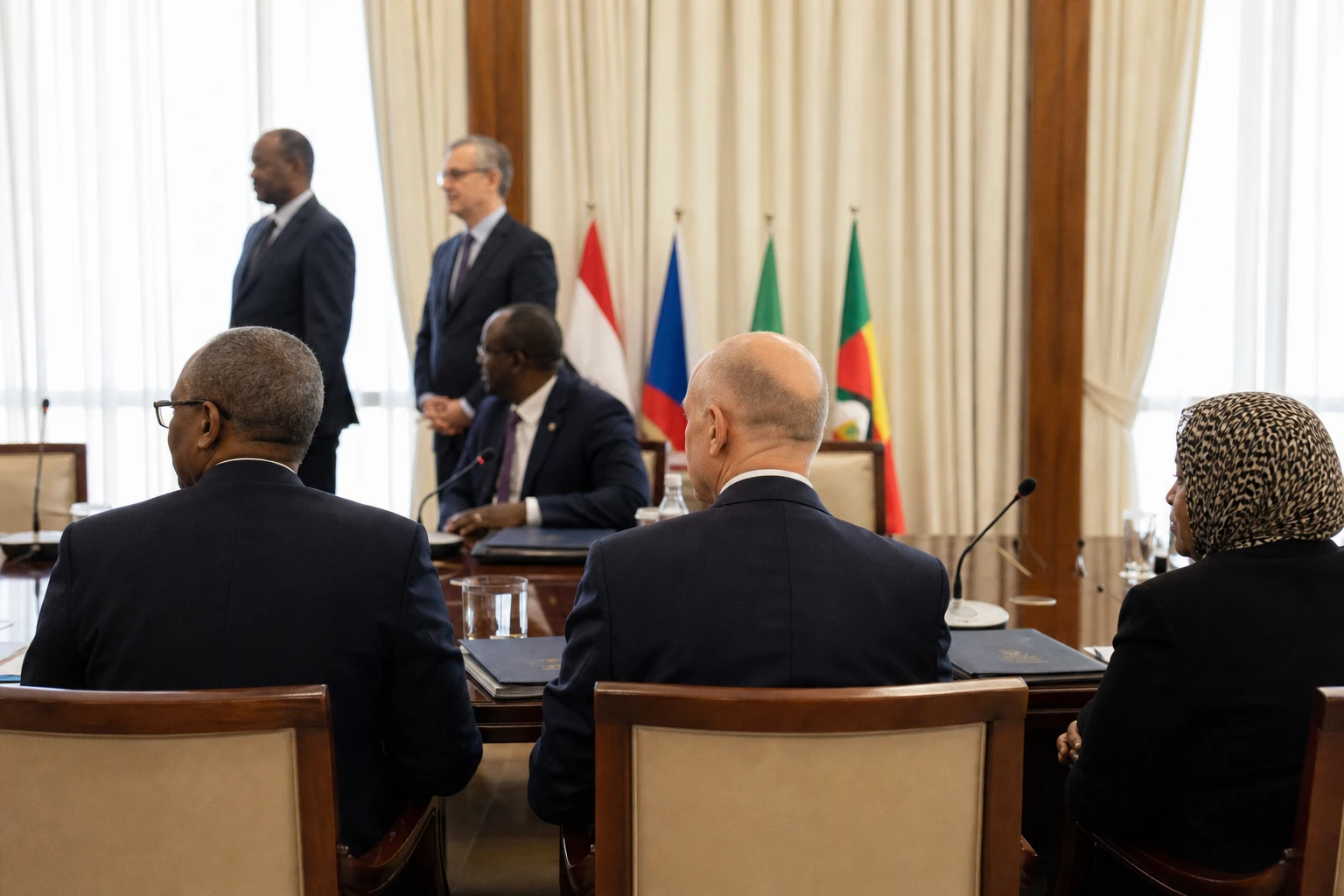
On 17 August 2026, Sudan and Saudi Arabia signed an agreement aimed at establishing a Supreme Council for Cooperation and Strategic Coordination. The idea is not new. It was revived in January 2026, when General Abdel Fattah al-Burhan, head of the Transitional Sovereignty Council and commander-in-chief of the Sudanese army, reorganised the bilateral body. In February 2026, the two sides again discussed the governance mechanisms for the future council in Riyadh.
What the agreement changes beyond its symbolism
The text signed on 17 August is part of a relationship that extends beyond the Sudanese crisis alone. Since the war began, Riyadh has established itself as a central diplomatic player. Saudi Arabia co-facilitated the Jeddah talks with the United States in 2023, and has repeatedly reiterated its support for Sudan’s unity, sovereignty and stability. In January 2026, a Saudi deputy foreign minister again stressed the need for a ceasefire and the preservation of Sudanese institutions.
According to details published ahead of the signing, the new council is expected to cover several economic and strategic issues, providing a more stable institutional framework for managing bilateral relations. Arabic-language sources have referred to around ten areas of work, ranging from investment and trade cooperation to political and security coordination. The method matters as much as the outcome: in a fragmented Sudan, a formal structure makes it possible to move beyond constant improvisation and ensure continuity in exchanges with a Gulf partner.
The stakes for the Sudanese authorities are clear. The economy has been devastated by the war, administrative systems have fractured, and access to external financing remains vital. For Riyadh, the goal is not solely humanitarian. Saudi Arabia is also seeking to contain instability along the Red Sea-Horn of Africa corridor, a strategic area for maritime trade and regional security. In April 2026, Burhan had already discussed regional stability and Red Sea security with Crown Prince Mohammed bin Salman in Jeddah.
This perspective sheds light on the current sequence of events. The bilateral council is not merely a piece of diplomatic window-dressing. It gives Saudi Arabia a more regular mechanism for monitoring the Sudanese situation. It also gives the Sudanese army’s camp a high-level political channel to a Gulf actor with financial resources, mediation capacity and considerable religious and diplomatic influence.
Sudan amid war, diplomacy and regional realignment
Sudan remains at the heart of a competition for influence that extends beyond its borders. The African Union, the Intergovernmental Authority on Development, Egypt, the United Arab Emirates, Saudi Arabia and the United States have all taken part, to varying degrees, in efforts to resolve the crisis. Gulf countries are also following the situation closely, as stability in Sudan affects trade routes, food flows and the security balance in the Red Sea.
In this context, the rapprochement between Khartoum and Riyadh has clear significance for Africa. It shows that a state at war does not disappear from the diplomatic arena; instead, it seeks to re-enter it through structured frameworks. It also shows that, in the face of protracted crises, African and Arab capitals are increasingly turning to hybrid formats that combine political, economic and security dimensions. Sudan, whose official capital is Khartoum, is thus seeking to preserve its levers of sovereignty at a time when the balance of power on the ground remains in flux.
The decisive question remains: will this council be an instrument of genuine stabilisation or merely another framework in a war that has yet to find an end? The answer will depend on its ability to deliver tangible results on financing, aid, political coordination and, above all, any prospect of a lasting ceasefire. For now, the signal from the two capitals is clear: they want to build a long-term relationship, even as Sudan continues to live through an unfinished transition and an open conflict.