Algeria
 Egypt
 Libya
 Morocco
 Sudan
 Tunisia
 Benin
 Burkina Faso
 Cabo Verde
 Côte d'Ivoire
 Ghana
 Guinea-Bissau
 Liberia
 Mali
 Mauritania
 Niger
 Nigeria
 Senegal
 Sierra Leone
 The Gambia
 Togo
 Cameroon
 Central African Republic
 Chad
 DR Congo
 Equatorial Guinea
 Gabon
 Republic of the Congo
 São Tomé and Príncipe
 Burundi
 Comoros
 Djibouti
 Eritrea
 Ethiopia
 Kenya
 Madagascar
 Malawi
 Mauritius
 Mozambique
 Rwanda
 Seychelles
 Somalia
 South Sudan
 Tanzania
 Uganda
 Angola
 Botswana
 Eswatini
 Lesotho
 Namibia
 South Africa
 Zambia
 Zimbabwe
When bauxite funds other mining ventures
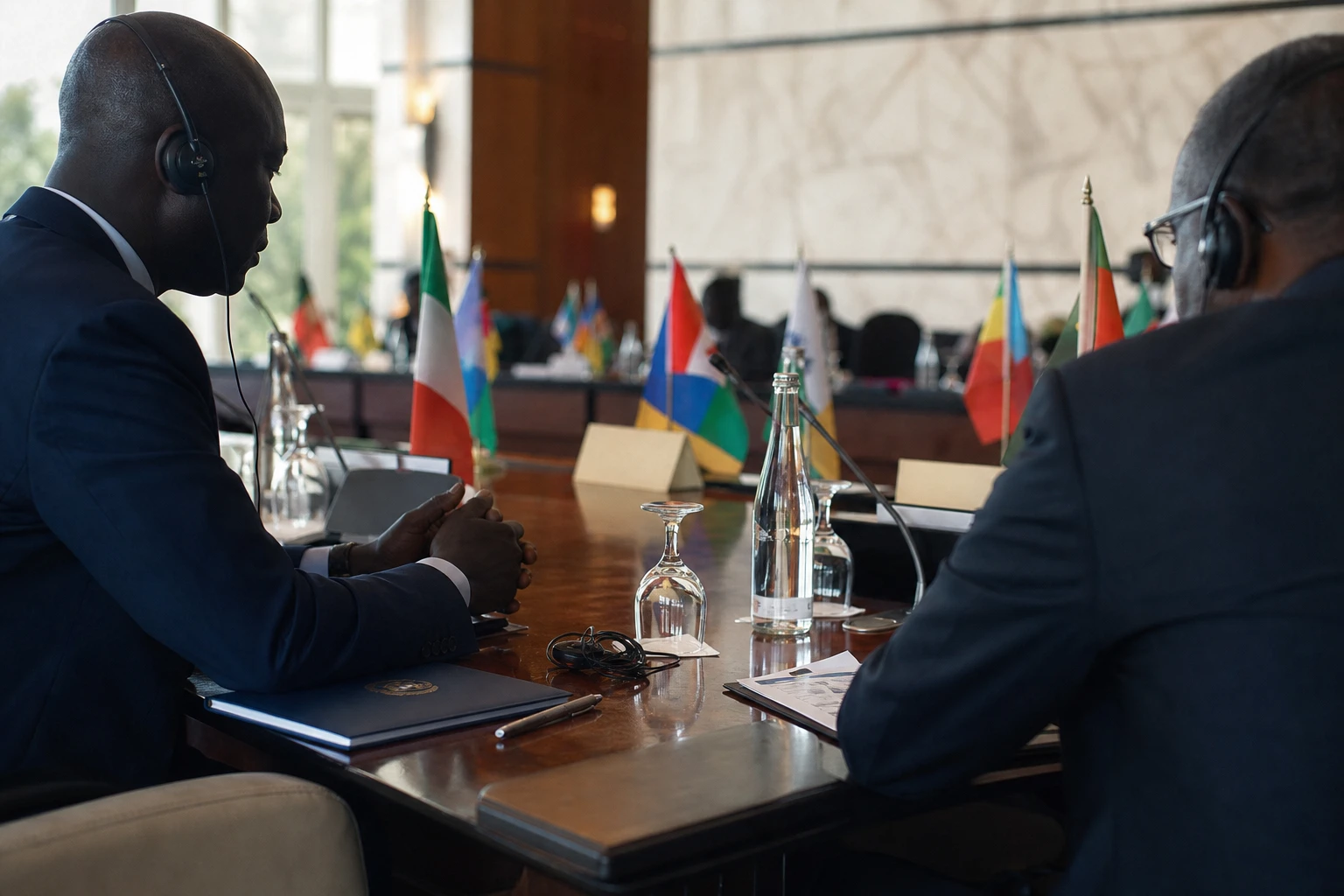
In Guinea, the question is no longer just how many tonnes of bauxite leave the ports. It is also what comes next. The country wants to turn its mining revenues into a lasting industrial tool, and state-owned Nimba Mining Company is now advancing on two fronts: consolidating its position in bauxite, then seeking other sources of growth, starting with gold. This approach forms part of the national strategy set out under Simandou 2040, which puts the upgrading of resources at the heart of Conakry’s economic agenda.
This is no minor shift. Guinea remains one of the world’s leading suppliers of bauxite, an ore essential to aluminium production. But several Guinean authorities now want to avoid letting a single commodity dictate the sector’s entire trajectory. The Guinea Investment Promotion Agency notes that an alumina refinery project is under way, a sign that local processing remains a stated objective. In this context, Nimba Mining’s diversification is not simply an addition to its portfolio. It is an attempt to build a broader, more resilient state-owned mining company that is less dependent on a single raw material.
A gold joint venture to test the model
On 13 August, Nimba Mining Gold, the subsidiary dedicated to Nimba Mining Company’s ambitions in gold, and Australian group Resolute Mining signed the articles of association for Landaya Gold, their equally owned joint venture. Based in Conakry, it is to assess and explore gold areas in Guinea and, if results allow, develop them. The step builds on a memorandum of understanding signed by the two partners in the spring. Resolute had then said it wanted to assess gold projects in Guinea alongside the Guinean state-owned company, with a joint structure envisaged within 90 days.
The timetable gives an indication of the approach: first a framework agreement, then an assessment phase, and finally the possible establishment of an investment vehicle. This sequence reflects a now-standard practice in mineral exploration: share the initial risk, map the geological potential, and decide what comes next only after the first technical results. Resolute confirmed in its quarterly updates that work on the joint venture with Nimba Mining was progressing in Guinea and that it was accompanied by applications for permits related to the project.
The announced budget for gold exploration, at $10 million a year, shows that the initiative is not symbolic. But the stakes go well beyond discovering a deposit. For Conakry, it is also about developing national expertise. Nimba Mining says it wants to become an integrated and diversified mining player, capable of covering several minerals. Its chief executive, Patrice L’Huillier, has already cited gold, base metals and even graphite among the resources targeted. This direction aligns with the authorities’ stated desire to create a more autonomous state-owned group, no longer confined to a single concession.
Bauxite remains the project’s financial base
Yet this diversification rests on a very concrete reality: bauxite pays the first bill. According to information published by Nimba Mining, the company had exported more than 4 million tonnes by the summer of 2026, after starting commercial operations in late 2025. The group was targeting 10 million tonnes in 2026, then 14 million in 2027, as part of a ramp-up described as gradual. These figures, reported by the authorities and the company itself, remain at the centre of its business model. Without these volumes, the gold subsidiary would not have the expected financial foundation.
The case also has institutional significance. Guinea’s presidency has described Nimba Mining as the first 100% nationally owned mining company, created in the wake of the withdrawal of the concession previously held by Guinea Alumina Corporation. The episode marked a turning point in relations between the Guinean state and foreign private operators. It also sent a clear message to the sector: access to resources now depends more heavily on compliance with the mining code and alignment with public policy. In an economy where mineral export revenues carry considerable weight, the question of national control is not theoretical. It affects the state’s ability to influence volumes, contracts and value chains.
For workers, subcontractors and production areas, the stakes are twofold. On the one hand, Nimba Mining’s expansion could support activity in the Boké region, along logistics corridors and at the port of Kamsar. On the other, diversification into gold will have no immediate effect on the ground. Exploration takes time and requires drilling, studies and financial decisions. Several years can pass between signing a joint venture and bringing a mine into production. That is why the announcement matters chiefly as a signal of intent: Guinea now wants to learn how to capitalise on its resources itself, rather than remain merely a transit point for cargoes.
A test for Guinea’s mining policy and the region
The Nimba Mining project extends beyond Guinea’s borders. In West Africa, ECOWAS is closely watching mining strategies that combine greater state control, foreign partnerships and efforts to add value locally. Guinea, for its part, is moving forward in an environment where raw ore is no longer enough as an ambition. Its neighbours are following this shift too, as competition now centres on exploration, processing and taxation, not just extraction. If Landaya Gold finds a deposit, the question will be whether Guinea can retain a significant share of decision-making and revenue along the value chain.
What happens next will depend on Nimba Mining’s ability to turn its bauxite revenues into patient capital and then into geological expertise. It will also depend on the stability of partnerships with groups able to provide technical expertise, financing and commercial networks. That is where the real test lies. If the strategy succeeds, Guinea could show that a producer state can move from guarding concessions to acting as a leading operator. If it fails, diversification will remain another slogan. For now, Conakry has chosen to open a new front, with gold as the first step and bauxite as its start-up capital.