
 Algeria
 Egypt
 Libya
 Morocco
 Sudan
 Tunisia
 Benin
 Burkina Faso
 Cabo Verde
 Ghana
 Guinea
 Guinea-Bissau
 Liberia
 Mali
 Mauritania
 Niger
 Nigeria
 Senegal
 Sierra Leone
 The Gambia
 Togo
 Cameroon
 Central African Republic
 Chad
 DR Congo
 Equatorial Guinea
 Gabon
 Republic of the Congo
 São Tomé and Príncipe
 Burundi
 Comoros
 Djibouti
 Eritrea
 Ethiopia
 Kenya
 Madagascar
 Malawi
 Mauritius
 Mozambique
 Rwanda
 Seychelles
 Somalia
 South Sudan
 Tanzania
 Uganda
 Angola
 Botswana
 Eswatini
 Lesotho
 Namibia
 South Africa
 Zambia
 Zimbabwe
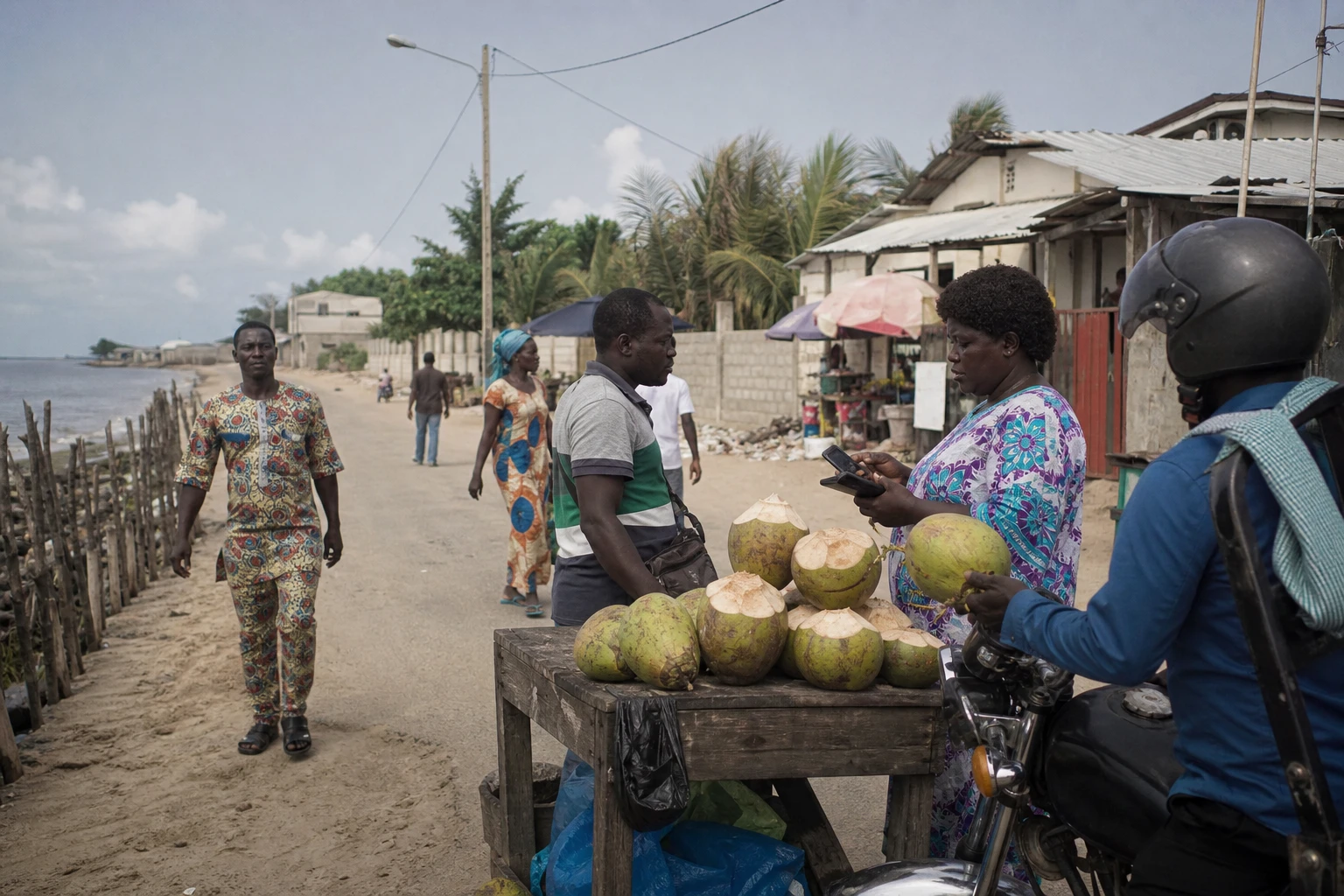
A coastline that still feeds people, but is shrinking
Along Ivory Coast’s coastline, coconuts are more than just a crop. They underpin incomes, protect sandy soils and support families who have lived for generations between the sea, the lagoon and expanding neighbourhoods. But this quiet economy is now caught between two forces advancing in tandem: the sea eating away at the beach and the city spreading towards the shore.
The issue goes beyond agricultural production alone. Ivory Coast has a 566-kilometre coastline, and more than two-thirds of it is affected by erosion, according to a World Bank note. At the same time, Abidjan is expanding rapidly, while urban growth has outpaced the provision of planning and protection. Coconut groves, too, are caught in this pressured space.
Pressure is visible between Abidjan, Jacqueville and Grand-Bassam
Southern Ivory Coast accounts for a significant share of coastal activity. The areas of Dabou, Jacqueville and Grand-Bassam are among those where coastal resilience projects have been launched or stepped up in recent months. In 2024, a four-year programme, funded to the tune of about 8.4 billion CFA francs, was officially launched to protect coastal communities in Ivory Coast and Ghana. In 2025, field missions confirmed the extent of the damage, including building collapses, population displacement and a decline in tourism- and fishing-related activities.
In this landscape, coconut groves play a very tangible role. They have long occupied Ivory Coast’s coastline, particularly in Alladian and lagoon areas. Academic research shows that these plantations once dominated the landscape, before entering a period of decline as plots were abandoned, trees aged and annual crops such as cassava took their place. Urbanisation is accelerating this shift by drawing development towards land near roads, beaches and centres of community life.
A valuable sector, weakened from within
The coconut industry remains strategic. In 2025, the Ivorian government said that Ivory Coast was Africa’s leading exporter of coconut products and by-products. That same year, an ordinance extended the remit of the Rubber and Oil Palm Council to include coconuts, with the aim of strengthening regulation, monitoring and the revival of the sector. This institutional signal matters: it shows that the state no longer treats the coconut palm as a secondary crop, but as a sector to be organised.
The challenge, however, is twofold. On the one hand, the sector suffers from a lack of plantation renewal and limited modernisation in some areas. On the other, producers are grappling with pressure on land, as coastal areas become more sought-after for housing, commercial activity and urban infrastructure. In this context, a coconut grove can be seen both as a source of income and as a potential land reserve and natural barrier against winds and sea spray.
This competition for land is critical for households. When a plot shrinks, income falls. When the beach disappears, the coconut palm’s protective function also weakens. Yet current resilience measures rely precisely on an approach that combines infrastructure, mangrove restoration and alternative livelihoods. In other words, the future of the coastline will not be decided by sea walls alone; it will also depend on trees, land use and planning choices.
What Ivory Coast’s case reveals across West Africa
Ivory Coast is not an isolated case. West Africa’s coastline is everywhere facing the combined effects of urbanisation, port infrastructure, rising sea levels and the loss of natural buffer zones. Regional programmes such as WACA, the West Africa Coastal Areas programme, reflect this shared reality. The response must therefore be regional as well as national, because water and sediment do not stop at administrative borders.
For Abidjan, the pressure is even greater. The metropolis accounts for a major share of the national economy, critical infrastructure and populations exposed to flooding and erosion. Protecting the coastline therefore matters not only to coconut growers, but also to transport operators, fishers, traders and households living by the sea. As beaches retreat, activities move with them. If coconut groves disappear, part of the local economy and the coastline’s natural protection will disappear too.
In this story, the real issue is time. Ivory Coast has already launched resilience projects, sector reforms and consultation mechanisms with Ghana, the Abidjan Convention and UN-Habitat. It remains to be seen whether these tools can be put into practice quickly enough in a landscape where the sea is advancing, housing developments are growing denser and coconut palms are ageing without always being replaced. This is where a part of the future of Ivory Coast’s coastline is being decided, in very concrete terms.



