Algeria
 Egypt
 Libya
 Morocco
 Sudan
 Tunisia
 Benin
 Burkina Faso
 Cabo Verde
 Côte d'Ivoire
 Ghana
 Guinea-Bissau
 Liberia
 Mali
 Mauritania
 Niger
 Nigeria
 Senegal
 Sierra Leone
 The Gambia
 Togo
 Cameroon
 Central African Republic
 Chad
 DR Congo
 Equatorial Guinea
 Gabon
 Republic of the Congo
 São Tomé and Príncipe
 Burundi
 Comoros
 Djibouti
 Eritrea
 Ethiopia
 Kenya
 Madagascar
 Malawi
 Mauritius
 Mozambique
 Rwanda
 Seychelles
 Somalia
 South Sudan
 Tanzania
 Uganda
 Angola
 Botswana
 Eswatini
 Lesotho
 Namibia
 South Africa
 Zambia
 Zimbabwe
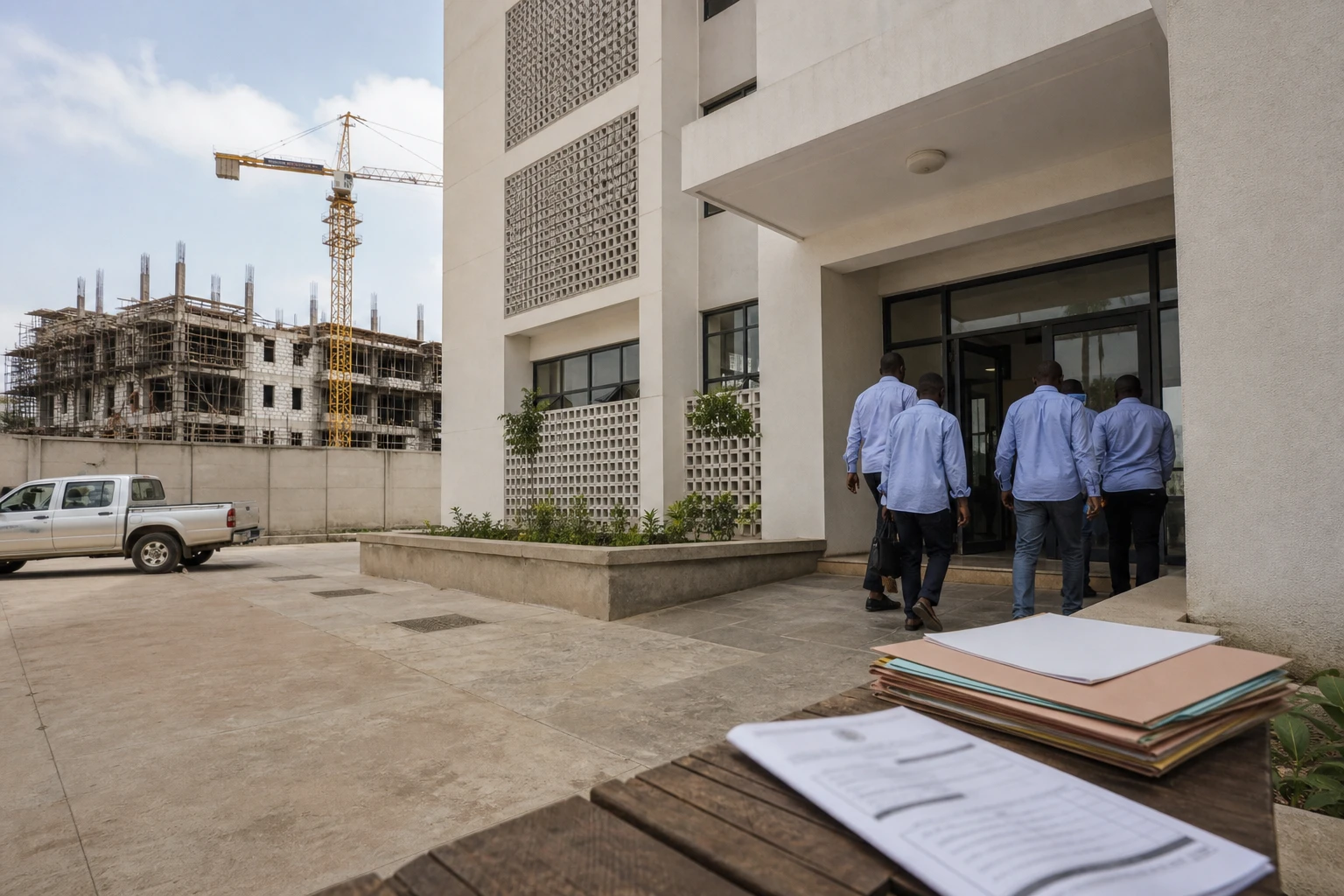
In Conakry, fragile construction sites are no longer just an urban planning problem
In the outskirts of Conakry, a building under construction collapsed in the middle of the night, reminding people that Guinea’s capital now faces a very practical question: who is really overseeing construction sites that spring up quickly, sometimes too quickly? In just a few weeks, the city has seen similar tragedies recur, with families trapped in buildings still under construction.
This latest collapse cannot be viewed as an isolated accident. It is part of a wider urban crisis in Conakry, where pressure on land, rapid densification and imperfect oversight of building permits are creating hazardous situations. Guinea remains an ECOWAS member, with Conakry as its capital and administrative centre, but managing urban space is becoming a matter of public safety as much as local politics.
The night-time tragedy and initial confirmations
According to information gathered at the scene and figures reported by several sources, the five-storey building collapsed during the night of Monday 10 to Tuesday 11 August 2026. The provisional toll stands at five dead and nine injured, who were taken to hospital. The victims included a nine-year-old girl, three teenagers and an elderly woman. These details were given in the first public account of the toll and later reported by local media.
At the scene, rescue workers spent several hours clearing the rubble and checking that no one else remained trapped beneath the debris. The minister responsible for housing visited the site with a fellow government minister. He said residents had been warned and told to evacuate the area, while expressing regret that some people had returned to shelter in the building at the time of the tragedy. This official account should be treated as such, as witnesses have spoken of cracks and signs of weakness before the collapse.
An account from a relative of the victims conveys the moment everything changed. A member of the bereaved family said the occupants were asleep at around 2am when the building gave way. This testimony, consistent with the time of the night-time disaster, does not resolve the questions surrounding the construction site itself: permits, the quality of materials, technical supervision and compliance with building regulations remain under scrutiny.
A recurring pattern raises questions about oversight
The most striking point is not only the death toll. It is the recurrence. Just weeks earlier, in June, another building collapse had struck the outskirts of Conakry, in the Lambanyi district. The Ministry of Urban Planning had then ordered evacuations within a 200-metre radius of the affected area and announced the demolition of buildings deemed dangerous. In July, a building under construction also collapsed in Kaporo, killing at least one person and injuring others, according to local sources.
This succession of tragedies shows that the problem goes beyond the sole responsibility of a property owner or contractor. It calls the entire chain into question: the granting of permits, monitoring of works, inspections, sanctions and land management. In Conakry, where urban expansion is moving faster than oversight capacity, residents of outlying districts are often the first to be exposed, while state technical services struggle to keep pace with a continuously expanding building stock.
The memory of a previous government response also remains. After two buildings collapsed in Matoto in July 2023, the prime minister’s office had already called for investigations and stronger oversight of construction sites in the Republic of Guinea. Three years later, the same words are being heard again, proof that the challenge is not simply to identify risks, but to ensure that rules are enforced over the long term in a capital where construction is growing under pressure.
What this tragedy says about Conakry, and urban Africa more broadly
The implications of this collapse extend beyond Guinea. Across West Africa, capitals are growing rapidly, with enormous needs for housing, roads and public infrastructure. ECOWAS, of which Guinea is a member, does not set national urban planning rules, but countries across the region face the same challenges: demographic pressure, informal construction, the cost of land and weak technical oversight. In Conakry, as elsewhere, the debate is not about choosing between development and safety. It raises a simpler question: how can construction proceed quickly without condemning residents to live in fear of a collapse?
For Guinea’s government, the issue is also political. After a series of urban incidents, every announcement of an evacuation or demolition is now judged by whether it is actually carried out. For families in Conakry’s outskirts, the immediate priorities remain clear: find survivors, bury the dead and understand why a building still under construction was able to collapse during the night. The authorities will need to go beyond repeated acknowledgements of the problem. Without audits of high-risk construction sites, visible sanctions and regular inspections, the next warning could once again turn into another tragedy.
In a capital such as Conakry, the quality of buildings has become a continental issue because it touches on the same equation everywhere: rapid urbanisation, local governance, residents’ safety and the credibility of the state. Guinea is therefore not facing just another accident. It is facing a test of state capacity, at a time when West Africa is seeking to build cities that are safer, better planned and more fit for their populations.