
 Algeria
 Egypt
 Libya
 Morocco
 Sudan
 Tunisia
 Benin
 Burkina Faso
 Cabo Verde
 Côte d'Ivoire
 Ghana
 Guinea
 Guinea-Bissau
 Liberia
 Mali
 Mauritania
 Niger
 Nigeria
 Senegal
 Sierra Leone
 The Gambia
 Togo
 Cameroon
 Central African Republic
 Chad
 Equatorial Guinea
 Gabon
 Republic of the Congo
 São Tomé and Príncipe
 Burundi
 Comoros
 Djibouti
 Eritrea
 Ethiopia
 Kenya
 Madagascar
 Malawi
 Mauritius
 Mozambique
 Rwanda
 Seychelles
 Somalia
 South Sudan
 Tanzania
 Uganda
 Angola
 Botswana
 Eswatini
 Lesotho
 Namibia
 South Africa
 Zambia
 Zimbabwe
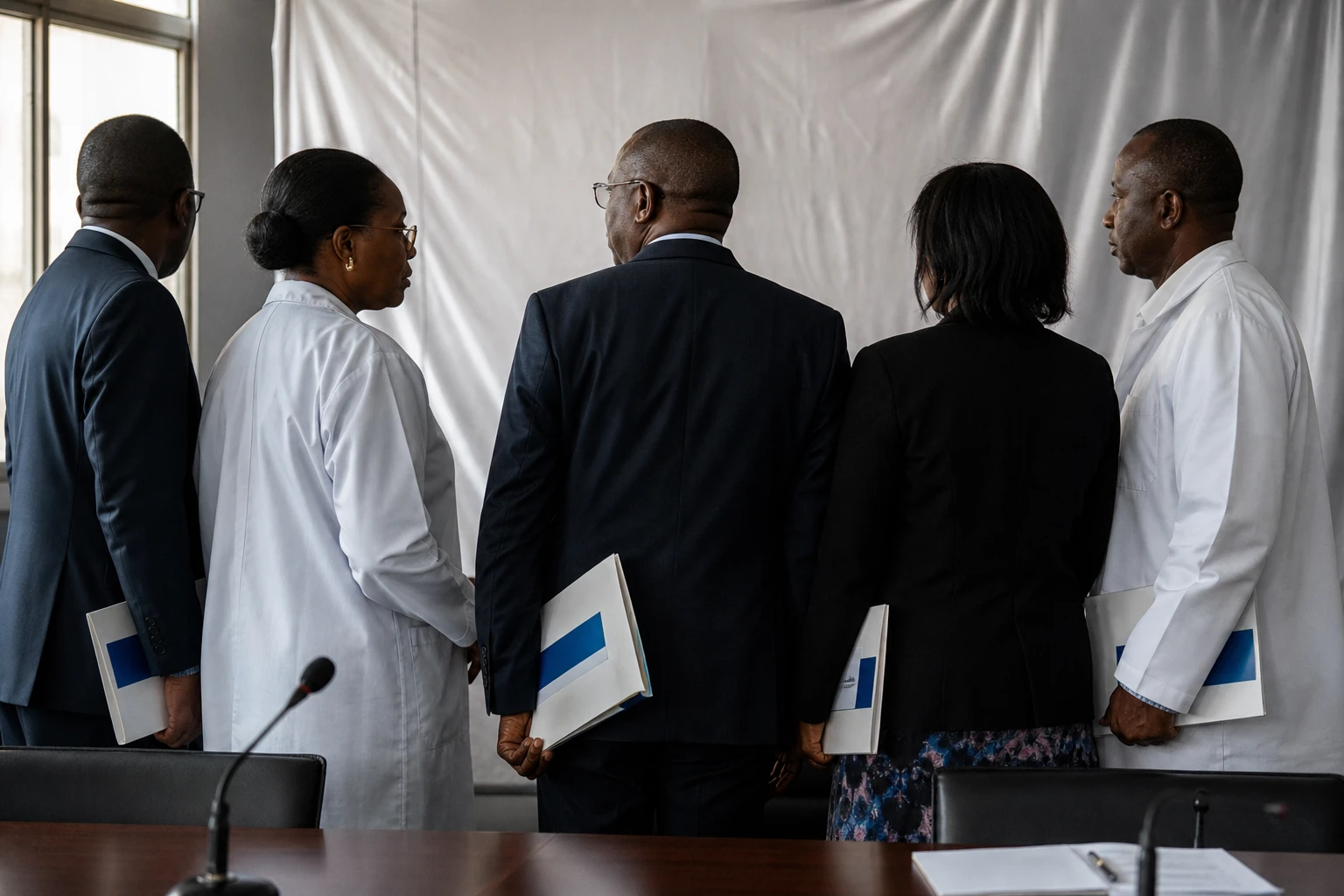
In Bunia, the fight against Ebola is not taking place only at patients’ bedsides
In the east of the Democratic Republic of the Congo, every day lost makes the response more difficult. Between health zones, population movements and mistrust fuelled by repeated emergencies, the health response must move fast, but also win people’s confidence. The challenge is no longer just to provide treatment. It is to test, compare and prove what really works on the ground.
Since 15 May 2026, Kinshasa and the WHO have been facing an Ebola outbreak caused by the Bundibugyo virus, declared in Ituri province before spreading to other areas in the east of the country. The WHO subsequently classified the event as a public health emergency of international concern, while Africa CDC declared it a continental public health emergency, a strong signal for the entire Great Lakes region.
An epidemic highlighting the fragility of health corridors in eastern DR Congo
DR Congo is no stranger to Ebola crises. The country has experienced several outbreaks, and the 2026 outbreak is part of a pattern marked by overstretched health systems, difficult distances to cover and populations sometimes cut off from care by insecurity. Ituri, North Kivu, South Kivu, Haut-Uele and Tshopo are among the provinces now reported to be affected.
The geography of the epidemic matters as much as the figures. The wider the alert spreads, the more complex contact tracing, ring vaccination and the isolation of suspected cases become. Africa CDC has advised against broad travel restrictions, arguing that they bring little public health benefit and further disrupt trade and essential services.
The facts: the WHO is pushing for clinical research, not a routine solution
The most important point is this: the WHO is not calling for Ervebo to be rolled out as the standard response to this outbreak. On the contrary, the organisation stresses that this vaccine, designed for Zaire ebolavirus, is not recommended for programmatic use against the Bundibugyo virus outside controlled research protocols. Experts convened by the WHO judged that evidence for possible cross-protection remains limited and inconclusive.
The organisation has also supported the launch of clinical trials to assess treatments and candidate vaccines suited to the strain involved. In May 2026, its expert groups recommended prioritising candidate vaccines specific to Bundibugyo and evaluating several potential treatments through research. On 2 July 2026, the WHO also announced that recruitment had begun in the PARTNERS trial in DR Congo to test antiviral treatments for the disease.
As of 15 July 2026, the WHO reported 2,124 confirmed cases and 828 deaths in DR Congo, with cases reported in 46 health zones across five provinces. Earlier, on 1 July, the organisation had already counted 1,460 cases and 452 deaths. The gap between these totals does not reflect a simple change in assessment: it reflects the expansion of surveillance, diagnosis and reporting during an outbreak that remains active.
Why a clinical trial changes the picture
From a medical perspective, a clinical trial may seem abstract. On the ground, it is a matter of survival. When there is no validated treatment for a given strain, comparing options within a scientific framework helps avoid improvisation and direct supplies, teams and protocols towards the most useful solutions. The WHO says there is currently no approved vaccine or treatment for Bundibugyo virus disease.
For Congolese health workers, research is therefore no academic luxury. It can speed up access to tools better suited to local realities. For families, it can also reduce uncertainty around a disease that is often initially mistaken for other serious fevers. This is precisely what complicates the first days of an outbreak: early symptoms are not specific, which can sometimes delay isolation and treatment.
The Africa Centres for Disease Control and Prevention and the WHO also stress a practical point: the response must remain compatible with routine health services. Closing facilities, diverting too many staff or blocking trade worsens communities’ vulnerability. The stakes go beyond Ebola. They affect trust in hospitals, continuity of care and the state’s ability to remain present in the eastern provinces.
A Congolese issue, but also a regional and pan-African one
The regional dimension is immediate. The outbreak in eastern DR Congo shares borders and patterns of movement with Uganda, Rwanda, Burundi and South Sudan. The alert has already led to imported cases and international notifications, showing that cross-border surveillance has become central. The African Union, through Africa CDC, has also placed the response within a continental framework, not just a national one.
For DR Congo, what happens next will depend on three levers. First, maintaining screening and rapid isolation in active health zones. Second, securing community acceptance of clinical protocols, without which even the best trial remains theoretical. Finally, coordinating the response with neighbouring countries to prevent gaps in the monitoring of cases and contacts. In a region where borders are also places where people live their lives, public health cannot operate in isolation.
What is at stake in DR Congo today therefore goes beyond the Ebola outbreak alone. It is a test of Africa’s ability to produce its own scientific evidence, organise responses suited to circulating strains and protect health systems without paralysing them. It is also a timely reminder: in Central Africa, health security is built as much in laboratories as in health centres, rural areas and cities in eastern DR Congo.



