Algeria
 Egypt
 Libya
 Morocco
 Sudan
 Tunisia
 Benin
 Burkina Faso
 Cabo Verde
 Côte d'Ivoire
 Ghana
 Guinea
 Guinea-Bissau
 Liberia
 Mali
 Mauritania
 Niger
 Nigeria
 Senegal
 Sierra Leone
 The Gambia
 Togo
 Cameroon
 Central African Republic
 Chad
 DR Congo
 Equatorial Guinea
 Gabon
 Republic of the Congo
 São Tomé and Príncipe
 Burundi
 Comoros
 Djibouti
 Eritrea
 Ethiopia
 Kenya
 Madagascar
 Mauritius
 Mozambique
 Rwanda
 Seychelles
 Somalia
 South Sudan
 Tanzania
 Uganda
 Angola
 Botswana
 Eswatini
 Lesotho
 Namibia
 South Africa
 Zambia
 Zimbabwe
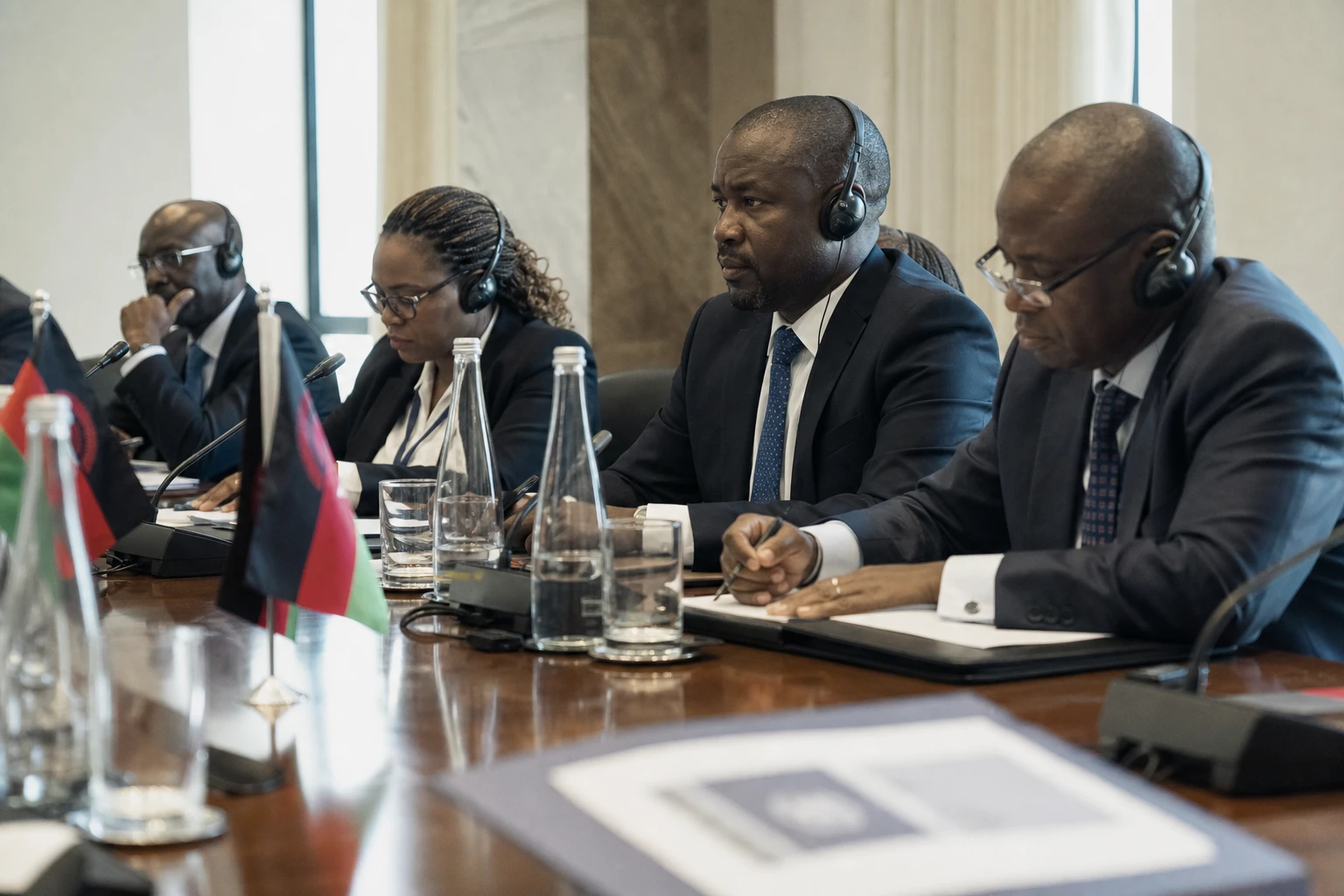
In Lilongwe, electricity security now also depends on the sun
In Malawi, every megawatt counts. When the grid falters, it is not only urban households that are affected, but also workshops, neighbourhood shops, pumping stations and small businesses that live with power cuts. In this landlocked country in southern Africa, electricity remains as much an economic driver as a public service, and dependence on hydropower still leaves the system exposed to falling water levels and climate-related disruptions.
Against this backdrop, the Malawian government is accelerating its efforts to diversify. The commissioning of the first phase of the Nanjoka solar project, in Salima district, is part of a broader programme to modernise the grid, alongside the Kanengo battery in Lilongwe and several projects aimed at making supply more flexible. The issue goes beyond generation alone: it concerns system stability, predictability for businesses and the state’s ability to meet its energy commitments.
What Nanjoka’s first phase will change
The first phase of the Salima solar project adds 10 MW to the capacity of EGENCO, the state-owned electricity generation company. The Nanjoka site was designed as an expandable plant, with capacity to be increased in stages to 50 MW. EGENCO announced a three-stage design in 2023, comprising 10 MW, then 10 MW, then 30 MW, on a 110-hectare site. Work began after the contract was awarded to Chint Electric Co. Ltd., with an 18-month schedule for the first phase.
The project is not happening in a vacuum. The Ministry of Energy says Malawi’s electricity remains predominantly hydropower-based, with installed capacity of about 398.39 MW in 2023, while EGENCO says it has total capacity of 444.67 MW, including 390.15 MW of hydropower, 53.22 MW of thermal power and just 1.3 MW of solar power before this latest addition. In other words, solar is growing, but from a very low base. That is precisely the imbalance Nanjoka is intended to address, by adding a more predictable source of power when dams generate less.
The project’s figures also point to a gradual industrial strategy. The announced cost of the first phase is $13.55 million, funded from EGENCO’s own resources. The overall plan is more ambitious: the government’s 2025 economic document refers to a 50 MW development at Nanjoka, with the first phase expected by December 2025, followed by successive additions to reach 50 MW by 2029. The timetable has slipped, but the direction has not changed: to make solar a pillar of public electricity supply.
A technical choice, but also a political and regional one
The plant’s significance extends beyond Salima. The district is becoming a link in a reshaping energy map spanning Lilongwe, the southern hydropower basins and new injection points on the grid. For households, the expected effect is straightforward: fewer interruptions and less strain on an already stretched system. For businesses, particularly those unable to afford generators, the stakes are even more tangible: better planning for production, refrigeration, digital services and pumping operations.
The Kanengo battery, commissioned in Lilongwe in July 2026, complements this approach. The government describes it as the country’s first standalone, grid-scale storage system, with a capacity of 20 MW/40 MWh. Its purpose is clear: to absorb fluctuations in solar generation, smooth supply and strengthen grid reliability. In practice, Nanjoka and Kanengo tell the same story from two different angles: generating power differently, then storing and distributing it more effectively. This combination has become central in several African countries seeking to integrate more renewables without undermining the grid.
The project also has a land and institutional dimension. The Malawian state has already made progress on compensation for communities affected at Nanjoka, following an environmental assessment approved in 2022 by the competent national authority. This matters because, in African energy projects, delays often stem less from technology than from access to land, compensation and coordination among government agencies, public operators and local communities. The Salima case therefore illustrates a simple truth: the energy transition is decided through land and budget files as well as speeches.
A development to watch across southern Africa
Malawi is a member of SADC, the Southern African Development Community, where states are seeking to secure electricity trade, share some infrastructure and become more resilient to climate shocks. In this regional context, progress at Nanjoka sends a useful signal: even with limited financial resources, a state can combine solar power, storage and interconnections to reduce its vulnerability. It is not a miracle solution. It is a credible, clear and replicable step.
For Malawi, what happens next will depend on three fronts. First, the ability to keep to the timetable for the next phases at Nanjoka. Second, the effective operation of Kanengo to stabilise the grid during peak demand and fluctuations in solar generation. Finally, these investments must translate into more regular electricity for urban areas and more remote communities, where the cost of power cuts weighs even more heavily on incomes. That is where the effectiveness of the energy strategy being pursued in Lilongwe and Salima will be measured.