Algeria
 Egypt
 Libya
 Morocco
 Sudan
 Tunisia
 Benin
 Burkina Faso
 Cabo Verde
 Côte d'Ivoire
 Ghana
 Guinea
 Guinea-Bissau
 Liberia
 Mali
 Mauritania
 Niger
 Nigeria
 Senegal
 Sierra Leone
 The Gambia
 Togo
 Cameroon
 Central African Republic
 Chad
 DR Congo
 Equatorial Guinea
 Gabon
 Republic of the Congo
 São Tomé and Príncipe
 Burundi
 Comoros
 Djibouti
 Eritrea
 Ethiopia
 Kenya
 Madagascar
 Malawi
 Mauritius
 Mozambique
 Rwanda
 Seychelles
 Somalia
 South Sudan
 Tanzania
 Angola
 Botswana
 Eswatini
 Lesotho
 Namibia
 South Africa
 Zambia
 Zimbabwe
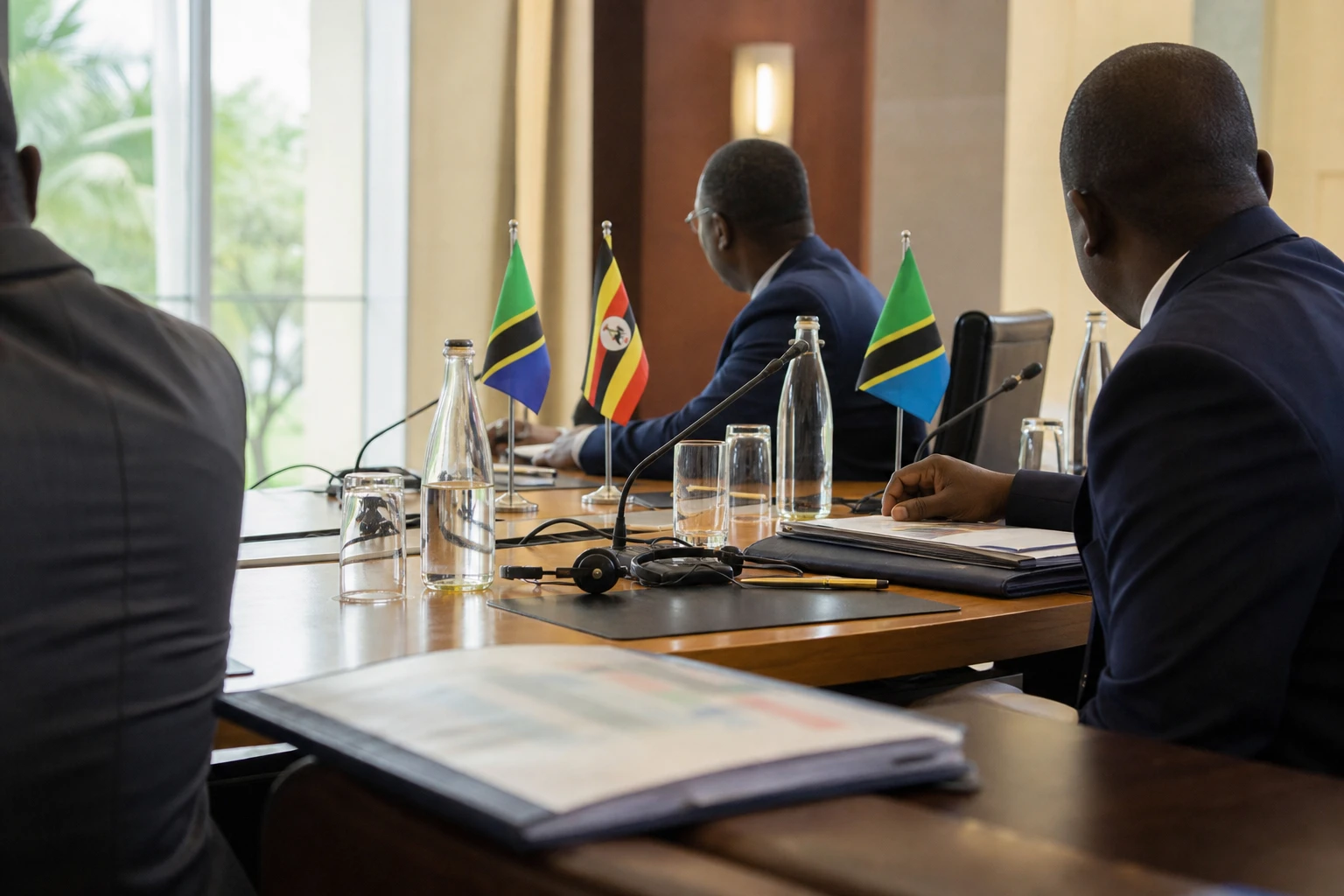
In Kampala, the question is no longer just how to produce oil, but how to move it without putting the country at risk.
For Uganda, the challenge is easy to state and difficult to solve: a barrel creates value only if it can reach a market and then return as fuel that is available and affordable. In a landlocked country, energy logistics are therefore as much a matter of economic sovereignty as of pipes, terminals and contracts. This is underscored by the rapprochement between Kampala and Dar es Salaam over Tanga, on Tanzania’s Indian Ocean coast.
This development forms part of a broader regional trajectory. East Africa is advancing through corridors, interconnections and agreements between member states of the East African Community (EAC), which is seeking to facilitate trade, energy and transport. Uganda is playing a strategic hand: securing both future crude exports and imports of refined products, as domestic demand continues to grow and supply routes remain vulnerable to regional tensions. Uganda’s energy ministry has also confirmed that deliveries continue to use several routes, including through Kenya and Tanzania, to reduce the risk of disruption.
The issue has gathered momentum in recent months. On 7 February 2026, following bilateral talks, Uganda’s presidency said the two heads of state had reviewed key energy projects, including the pipeline linking Hoima, in western Uganda, to the port of Tanga. The 1,443-kilometre infrastructure, known as EACOP, is intended to transport Ugandan crude to the Indian Ocean. Most of the route lies in Tanzania, which explains Tanga’s growing importance in Kampala’s calculations.
Tanga is becoming a hub, not merely an outlet for crude.
The new memorandum of understanding discussed in Dar es Salaam goes beyond exports. It covers an energy hub in Tanga, with storage, refining, distribution and logistics facilities. In other words, the Tanzanian city would no longer be just the terminus of a crude oil pipeline, but a regional platform capable of handling flows, redistributing petroleum products and serving as an interface between several landlocked countries in East Africa. Uganda’s public broadcaster reported in January 2026 that a maritime terminal at Chongoleani had been inspected, describing it as a milestone for the EACOP project.
This shift makes economic sense. Uganda still imports most of its petrol, diesel and kerosene. In May 2026, the energy ministry confirmed that UNOC, Uganda’s national oil company, relies on its partner Vitol to secure supplies from several sources around the world, including West Africa, Europe, India and the Americas. The ministry also stresses the need to maintain sufficient stocks and ensure continuity of deliveries through Kenya and Tanzania. This shows that future domestic crude production alone will not be enough to resolve dependence on fuel imports.
The crux of the problem is the gap between production and processing. The refinery planned at Kabaale in western Uganda is not expected to be ready as soon as oil production begins. As a result, the country may export crude before it has a fully operational domestic refining chain. That is why Tanga is of interest: at least in the interim, it could act as a regional pressure valve. This is a pragmatic response, but also a way to reduce reliance on Mombasa and the Kenyan corridor, through which Uganda has long transported more than 90% of its imported fuel.
The partnership with Vitol also illustrates the role of private players in the region’s new energy geography.
Vitol’s presence is central to this issue. Through its Bahrain-based entity, the company is already a key supplier of petroleum products to Uganda and has strengthened its position by providing financing to UNOC. Official communications from the Ugandan company say an agreement worth up to $2 billion has been executed to finance strategic national infrastructure, while UNOC has also acquired a stake in Kenya Pipeline Company. This points to a growing role for a global private operator in a chain combining supply, credit, transport and storage.
This concentration raises questions about the balance of power, although public documents do not allow us to conclude that it is inherently problematic. What can be said, however, is that the emerging model relies on a small number of players able to bring together financing, expertise and commercial networks. For Kampala, this speeds things up. For regulators, it calls for greater scrutiny of costs, competition and transparency. For the public, the stakes are more tangible: prices at the pump, stability of supply, and the country’s ability to turn its resources into public services and industrial activity.
The implications extend beyond Uganda. Rwanda, too, has begun using Tanga to diversify its supplies, with the first direct fuel shipment expected in summer 2026, according to the Kigali press. Tanzania is thus positioning itself as the region’s energy crossroads, while the Uganda-Tanzania electricity interconnection project, backed by the World Bank, adds another layer to this integration. In East Africa, energy infrastructure is no longer just laying out trade routes: it is reshaping dependencies, negotiating leverage and the way landlocked states seek to secure their industrial future.
What happens next will depend on a precise timetable. The concrete implementation of the Dar es Salaam memorandum, progress on the Tanga terminal, the phased commissioning of EACOP-related infrastructure and Uganda’s ability to bring together crude exports, domestic refining and local supply will all need to be monitored. For Kampala, the challenge is not simply to produce oil. It is to build a regional chain robust enough to make this resource a lasting lever, rather than another disguised dependency.