
 Algeria
 Egypt
 Libya
 Morocco
 Sudan
 Tunisia
 Benin
 Burkina Faso
 Cabo Verde
 Côte d'Ivoire
 Ghana
 Guinea
 Guinea-Bissau
 Liberia
 Mali
 Mauritania
 Niger
 Nigeria
 Senegal
 Sierra Leone
 The Gambia
 Togo
 Cameroon
 Central African Republic
 Chad
 Equatorial Guinea
 Gabon
 Republic of the Congo
 São Tomé and Príncipe
 Burundi
 Comoros
 Djibouti
 Eritrea
 Ethiopia
 Kenya
 Madagascar
 Malawi
 Mauritius
 Mozambique
 Rwanda
 Seychelles
 Somalia
 South Sudan
 Tanzania
 Uganda
 Angola
 Botswana
 Eswatini
 Lesotho
 Namibia
 South Africa
 Zambia
 Zimbabwe
A journey that says more than fatigue
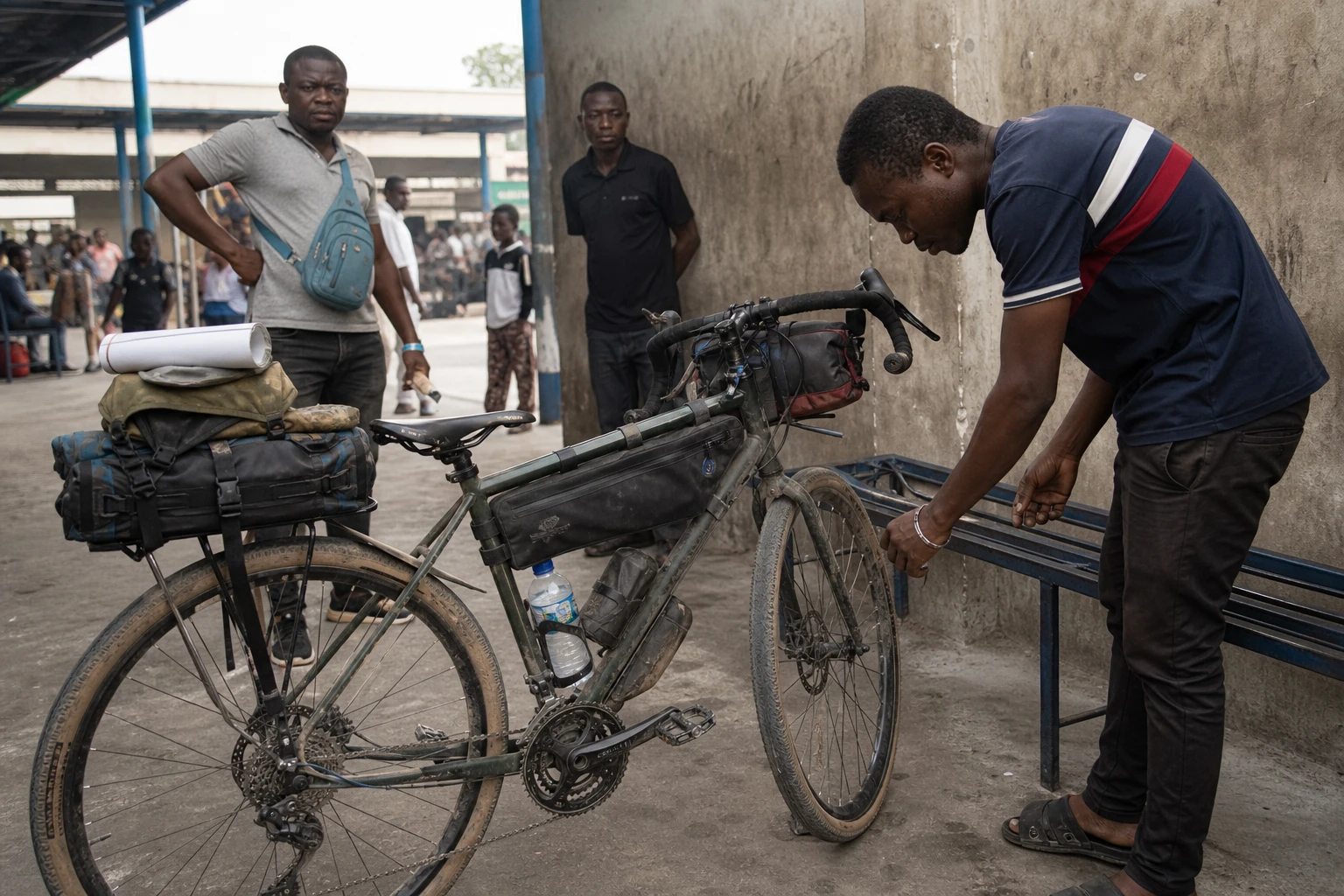
In Kinshasa, the arrival of a cyclist from the east of the country did more than mark the end of a sporting stage. Above all, it was a reminder that in the Democratic Republic of the Congo, travel can become a political language, and a bicycle a tool for telling a national story. Miguel Masaisai, a young Congolese man from Goma, reached the capital after a long journey by bike that began on 1 May 2026.
His journey took on particular significance because it unfolded in a DR Congo where the east remains marked by insecurity, forced displacement and unfinished peace negotiations. Goma, in North Kivu, remains at the heart of this equation, caught between everyday life, civic mobilisation and security pressures. The city is now at the centre of the crisis pitting Kinshasa against the AFC/M23, while local peace initiatives seek to maintain links between Congolese territories.
From Goma to Kinshasa, then on to Rabat
Miguel Masaisai’s challenge was conceived in two stages. First, an internal journey of around 6,700 kilometres between Goma and Kinshasa, completed in 67 days. Then a far more ambitious goal: to connect Goma to Rabat, Morocco, covering more than 14,000 kilometres in total. Radio Okapi had already presented the «Pedals for Peace» project in June as a route set to pass through Lubumbashi, before continuing towards southern Africa and the rest of the continent.
The cyclist explained that the journey was a response to what he experienced and observed in the east of the country. In his own words, he wanted to show that Congo «is not only about war». The phrase sums up the significance of his endeavour: to convey the scale of the challenges without reducing DR Congo to violence alone. The previous year, he had already attempted a Goma–Cape Town route, a sign of how, for him, a sporting pursuit has become an act of bearing witness.
A welcome in Kinshasa that goes beyond sport
When he arrived in the Congolese capital, the welcome Miguel Masaisai received went beyond the world of sport. Kinshasa saw his arrival as a moment of coming together, at least symbolically, around a young man who had linked provinces often viewed through their divisions rather than their solidarity. This kind of initiative resonates particularly in a city where civic, artistic and sporting expression often serves as a bridge between the political centre and the country’s periphery.
The physical toll, however, is very real. The cyclist said he had travelled through Rwanda, Tanzania and Zambia before entering through Kasumbalesa, then passing through Lubumbashi, Likasi and Kolwezi. This cross-border route also shows the practical realities of movement in central and southern Africa: borders to negotiate, permits to obtain, and distances that demand stamina and logistical planning. His route had to be changed because he did not have an Angolan visa, a reminder of how pan-African projects often remain dependent on travel regulations.
Peace, youth and the country’s image
In DR Congo, Miguel Masaisai’s initiative joins a series of public expressions that associate young people with peace, social cohesion and the rebuilding of national ties. In Goma, campaigns for non-violence, peace murals and cultural mobilisations show that part of Congolese society refuses to be defined solely by conflict. Masaisai’s bicycle belongs to this same civic vocabulary, with a simple message: move forward, connect, show.
For people in the east, the message carries different weight depending on their circumstances. In areas affected by fighting, the idea of a united country remains weakened by displacement and the disruption of normal life. In major cities such as Kinshasa, by contrast, the journey can be seen as proof of resilience and individual initiative. Between the two, the provinces crossed by the cyclist are a reminder that DR Congo is also held together by its roads, businesses, stops, welcomes and human connections.
A regional resonance beyond DR Congo’s borders
Miguel Masaisai’s project is therefore about more than sporting achievement. It touches on a central question for Africa: how to connect places, peoples and economies when visas, conflicts and administrative borders still hamper pan-African ambitions. His journey towards Rabat is a small-scale reminder of the promises of the African Continental Free Trade Area, which aims precisely to facilitate trade and mobility across the continent.
For DR Congo, this story also comes at a time when peace efforts in the east remain under close scrutiny from regional and international actors. Kinshasa, Goma, Kigali, the capitals of the Great Lakes region and continental organisations are following still-fragile dynamics. In this context, a cyclist can sometimes convey more quickly than an official speech the idea that a country in crisis continues, despite everything, to produce acts of unity and outward-looking ambition.



