Algeria
 Egypt
 Libya
 Morocco
 Sudan
 Tunisia
 Benin
 Burkina Faso
 Cabo Verde
 Côte d'Ivoire
 Ghana
 Guinea
 Guinea-Bissau
 Liberia
 Mali
 Mauritania
 Niger
 Nigeria
 Senegal
 Sierra Leone
 The Gambia
 Togo
 Cameroon
 Central African Republic
 Chad
 DR Congo
 Equatorial Guinea
 Gabon
 Republic of the Congo
 São Tomé and Príncipe
 Burundi
 Comoros
 Djibouti
 Eritrea
 Ethiopia
 Madagascar
 Malawi
 Mauritius
 Mozambique
 Rwanda
 Seychelles
 Somalia
 South Sudan
 Tanzania
 Uganda
 Angola
 Botswana
 Eswatini
 Lesotho
 Namibia
 South Africa
 Zambia
 Zimbabwe
As the water advances, daily life retreats
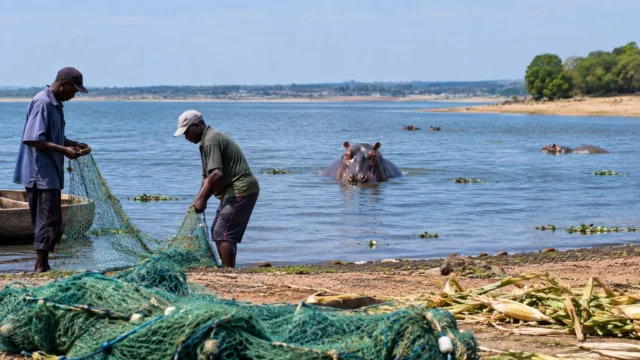
In Kenya’s Rift Valley, rising waters are no longer just a matter of a flooded map. They are changing how people live, travel, teach and protect their families. Around Lake Baringo, about 200 kilometres north-west of Nairobi, homes, schools and tourist sites now stand right beside the water, sometimes just a few metres from hippos and crocodiles. This is part of a broader trend in Kenya, where levels in several Rift Valley lakes have remained very high after exceptional rains linked to El Niño and recent climate variability.
Kenya is not facing an isolated incident, but an environmental shift that is also affecting the local economy. The Rift Valley is home to lakes, reserves, grazing land, roads and tourism activities. When the water advances, it reaches homes, classrooms, clinics, farms and visitor-dependent incomes all at once. The problem is therefore both ecological and social. It also has a regional dimension, as the Rift Valley lakes form a connected system closely monitored by Kenyan institutions and by African and international frameworks for wetland protection.
Lake Baringo: immediate danger and a disrupted ecosystem
In Baringo County, wildlife and civil protection authorities describe a transformed landscape. The Kenya Wildlife Service says the growing proximity of the water to homes has increased encounters with crocodiles and hippos. This is not necessarily because there are suddenly more animals, but because their habitat and that of people overlap more. This assessment is consistent with recent observations of Kenya’s Rift Valley lakes, whose surface areas have expanded since 2010.
Lake Baringo also illustrates a longer-standing vulnerability. Climate studies and reports show that Kenya’s Rift Valley lakes have risen markedly over the past 15 years, with levels sometimes exceeding previous records. The Kenya Meteorological Department recorded 2023 as the hottest year ever observed in the country, with irregular rainfall, drought episodes and severe flooding in different areas. In 2024, water levels remained very high in several basins, including in the Rift Valley.
This trend has very tangible effects. Families are displaced, sometimes more than once. Schools are operating under strain. Hotels have been abandoned or partly submerged. Community reserves have lost some of their land. One of the most pressing concerns is children’s safety. On some islands and along some shores, schools have had to step up night-time monitoring because hippos and crocodiles are moving closer to buildings.
Bogoria: fragile biodiversity and tourism under pressure
Lake Bogoria, next to Lake Baringo, is a site of international importance. It is listed under the Ramsar Convention on wetlands and recognised as a key area for waterbirds, especially lesser flamingos. The site is also home to hippos and other vulnerable species, in a balance that depends on very particular water chemistry. When water levels rise, that chemistry changes. The algae that flamingos feed on become scarcer, and the birds move elsewhere.
The Kenya Wildlife Service recently said that the Rift’s major bird sites have been profoundly reshaped. At Bogoria, the lake’s surface area has increased substantially compared with its historical average, while Baringo has also continued to expand. This shifting water undermines tourist attractions, as well as the income chains that depend on them: guides, hoteliers, transport operators, local vendors and community-based operators. Tourism here is no longer a supplementary activity; it has become a matter of local economic resilience.
Kenya’s climate data show that the disaster is not caused by seasonal rainfall alone. It is part of a chain of events: intense precipitation, soil erosion, sediment carried into lakes and already vulnerable basins. Researchers have also stressed that rising Rift Valley lakes are driven by several interlocking factors, including climate, geology and land use. In other words, the water is rising fast, but the public response must also become more sophisticated.
What this says about Kenya today, and East Africa
The Baringo-Bogoria case goes beyond the question of wildlife. It raises an issue of land-use planning. Where should people build, where should they be resettled, where should water be allowed to flow, and how can livelihoods be protected without leaving people stuck in limbo? In rural areas, relocation does not carry the same cost as it does in cities. It involves land, livestock, access to water, schooling and a sense of place. For poorer households, moving a second time may become impossible.
Kenya also faces a governance challenge. The response cannot depend on a single institution. It requires coordination among the Kenya Wildlife Service, county authorities, meteorological services, water managers, education officials and local communities. This is precisely the kind of challenge that regional frameworks, such as the East African Community, and continental initiatives on climate and wetlands are seeking to address more effectively, since climate pressure respects neither administrative borders nor electoral timetables.
Across the continent, the Kenyan case echoes other African front lines: rising lakes, eroding coastlines, displaced schools and species changing their refuges. The IPCC report notes that Kenya’s Rift Valley lakes have already exceeded historical levels, and UN analyses show that water extremes become more destructive when ecosystems are already weakened. The future of Baringo and Bogoria will therefore be a useful test for the whole region: can communities be protected without disrupting the ecological balance that sustains these areas?