Algeria
 Egypt
 Libya
 Morocco
 Sudan
 Tunisia
 Benin
 Burkina Faso
 Cabo Verde
 Côte d'Ivoire
 Ghana
 Guinea-Bissau
 Liberia
 Mali
 Mauritania
 Niger
 Nigeria
 Senegal
 Sierra Leone
 The Gambia
 Togo
 Cameroon
 Central African Republic
 Chad
 DR Congo
 Equatorial Guinea
 Gabon
 Republic of the Congo
 São Tomé and Príncipe
 Burundi
 Comoros
 Djibouti
 Eritrea
 Ethiopia
 Kenya
 Madagascar
 Malawi
 Mauritius
 Mozambique
 Rwanda
 Seychelles
 Somalia
 South Sudan
 Tanzania
 Uganda
 Angola
 Botswana
 Eswatini
 Lesotho
 Namibia
 South Africa
 Zambia
 Zimbabwe
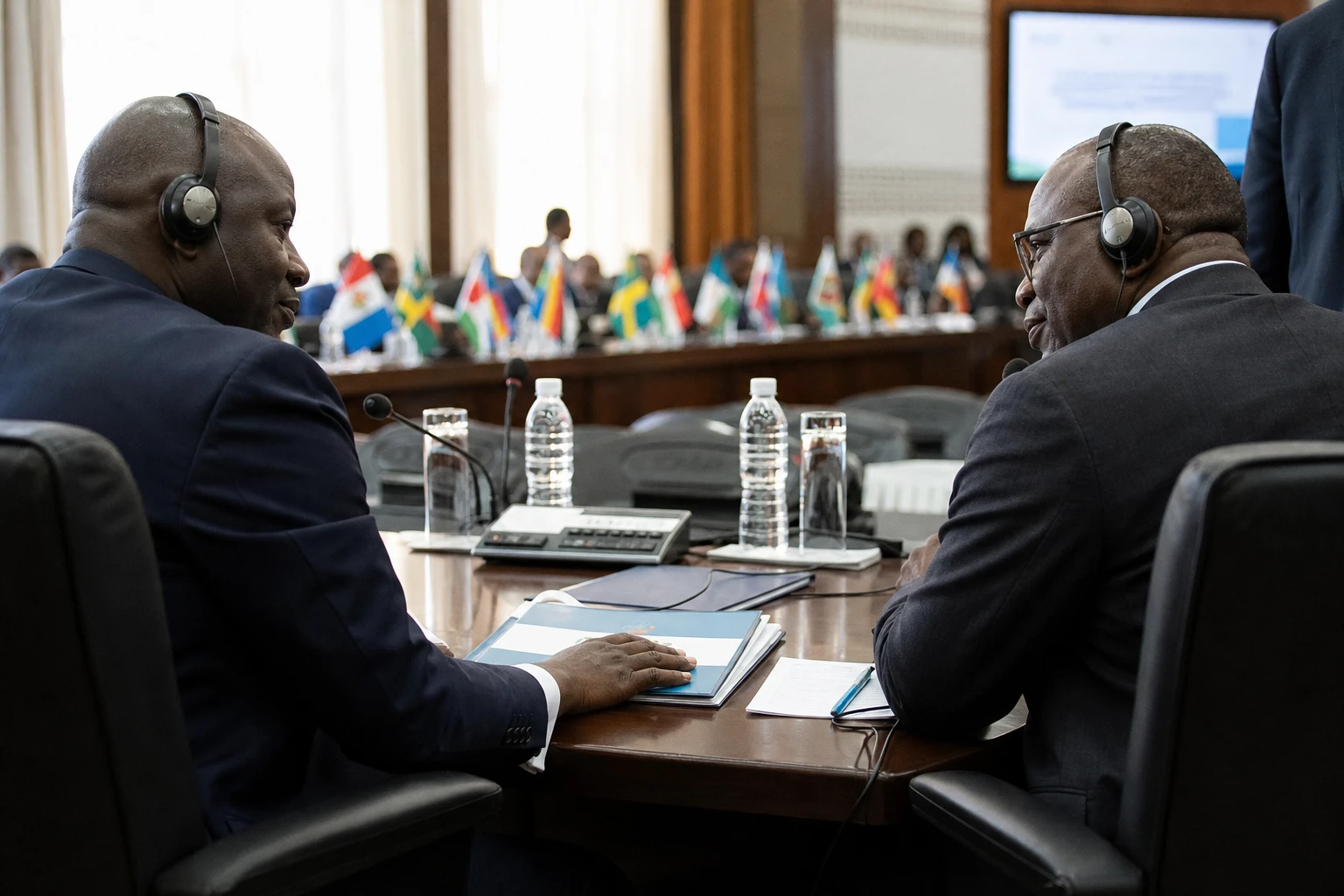
In Conakry, young people are no longer a peripheral issue
In Guinea, the question of young people goes beyond a ministry. It concerns jobs, training, sport, entrepreneurship and the role of cities in an economy being reshaped. In a country where most of the population is young and social expectations remain high, every announcement in this area is read as a political as well as an administrative signal.
This context matters. In Conakry, the authorities now present Simandou 2040 as the national development framework for 2026-2040. The text, adopted in March 2026 by the National Council of the Transition, sets out an initial acceleration phase for 2025-2030 worth more than $65 billion, with priorities including infrastructure, energy, agriculture, education and tourism. The project is therefore no longer just about mining. It is the backbone of a broader vision.
Béa Diallo’s return says something about Doumbouya’s approach
On 27 July 2026, Guinea’s presidency announced the new composition of the government. Lansana Béa Diallo is named as Minister for Youth, while Cellou Baldé takes the Sports portfolio. The choice confirms a clear separation of the two portfolios, after several months of institutional adjustments in the sector.
Béa Diallo is no stranger to Conakry. In November 2021, he was appointed Minister for Youth and Sports in the transitional government. In March 2024, he left the portfolio in a reshuffle. His return three years later, this time with responsibility solely for youth, shows that the authorities want to give the area greater political and programmatic weight.
His background matters. A former MP and local elected official in Belgium, entrepreneur and sports figure, Béa Diallo brings rare diaspora experience to the Guinean government. For Conakry, this kind of career supports a particular narrative: skills returning to the country of origin without severing ties with European networks.
What Simandou changes, and what it has yet to change
That is the crux of the matter. Simandou 2040 is more than a promise of mining wealth. The authorities have formalised it as a public policy framework, with ambitions to structurally transform the economy, ensure the sustainable use of natural resources and improve human capital. The official argument is clear: underground wealth is not enough; skills, services, SMEs and local value addition are also needed.
This vision speaks directly to Guinea’s young people. Guinea has a population of around 17.52 million in 2026, and World Bank data underline the country’s strong demographic pressure, with a very large share of the population of working age. In this context, the challenge is not just to create jobs. Schools, vocational training and the labour market must also be aligned.
This is where Béa Diallo’s message makes sense. The Ministry for Youth cannot, on its own, solve unemployment or transform the country’s productive structure. But it can become a hub: guiding young people, supporting self-employment, building links with technical colleges, backing associations and connecting with local authorities. In other words, it can turn a national ambition into individual opportunities. This interpretation is based on the priorities set out by the state for Simandou 2040 and the emphasis international partners place on jobs and skills.
Implementation remains the sensitive point. Guinea has often had ambitious plans, but it has taken time for tangible benefits to reach neighbourhoods, municipalities and rural areas. The gap between the narrative around major projects and everyday life therefore remains decisive. In Conakry, a construction project is visible. In the regions, roads, training workshops, access to energy and agricultural markets will be the real test.
The case for a more balanced partnership with Europe and West Africa
Béa Diallo’s return to government also comes as Guinea seeks to diversify its alliances. The Foreign Ministry now includes “African integration” in its title, a sign that regional ties remain central. For a West African country such as Guinea, this means ECOWAS, cross-border trade and the movement of young people, which underpin a significant part of the economy.
In this context, Belgium and the European Union remain useful partners, but no longer merely as aid donors or funders. The approach outlined by the minister is different: universities, training centres, skills mobility, entrepreneurship and co-financing for productive projects. This is closer to an exchange of capabilities than to top-down cooperation. The fact that a figure who built a career in Belgium is advancing this message strengthens its political credibility.
For young Guineans, the stakes are tangible. An effective youth policy is measured not only by the number of speeches. It is measured by the training courses made available, micro-projects funded, functioning stadiums and youth centres, genuine incubators and jobs created in local value chains. The challenge for the state is therefore to bring the ministry, budget, local authorities and technical partners together around measurable objectives.
Ultimately, Béa Diallo’s return tells a simple story: in Guinea, young people are no longer treated as a group waiting for its turn, but as a lever of economic sovereignty. If Simandou 2040 delivers on its promises, the issue will not simply be getting ore out of the ground. It will be bringing skills, businesses and careers into the national economy. That is where the continental significance of Guinea’s experience will be decided. Other African capitals are already watching this kind of model, in which natural resources are meant to finance the upgrading of human capital.