
 Algeria
 Egypt
 Libya
 Morocco
 Sudan
 Tunisia
 Benin
 Burkina Faso
 Cabo Verde
 Côte d'Ivoire
 Ghana
 Guinea
 Guinea-Bissau
 Liberia
 Mali
 Mauritania
 Niger
 Nigeria
 Senegal
 Sierra Leone
 The Gambia
 Togo
 Cameroon
 Central African Republic
 Chad
 Equatorial Guinea
 Gabon
 Republic of the Congo
 São Tomé and Príncipe
 Burundi
 Comoros
 Djibouti
 Eritrea
 Ethiopia
 Kenya
 Madagascar
 Malawi
 Mauritius
 Mozambique
 Rwanda
 Seychelles
 Somalia
 South Sudan
 Tanzania
 Uganda
 Angola
 Botswana
 Eswatini
 Lesotho
 Namibia
 South Africa
 Zambia
 Zimbabwe
A campaign that says much about DR Congo
In the Democratic Republic of the Congo, campaigning is no simple matter of moving from one city to another. When a candidate has to speak to voters spread across 2.3 million square kilometres, amid incomplete roads and areas still marked by insecurity, every stop becomes an operation in its own right. This, ultimately, is what the 2023 presidential tour revealed: it measured not only a candidate’s strength but also the material limits of an immense state.
This reality is set within a specific institutional and regional framework. The DRC belongs to SADC, the East African Community and ECCAS, all of which closely monitor security in the east, integration routes and the movement of people and goods. In a country where air and river transport often remain essential for connecting provinces, an election campaign also becomes a test of territorial sovereignty.
The ground, security and a tight timetable
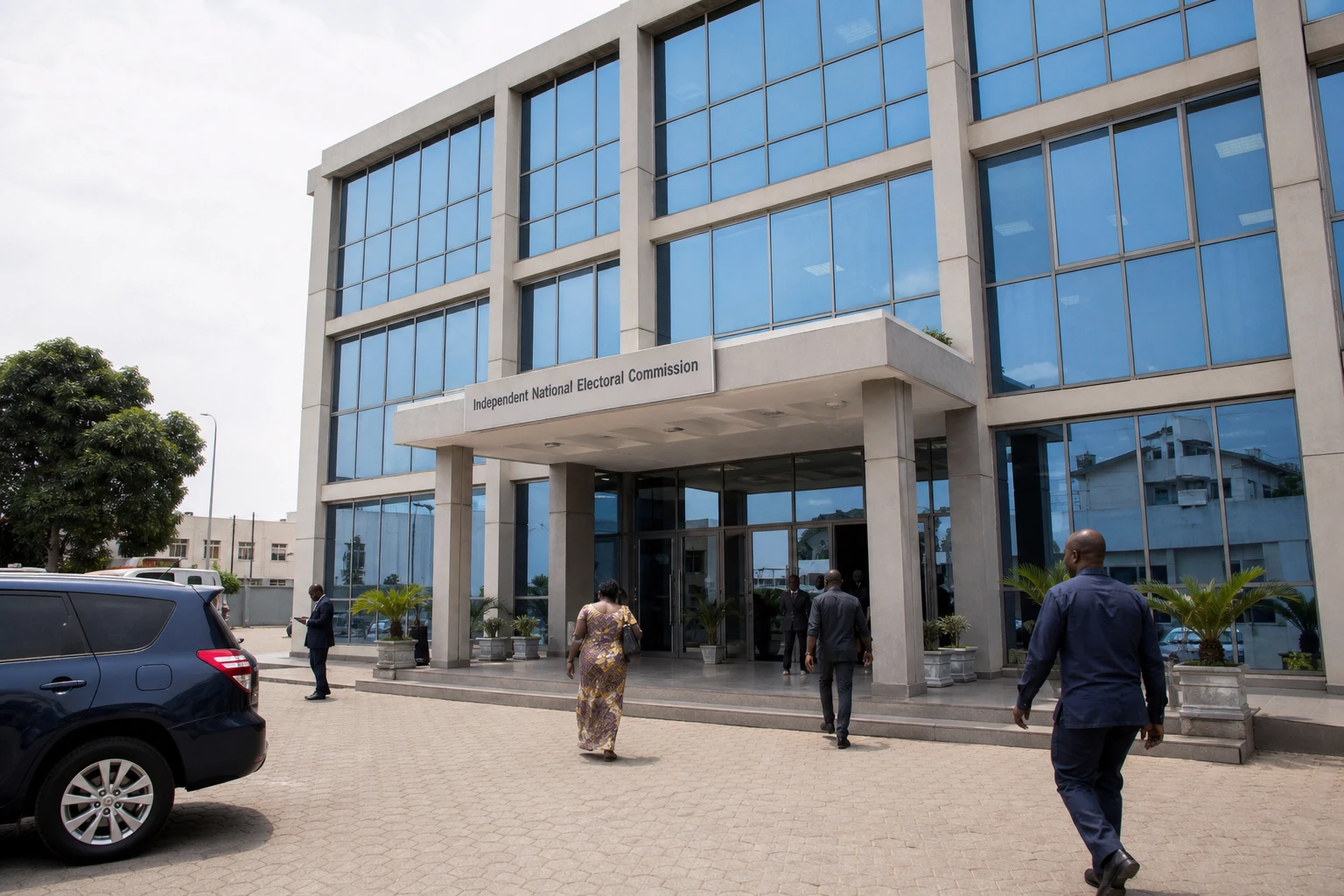
The presidential election on 20 December 2023 featured 26 candidates approved by CENI, the Independent National Electoral Commission. The timetable allowed only about 30 days of campaigning in a country where regions are separated by long distances, deteriorating roads and persistent security constraints. CENI later announced Félix Tshisekedi as the winner with 73.34% of the votes cast, or 13,215,366 votes, before the Constitutional Court upheld the result. Reuters and the Associated Press had already reported a victory of more than 70%.
In this context, the incumbent president’s campaign relied on a major logistical operation: planes, helicopters, road convoys, local teams, security and communications. The operation was particularly visible in major cities, but also in provinces that are harder to reach. Radio Okapi documented several campaign trips, while the Congolese Ministry of Communication publicised the incumbent candidate’s second-term programme.
The figures cited by his entourage give a sense of the effort: more than 50 rallies in 30 days and a presence in almost all the provinces. This figure was discussed publicly at the end of 2023 and repeated in several campaign reports. It speaks less to a personal feat than to a structural constraint: in the DRC, reaching voters means grappling with a territory fragmented by geography and insecurity.
In Goma, the campaign took on political meaning
The most symbolically charged moment was probably the visit to Goma, in North Kivu. The city was then under intense pressure because of fighting between Congolese forces and M23, an armed group at the heart of the east’s security crises. The rally at Afia Stadium on 10 December 2023 took place under heavy protection, in a province already scarred by mass displacement and the militarisation of everyday life. Le Monde, Africanews and Radio Okapi all described the event as a political gesture as much as a security one.
There, the presidential candidate promised to continue efforts against armed groups and restore state authority. The message was aimed first and foremost at people in the east, who are waiting for tangible results on security, movement along roads, access to services and the protection of civilians. In this region, campaigning is never simply about winning votes: it becomes a test of the central government’s credibility in the face of a conflict that extends beyond electoral politics alone.
For urban populations such as those in Goma, the stakes go beyond the rally itself. The question is whether Kinshasa can remain present in far-flung provinces in a tangible sense. For rural populations, the question is even simpler: whether the state will show up, make promises and then return. This difference between the capital and the periphery explains the emotional weight of presidential visits in a country where power remains highly centralised, but physical distance can quickly become political distance.
What the other candidates’ campaigns also reveal
The 2023 presidential election did not give everyone the same resources. Floribert Anzuluni, a candidate from civil society, ran a grassroots campaign that was lighter logistically and more direct in its contact with voters. His journey, particularly in South Kivu, also highlighted the familiar obstacles of Congolese politics: blocked roads, difficult travel, poor access to localities and very practical concerns about registration on the electoral roll and replacement voter cards.
These difficulties point to another, less visible but central issue: the electoral administration’s actual capacity to cover such a vast territory. CENI had to manage the opening of thousands of polling stations, the delivery of materials and then the transmission of results in an environment that was sometimes disrupted. In such circumstances, campaigning is not merely an exercise in communication. It also reflects the state of infrastructure, the influence of local political networks and the strength of provincial administrations.
For voters, these differences in resources matter greatly. Large rallies bring visibility, but they do not always make up for a lack of access to information, obstacles to registration and frustrations with the organisation of the vote. Smaller campaigns, by contrast, struggle to gain media attention, even when they better capture local anger. The Congolese campaign therefore reveals a lasting tension: a national election held in a country where the conditions for participation remain highly unequal.
A significance extending beyond the presidential election
This 2023 episode says something broader about the DRC and, beyond it, Central Africa and the continent as a whole. It is a reminder that holding an election in a country the size of a continent depends as much on infrastructure as on political programmes. It also shows that security in the east remains a regional issue, with repercussions in the East African Community, SADC and African mediation mechanisms. In other words, the Congolese campaign was a mirror of the country as it is: vast, fragmented and mobile, but also capable of quickly mobilising its political forces around a national deadline.
The final result confirmed Félix Tshisekedi’s electoral dominance, but the tour itself will be remembered above all as a revelation. It showed that in the DRC, winning power still depends on mastering distances, roads, planes and security balances. It also recalled that popular expectations remain very tangible: security, services, roads, jobs and freedom of movement. That is where the next stage of Congolese political debate will be shaped, well beyond the electoral calendar alone.



