
 Algeria
 Egypt
 Libya
 Morocco
 Sudan
 Tunisia
 Benin
 Burkina Faso
 Cabo Verde
 Côte d'Ivoire
 Ghana
 Guinea
 Guinea-Bissau
 Liberia
 Mali
 Mauritania
 Niger
 Nigeria
 Senegal
 Sierra Leone
 The Gambia
 Togo
 Cameroon
 Central African Republic
 Chad
 Equatorial Guinea
 Gabon
 Republic of the Congo
 São Tomé and Príncipe
 Burundi
 Comoros
 Djibouti
 Eritrea
 Ethiopia
 Kenya
 Madagascar
 Malawi
 Mauritius
 Mozambique
 Rwanda
 Seychelles
 Somalia
 South Sudan
 Tanzania
 Uganda
 Angola
 Botswana
 Eswatini
 Lesotho
 Namibia
 South Africa
 Zambia
 Zimbabwe
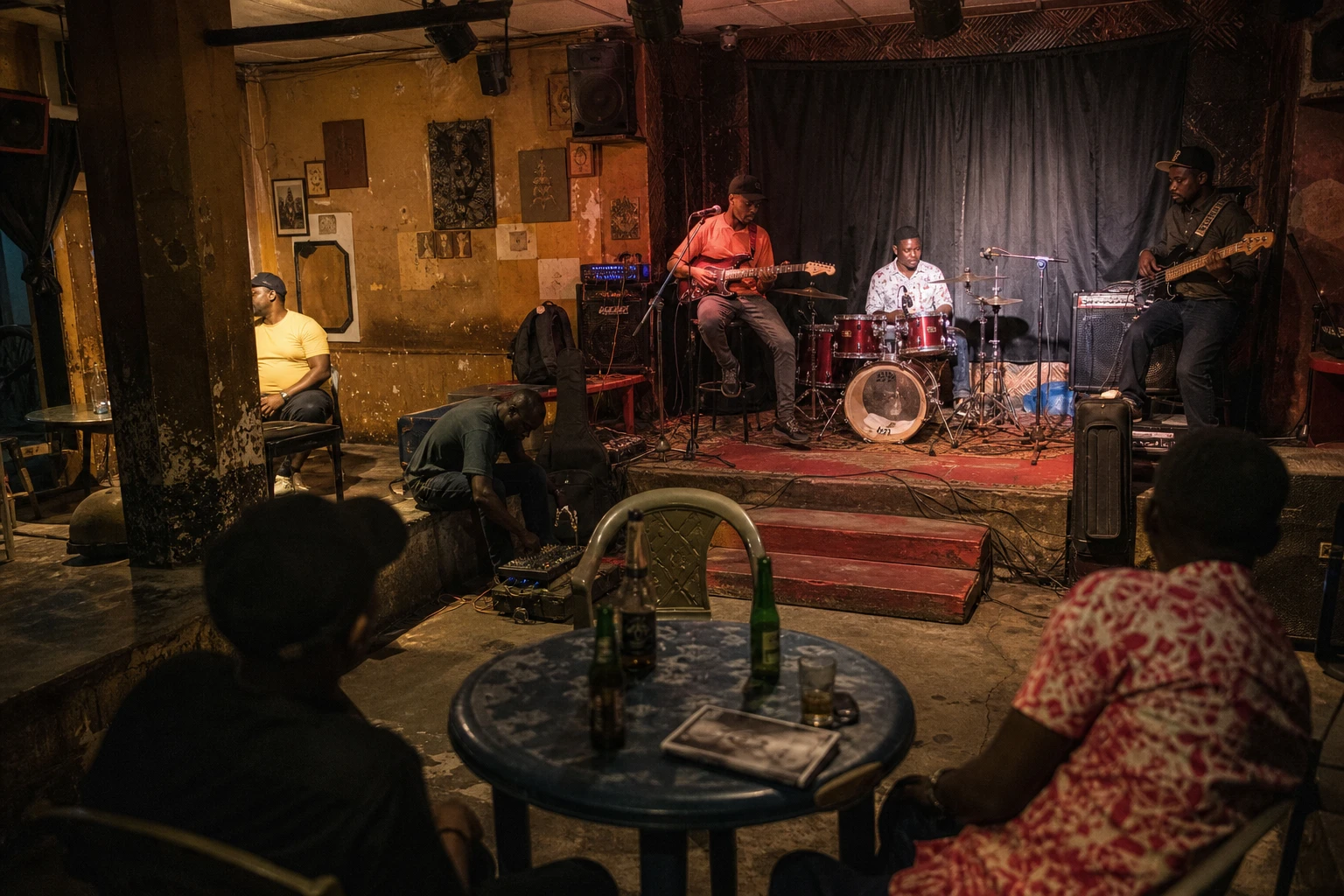
When Kinshasa’s nights tell the story of its politics
In Kinshasa, some places are more than somewhere to have a drink. They preserve the memory of the city’s beginnings, political debates and music that has spanned generations. Kimpwanza Bar belongs to that rare category of places where popular culture and national history have long intersected.
In the Congolese capital, bar-dance halls have played a much broader role than simply providing entertainment. Research into social life in Kinshasa notes that they long served as meeting places where people could exchange ideas and pass them on, at a time when political space was tightly controlled. In Kinshasa, music often preceded political parties, or at least accompanied their rise.
Kimpwanza Bar is in the commune of Kasa-Vubu, in the heart of Kinshasa. The name itself refers to national history: “Kimpwanza” means “independence” in Kikongo, and the venue is associated with the memory of Joseph Kasa-Vubu, the first president of the Democratic Republic of the Congo. In March 2025, the Prime Minister’s Office again referred to a tribute held at Kimpwaza roundabout, a sign that the site remains laden with symbolism in the city.
A place of music, ideas and memory
Accounts from Kinshasa describe a bar that opened in the 1950s and hosted several major names in Congolese rumba. This is no minor detail. Congolese rumba, now inscribed by UNESCO on the Representative List of the Intangible Cultural Heritage of Humanity, was born in the cities of the two Congos, shaped by Atlantic connections, urban guitar music and the nightlife of Léopoldville, the former name of Kinshasa.
In this account, Werrason and his orchestra rehearse on stage, as if to remind us that a place of great historical significance can also remain alive. This continuity matters. It shows that in Kinshasa, tradition does not survive behind glass. It is performed again, transformed and passed on through neighbourhood stages, rehearsals, concerts and bars where audiences are still looking for music that speaks their language.
The link between the venue and politics dates back to the colonial era. Before political parties were legalised, bars and cultural spaces served as refuges for exchanges between intellectuals, activists and supporters. This social life was not neutral. It made it possible to circumvent restrictions, prepare mobilisations and develop a collective voice. In Léopoldville, major political demands thus found their first public language in culture.
ABAKO, the Alliance of Bakongo, has a central place in this story. Founded as a cultural association, it became a decisive political force in the struggle for independence. Historical sources note that it took on a militant dimension under the presidency of Joseph Kasa-Vubu and played a major role in the rise of demands in 1959, after the January unrest in Léopoldville. According to local memory, Kimpwanza Bar was one of the meeting points for music, elites and Congolese nationalism.
The most famous symbol associated with this memory remains “Indépendance Cha Cha”. Grand Kallé’s song became a pan-African anthem of independence. Sources differ on where it was first performed in public: some accounts place it in Brussels, others within the circle of Congolese mobilisation surrounding the 1960 negotiations. They all agree, however, on its central role in the imagination of African independence. This point should therefore be treated with caution: what matters is not only the precise location, but the way the song encapsulated the hopes of a country and a continent.
What this bar says about Kinshasa today
Kimpwanza Bar also tells the story of a city built in layers. Kinshasa is not just an administrative capital. It is a cultural capital, with its communes, stages and symbolic landmarks. In Kasa-Vubu and other historic neighbourhoods, nightlife continues to support the local economy, providing work for musicians, technicians, waiters, promoters and informal traders. Rumba remains a strong marker of this urban economy.
This dynamic has a very tangible impact. For artists, it provides stages where heritage still matters. For the public, it keeps accessible spaces for socialising alive. For the city, it strengthens an identity that depends not only on institutions but also on popular practices. This is where Congolese history becomes tangible: in a place where people can hear political memory without leaving the realm of celebration.
The regional context reinforces this reading. Rumba is a link between the Democratic Republic of the Congo and the Republic of the Congo. UNESCO classifies it as a shared heritage of the two countries. In a Central Africa often viewed only through the lens of its crises, this heritage points to something else: the circulation of artists, repertoires and imaginings between Kinshasa and Brazzaville, between the banks of the Congo River and the diasporas that have carried this music far beyond the region.
Kimpwanza Bar is therefore part of a history broader than that of a simple drinking establishment. It bears witness to how Congolese people created places to speak before political speech was fully permitted, and later places of celebration where national memory continued to be passed on. In a capital in constant transformation, this kind of address is a reminder that a venue can be a neighbourhood establishment, a music stage and a living archive of the Democratic Republic of the Congo all at once.



