Algeria
 Egypt
 Libya
 Morocco
 Sudan
 Tunisia
 Benin
 Burkina Faso
 Cabo Verde
 Côte d'Ivoire
 Ghana
 Guinea
 Guinea-Bissau
 Liberia
 Mali
 Mauritania
 Niger
 Nigeria
 Senegal
 Sierra Leone
 The Gambia
 Togo
 Cameroon
 Central African Republic
 Chad
 DR Congo
 Equatorial Guinea
 Gabon
 Republic of the Congo
 São Tomé and Príncipe
 Burundi
 Comoros
 Djibouti
 Eritrea
 Ethiopia
 Kenya
 Madagascar
 Malawi
 Mauritius
 Mozambique
 Rwanda
 Seychelles
 Somalia
 South Sudan
 Tanzania
 Uganda
 Angola
 Botswana
 Eswatini
 Lesotho
 Namibia
 Zambia
 Zimbabwe
An economic hub attracting servers, but not without debate
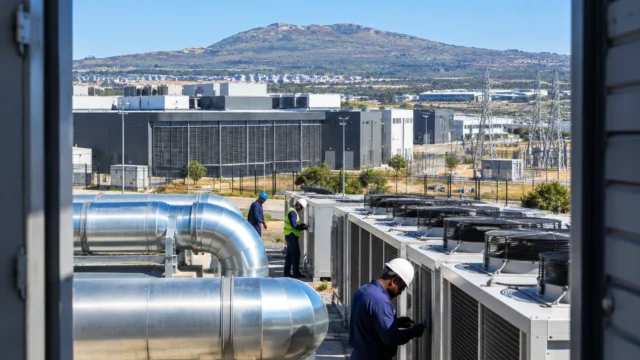
Digital technology is not abstract. It depends on physical buildings, cables, electricity and water. In Cape Town, South Africa, this reality lies at the heart of a very local debate with continental implications: how can the city accommodate large data centres without putting further strain on urban networks already under pressure?
The question goes beyond the case of Equinix, the US group specialising in digital infrastructure. It also concerns Pretoria, where the South African government has been promoting digital investment as a driver of growth for several months. President Cyril Ramaphosa confirmed in February 2026 that 55 data centres had already been built in the country and that more than 50 billion rand in additional investment was expected over three years.
In Cape Town, approval in principle and persistent objections
On 14 July 2026, Cape Town’s municipal planning tribunal approved a rezoning application linked to a project for two data centres in the King Air Industria area, north-east of the city. Several South African media outlets confirmed the date and location.
The case is not closed. The authorisation covers a planning stage, not the immediate start of construction. The company still has to submit a site development plan, a document required before work can begin. Opponents, meanwhile, are preparing a possible appeal.
The project has a stated electricity capacity of about 174 MVA, putting it in the category of very large industrial sites. Groups such as Housing Assembly and Foxglove have criticised the lack of publicly available information on electricity and water consumption, emissions, diesel generators and cooling.
In their view, the crux of the problem is not merely technical. It is also democratic. Residents say they lack the information needed to assess the project’s real impact on a neighbourhood already set in a dense urban environment, close to the international airport and major logistics routes.
Electricity, water and planning: the real fault line
The first issue is electricity. According to calculations cited before the tribunal and reported by the South African press, the two centres’ demand could be equivalent to the consumption of tens of thousands of households. One comparison raised in the debate puts this need close to the level of a major continental operator already established in South Africa.
But the most sensitive battle remains over water. Opponents cited a theoretical estimate based on data centres using traditional cooling. Applied to the stated 174 MW, this benchmark would amount to several billion litres a year. It is important to be clear, however: this figure is not a forecast provided by Equinix, but an argument put forward by the opponents’ representatives.
Equinix says its facilities are to use dry-air cooling, meaning no significant water consumption for the computer rooms. Elsewhere, in its water management policy, the company describes a preference for air cooling in water-stressed areas. This position has not ended the debate, as the project remains subject to further technical and regulatory checks.
The controversy is unfolding in a city that still remembers the 2018 crisis, when Cape Town came close to a complete water shut-off. Since then, public concern about industrial water use has increased sharply. In this context, a large data centre is no longer just an economic asset. It has become a test of trust between investors, authorities and residents.
A regulatory framework that remains too generic
The debate also highlights a structural weakness: South Africa does not yet have a framework specifically designed to assess large data centres as a whole. Planning tribunals therefore consider these projects under rules originally drawn up for warehouses or conventional industrial zones.
Yet a hyperscale data centre is no ordinary building. It requires servers, cooling systems, backup facilities, fuel reserves and grid connections on a scale rarely addressed in conventional planning. This very mismatch is fuelling criticism from the Legal Resources Centre, a South African public-interest law organisation.
The government, for its part, is pushing in a different direction. In Pretoria, the executive wants to attract capital into digital infrastructure even as it reorganises the water and electricity sectors. On 23 July 2026, Ramaphosa presented a National Water Action Plan, including legal reforms and an expansion of private investment. A few months earlier, the cabinet had already announced reforms to improve the regulation of municipal electricity, water and waste services.
What Cape Town says about southern Africa
The Cape Town case has implications beyond the municipality. South Africa is at the heart of SADC, the Southern African Development Community, and often plays a leading role there on infrastructure, regulation and financing. When a digital project of this scale faces objections over water and electricity, the competitiveness of cities across the region comes into focus.
For local authorities, the challenge is straightforward: attract high-value activities without straining urban networks or fuelling a sense of opacity. For the neighbourhoods concerned, the questions are more immediate: how much electricity will remain available, what water will be used, and who will bear the cost of the additional constraints?
The case also shows something essential: Africa’s digital transition is not simply about connectivity. It requires choices on land use, the electricity grid, water management and administrative transparency. In Cape Town, those choices are now being debated in public. They are likely to set a precedent for other cities in the region seeking to become hubs for data, cloud computing and artificial intelligence.