Algeria
 Egypt
 Libya
 Morocco
 Sudan
 Tunisia
 Benin
 Burkina Faso
 Cabo Verde
 Côte d'Ivoire
 Guinea
 Guinea-Bissau
 Liberia
 Mali
 Mauritania
 Niger
 Nigeria
 Senegal
 Sierra Leone
 The Gambia
 Togo
 Cameroon
 Central African Republic
 Chad
 DR Congo
 Equatorial Guinea
 Gabon
 Republic of the Congo
 São Tomé and Príncipe
 Burundi
 Comoros
 Djibouti
 Eritrea
 Ethiopia
 Kenya
 Madagascar
 Malawi
 Mauritius
 Mozambique
 Rwanda
 Seychelles
 Somalia
 South Sudan
 Tanzania
 Uganda
 Angola
 Botswana
 Eswatini
 Lesotho
 Namibia
 South Africa
 Zambia
 Zimbabwe
An economic pillar under pressure
In Accra, the cocoa question goes far beyond a single farming season. It affects foreign-exchange earnings, the incomes of tens of thousands of rural families and Ghana’s place in the global chocolate industry. When harvests decline, the entire economic balance comes under strain, from the fields to public finances.
Ghana remains one of West Africa’s two major cocoa producers, alongside Côte d’Ivoire. The sector is a major contributor to exports and the national economy, while ECOWAS, the Economic Community of West African States, is closely monitoring the combined effects of global prices, the climate and agricultural policy decisions.
Output forecast to fall in 2026-27
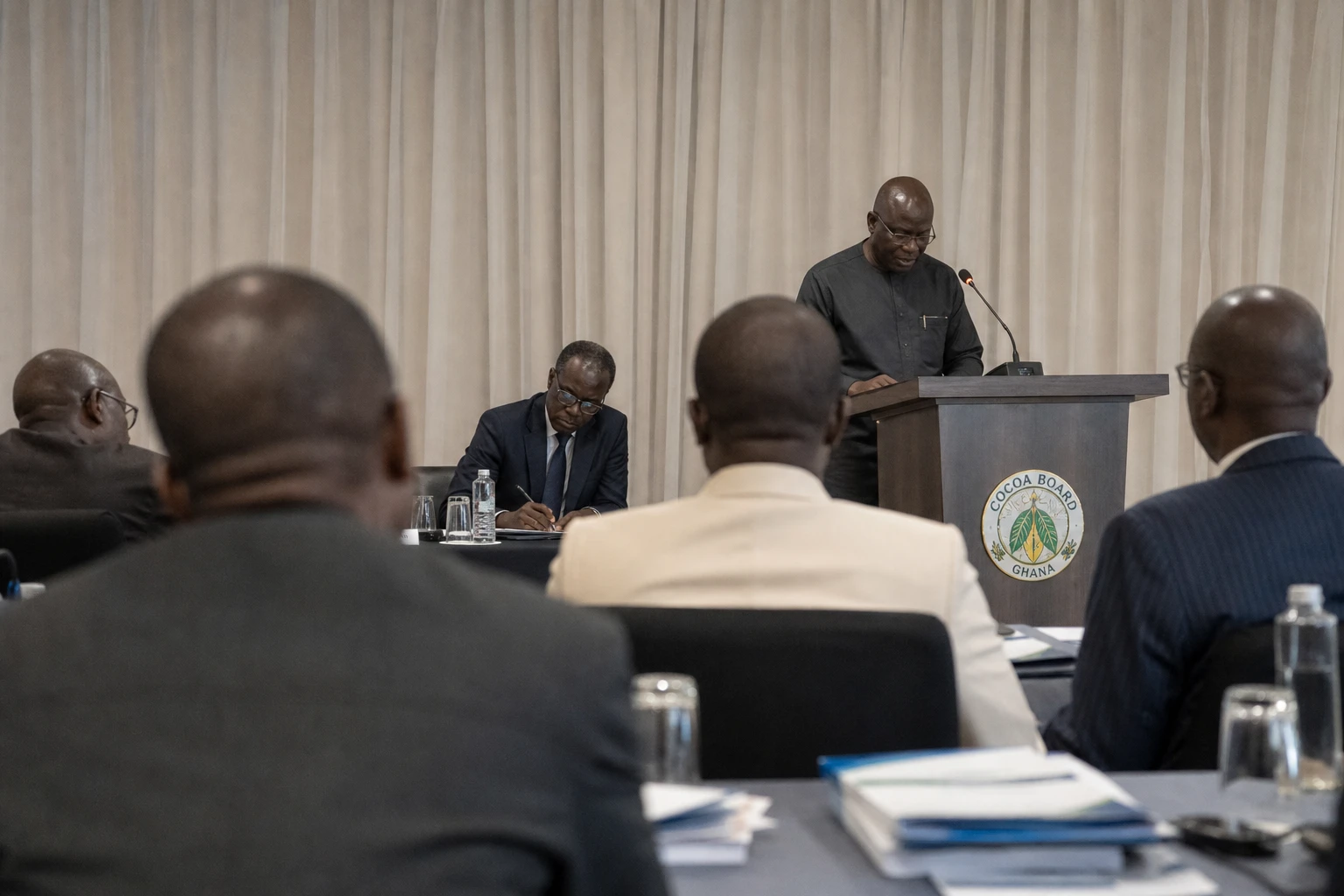
The Ghana Cocoa Board, COCOBOD, expects cocoa production to contract by at least 16% in the 2026-27 season. This forecast extends an already fragile period. In recent months, Ghanaian authorities have made a series of adjustments to prices, financing and inputs in an effort to stabilise the sector.
The expected decline is not down to a single factor. Excessive rainfall in several cocoa-growing areas, risks linked to the El Niño phenomenon and the cocoa tree’s natural cycle of alternating high- and low-yielding phases are undermining yields. These are compounded by longer-standing problems: swollen shoot disease, which destroys trees; ageing plantations; and illegal gold mining encroaching on farmland. COCOBOD’s plant health service says the fight against swollen shoot and the rehabilitation of old plantations are among its core responsibilities.
Agricultural causes, but structural problems too
The problem runs deeper than a single spell of bad weather. In several regions, farmers are dealing with tired orchards, infected plants and the loss of cultivable land. COCOBOD has itself cited rehabilitation programmes, the resumption of free fertiliser distribution and an expansion of crop protection treatments. Since July 2026, a national awareness campaign has also accompanied the return of these free inputs.
These measures point to a simple truth: without the renewal of plantations, Ghanaian production remains vulnerable. Figures cited by the authorities and local media indicate that some areas have lost entire tracts of land to cocoa diseases and pressure on land. The problem is therefore not only agronomic. It is also territorial, social and financial.
COCOBOD is also seeking a new financing model for the 2026-27 season. Its stated aim is twofold: to secure payment for cocoa beans and reduce reliance on external financing backed by future sales. The government also wants at least 50% of beans to be processed locally from the 2026-27 season. For local industry, the goal is clear: to retain more added value in Ghana, in Accra as well as in industrial areas.
For farmers, the stakes are immediate
On the ground, the effects are tangible. A smaller harvest reduces farmers’ incomes, makes it harder to hire seasonal labour and weighs on purchases of inputs. It also undermines public bean purchases, delays payments and puts social programmes linked to the sector at risk, including support schemes for farming families. The producer price set for the 2026-27 season and recent adjustments show that the state is trying to keep farmers in the sector despite pressure from global markets.
At the other end of the supply chain, grinders, exporters and chocolate manufacturers are keeping a close watch on Ghanaian supply. A prolonged decline could raise procurement costs, but it could also accelerate diversification towards other origins. Markets have already factored in this risk, even as Côte d’Ivoire also forecasts a smaller harvest. Together, the two countries continue to shape global supply, but their dominance can no longer be taken for granted.
A Ghanaian issue, but also a West African one
The issue extends beyond Ghana’s borders. Alongside Côte d’Ivoire, the country continues to advocate closer co-ordination on prices, agricultural research and the fight against disease. In June 2026, the two capitals strengthened their cocoa alliance, with plans to extend this co-operation to other African producers. The aim is strategic: to give Africa greater influence in the global value chain, when the continent produces most of the beans but still captures too little of the margins.
For the African Union and ECOWAS, this period is a reminder that an agricultural commodity can become a matter of economic sovereignty. If producer states do not invest in plantation health, local processing, research and commercial transparency, value will continue to leave the continent. The next season will show whether the reforms under way in Accra are enough to halt the decline. In the coming months, close attention will focus above all on rainfall, the health of orchards and COCOBOD’s ability to finance the recovery.