Algeria
 Egypt
 Libya
 Morocco
 Sudan
 Tunisia
 Benin
 Burkina Faso
 Cabo Verde
 Côte d'Ivoire
 Ghana
 Guinea
 Guinea-Bissau
 Liberia
 Mali
 Mauritania
 Niger
 Nigeria
 Sierra Leone
 The Gambia
 Togo
 Cameroon
 Central African Republic
 Chad
 DR Congo
 Equatorial Guinea
 Gabon
 Republic of the Congo
 São Tomé and Príncipe
 Burundi
 Comoros
 Djibouti
 Eritrea
 Ethiopia
 Kenya
 Madagascar
 Malawi
 Mauritius
 Mozambique
 Rwanda
 Seychelles
 Somalia
 South Sudan
 Tanzania
 Uganda
 Angola
 Botswana
 Eswatini
 Lesotho
 Namibia
 South Africa
 Zambia
 Zimbabwe
When machinery costs hold back farming
In Senegal, the question is no longer just how to grow more. It is also how to farm better, with suitable tools, in a country where agriculture still accounts for around 17% of gross domestic product and supports a significant share of households. Modernising farms therefore remains a practical challenge, from the groundnut basin to the Senegal River valley.
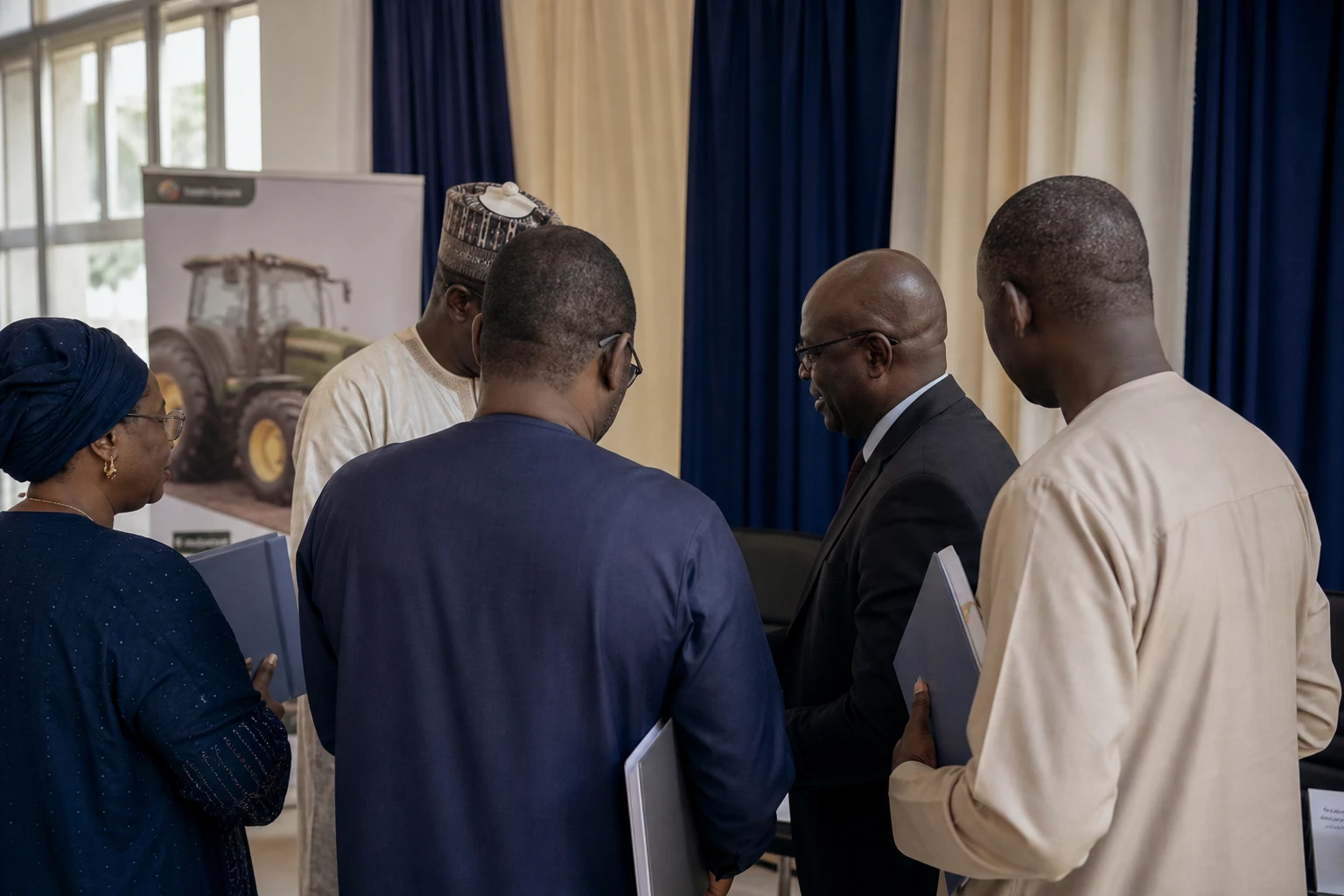
In this context, reducing the cost of equipment is no minor tax issue. For many farms, the price of a tractor, seed drill, irrigation pump or harvesting system weighs as heavily as the machine itself. This is precisely where the new tax measure announced by the authorities is intended to have an impact.
A tax signal within a broader agricultural strategy
The permanent exemption from value-added tax on a list of agricultural equipment and services is part of a wider sequence of measures. In Dakar, the government has made a series of announcements since 2025 on mechanisation, access to equipment, operator training and the creation of service centres. These choices respond to a simple reality: without available, maintained and accessible machinery, modernisation remains theoretical.
Senegal is not starting from scratch, however. The Directorate of Analysis, Forecasting and Agricultural Statistics has documented low levels of equipment. In its 2022-2023 agricultural survey, it shows that farming households have few motorised machines and that repair and maintenance services remain unevenly distributed across the country. The finding echoes that of the FAO: agriculture still accounts for a large share of employment and national income in the country.
What the announced measure changes
The core of the reform is fiscal. According to APIX’s official statement, VAT that could become a final cost on certain agricultural investments has now been abolished for operators eligible under the Investment Code. The stated aim is to reduce the real cost of agricultural projects and make machinery purchases less burdensome for approved investors.
In practical terms, the measure covers equipment for soil preparation, sowing, fertilisation, irrigation and harvesting, as well as activities in horticulture, livestock farming and poultry farming. It adds to other measures already introduced by the state, such as the Allo Tracteur programme, the rollout of agricultural machinery service centres and training initiatives in agricultural mechanisation.
This framework aims to address a familiar problem in African agricultural policy: lowering the purchase price is not enough if financing remains scarce, spare parts are unavailable and machine operators are not trained. In other words, VAT relief can trigger investment, but it cannot replace credit, technical assistance or a maintenance ecosystem. This is an inference based on the obstacles described by the authorities and DAPSA.
Saint-Louis, Podor and Dagana as testing grounds
The north of the country offers a good example of this approach. On 21 July 2026, two agricultural machinery service centres were inaugurated in the Saint-Louis region, in the departments of Dagana and Podor. The aim is to improve producers’ access to equipment and machinery maintenance in an area where the Senegal River valley plays a central role in rice, irrigated crops and horticulture.
The government has also invested in training. In Podor, a skills centre for agricultural mechanisation was launched to train young Senegalese in operating, maintaining and managing equipment. This focus matters because mechanisation without local expertise often creates further dependence instead of generating value locally.
The industrial approach follows the same line. In 2025, the authorities announced a project to assemble tractors and agricultural equipment with private partners, while the Allo Tracteur programme was due to establish 13 agricultural machinery service centres in several regions of the country. The message is clear: Dakar wants to reduce its dependence on imports and build a local agricultural services chain.
Between food sovereignty and fiscal balance
Politically, the reform forms part of the Senegalese government’s stated food sovereignty strategy. In 2026, the Ministry of Agriculture highlighted mechanisation, the digitalisation of agricultural inputs and the strengthening of value chains as drivers of productivity. At the same time, budget authorities must safeguard public revenues that are already under pressure. The tax exemption is therefore a trade-off: less VAT in the short term, in the hope of greater productive investment in the medium term.
For producers, the expected impact is tangible: somewhat cheaper access to equipment, and therefore a greater ability to sow on time, irrigate more regularly and harvest faster. For small family farms, however, the challenge remains effective access to shared services, since most cannot buy heavy machinery on their own. For approved investors, the measure improves project profitability. For the state, it should accelerate the sector’s transformation without unnecessarily widening inequalities between well-served areas and more remote regions.
Across ECOWAS and WAEMU, Senegal’s decision is part of a broader trend: governments are seeking to reduce the cost of inputs, modernise agriculture and secure food supplies. Senegal’s case therefore matters beyond its borders. If the measure genuinely attracts investment, it could serve as a model. If it remains isolated, it will instead show that a tax incentive, without infrastructure or services, is not enough to transform an agricultural system.