
 Algeria
 Egypt
 Libya
 Morocco
 Sudan
 Tunisia
 Benin
 Burkina Faso
 Cabo Verde
 Ghana
 Guinea
 Guinea-Bissau
 Liberia
 Mali
 Mauritania
 Niger
 Nigeria
 Senegal
 Sierra Leone
 The Gambia
 Togo
 Cameroon
 Central African Republic
 Chad
 DR Congo
 Equatorial Guinea
 Gabon
 Republic of the Congo
 São Tomé and Príncipe
 Burundi
 Comoros
 Djibouti
 Eritrea
 Ethiopia
 Kenya
 Madagascar
 Malawi
 Mauritius
 Mozambique
 Rwanda
 Seychelles
 Somalia
 South Sudan
 Tanzania
 Uganda
 Angola
 Botswana
 Eswatini
 Lesotho
 Namibia
 South Africa
 Zambia
 Zimbabwe
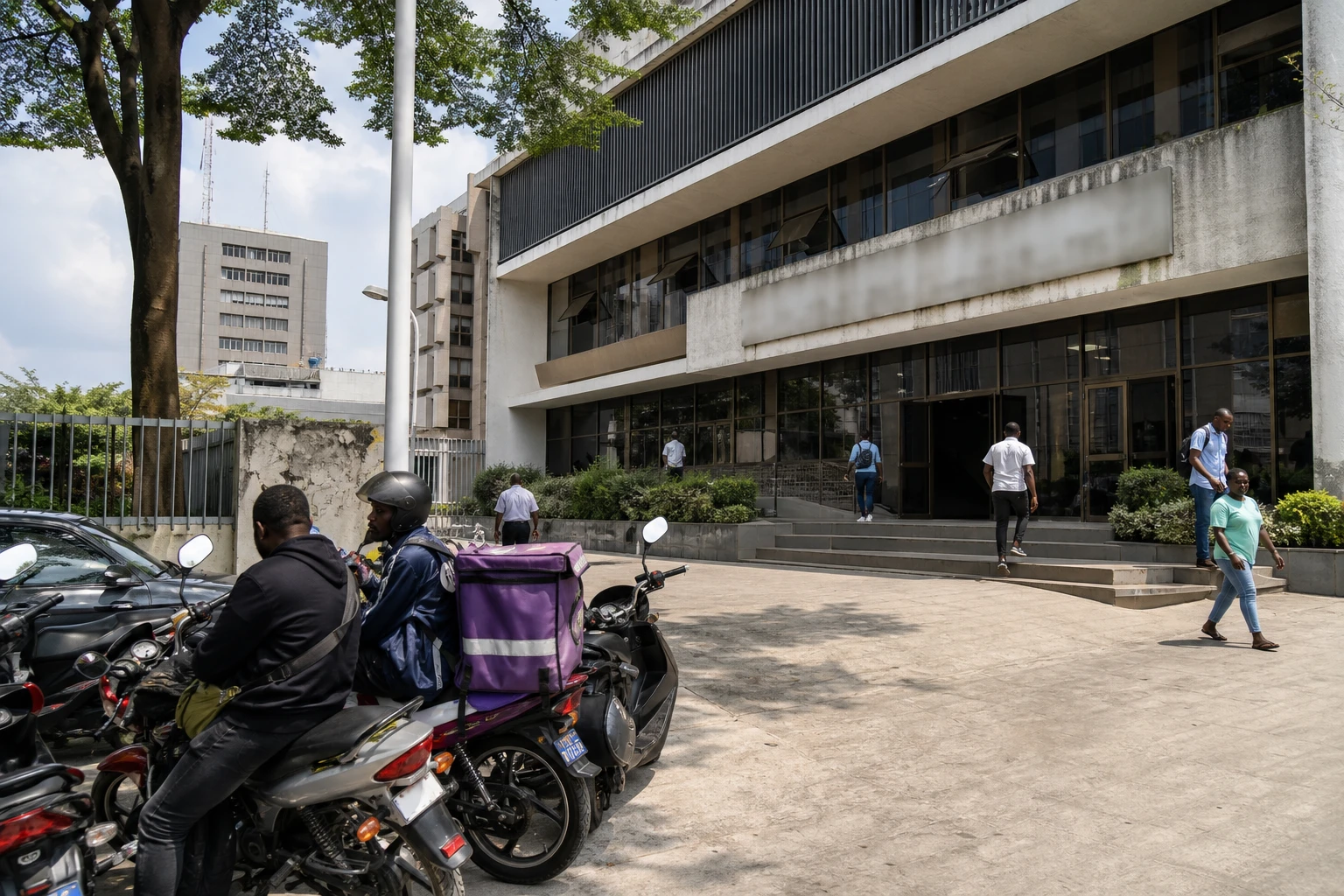
In Abidjan, delivery motorbikes have become both a tool of work and a frontline
In Côte d’Ivoire’s economic capital, motorbike delivery has taken hold because it meets a simple need: getting around quickly, bypassing traffic jams and serving a sprawling city. But this time-saving comes at a human cost. For many couriers, every late delivery, every neighbourhood crossed at night, every forced stop on an isolated road adds an element of uncertainty to the job. The tragedy that took place in Abidjan in early July brutally underscored this vulnerability.
This reality concerns more than just delivery workers. It also says something about urban mobility in Côte d’Ivoire, whose capital is Yamoussoukro but whose economic powerhouse remains Abidjan. In the country, the authorities have already stepped up awareness-raising and enforcement measures in 2025 and 2026 targeting two- and three-wheeled vehicles, showing that the issue goes beyond a single news story.
The July 2026 verdict and the judicial response
On Thursday 23 July 2026, the Abidjan-Plateau court sentenced two defendants to life imprisonment and two others to ten years in prison, as well as imposing a fine, in the case of a motorbike courier murdered on the night of 6 to 7 July 2026 in Cocody, in the Vallons district. The case, attributed to an attack by men armed with machetes and knives, also led to the seizure of the victim’s motorbike and video evidence, according to the national police.
Information cross-checked from multiple sources converges on the essential details: the victim, Amidou Koné, was attacked at around 3am, and the investigation led to the arrest of four suspects. The verdict is therefore far more than an individual punishment. It draws a clear criminal justice line against attacks targeting couriers, who have become visible links in Abidjan’s urban economy over the past few years.
The public prosecutor at the Abidjan court of first instance announced that perpetrators of this type of assault would face the full force of the law. This firm stance is part of a pattern already seen in other recent cases, in which Côte d’Ivoire’s justice system intends to show that it responds swiftly when public order, urban security and traffic come under strain.
Why this case matters to an indispensable profession
Motorbike couriers are no longer marginal players. They provide a substantial share of last-mile logistics, particularly in densely populated neighbourhoods, commercial areas and districts where delivery times matter. The public platform POLI, promoted by the government, had already registered nearly 5,000 couriers at the beginning of 2026. This confirms the scale of a sector taking shape, with jobs for young people that are often informal or semi-formal, and which expose workers to the streets, irregular hours and multiple risks.
Professionals’ accounts convey a very real anxiety: working at night, carrying a phone, cash or an insulated delivery bag, then becoming a target. The risk is therefore not only road-related. It is also criminal. That is why couriers’ response in the hours after the tragedy went beyond an emotional reaction. It focused on safety, routes, street lighting, monitored areas and police presence on certain roads.
At the same time, Côte d’Ivoire’s authorities have stepped up enforcement of traffic offences. In March 2026, an operation in Abidjan impounded 82 motorbikes and tricycles out of 800 vehicles checked, while the Ministry of Transport recalled that two- and three-wheelers account for nearly 40% of road-accident deaths. In this context, courier safety depends on two fronts at once: preventing accidents and reducing assaults.
Professionals’ demands are therefore consistent with public priorities: tougher penalties, more prevention, better signage and suitable infrastructure. Their representatives’ call for cycle lanes points to a broader issue of sharing road space in a metropolis where motorbikes, cars, taxis and public transport compete for room.
A warning from Côte d’Ivoire that reaches beyond Abidjan
This case resonates beyond Côte d’Ivoire because it touches on a phenomenon found in many West African capitals: the rapid growth of motorbike delivery and transport services, driven by the digital economy and pressure on urban employment. Across the ECOWAS region, where work-related mobility is increasing, the question is no longer simply how these jobs are growing. It is now about regulation, social protection and effective safety.
For Côte d’Ivoire, the challenge is twofold. On the one hand, the state wants to show that it protects frontline workers and will not allow assaults to become normalised. On the other, it must ensure that its response is not limited to enforcement. The profession is also calling for clear rules, better-planned routes and a city that is easier to navigate at night. In this respect, the verdict of 23 July 2026 does not close the debate. Rather, it opens a period in which the justice system, police, local authorities and digital-sector players will have to answer the same question: how can Abidjan become a city where making deliveries no longer means facing danger alone?



