Algeria
 Egypt
 Libya
 Morocco
 Sudan
 Tunisia
 Benin
 Burkina Faso
 Cabo Verde
 Côte d'Ivoire
 Ghana
 Guinea
 Guinea-Bissau
 Liberia
 Mauritania
 Niger
 Nigeria
 Senegal
 Sierra Leone
 The Gambia
 Togo
 Cameroon
 Central African Republic
 Chad
 DR Congo
 Equatorial Guinea
 Gabon
 Republic of the Congo
 São Tomé and Príncipe
 Burundi
 Comoros
 Djibouti
 Eritrea
 Ethiopia
 Kenya
 Madagascar
 Malawi
 Mauritius
 Mozambique
 Rwanda
 Seychelles
 Somalia
 South Sudan
 Tanzania
 Uganda
 Angola
 Botswana
 Eswatini
 Lesotho
 Namibia
 South Africa
 Zambia
 Zimbabwe
A connected school, but above all a useful one
In Mali, the question is no longer simply whether to put computers in classrooms. It is whether public schools can still prepare young people to enter an economy where administrative procedures, training and some jobs are now conducted digitally. In Bamako, the government has chosen to tackle the issue from the ground up, initially targeting secondary schools, technical establishments and vocational training.
The stakes are tangible. In a country where internet use reached 37% of the population in 2024, most pupils remain exposed to a significant digital access divide, especially outside major urban centres. The ITU also reported that in 2024, 3G coverage reached 70% and 4G coverage 53%, leaving some areas and educational uses on the margins.
What Bamako plans, and what is still holding it back
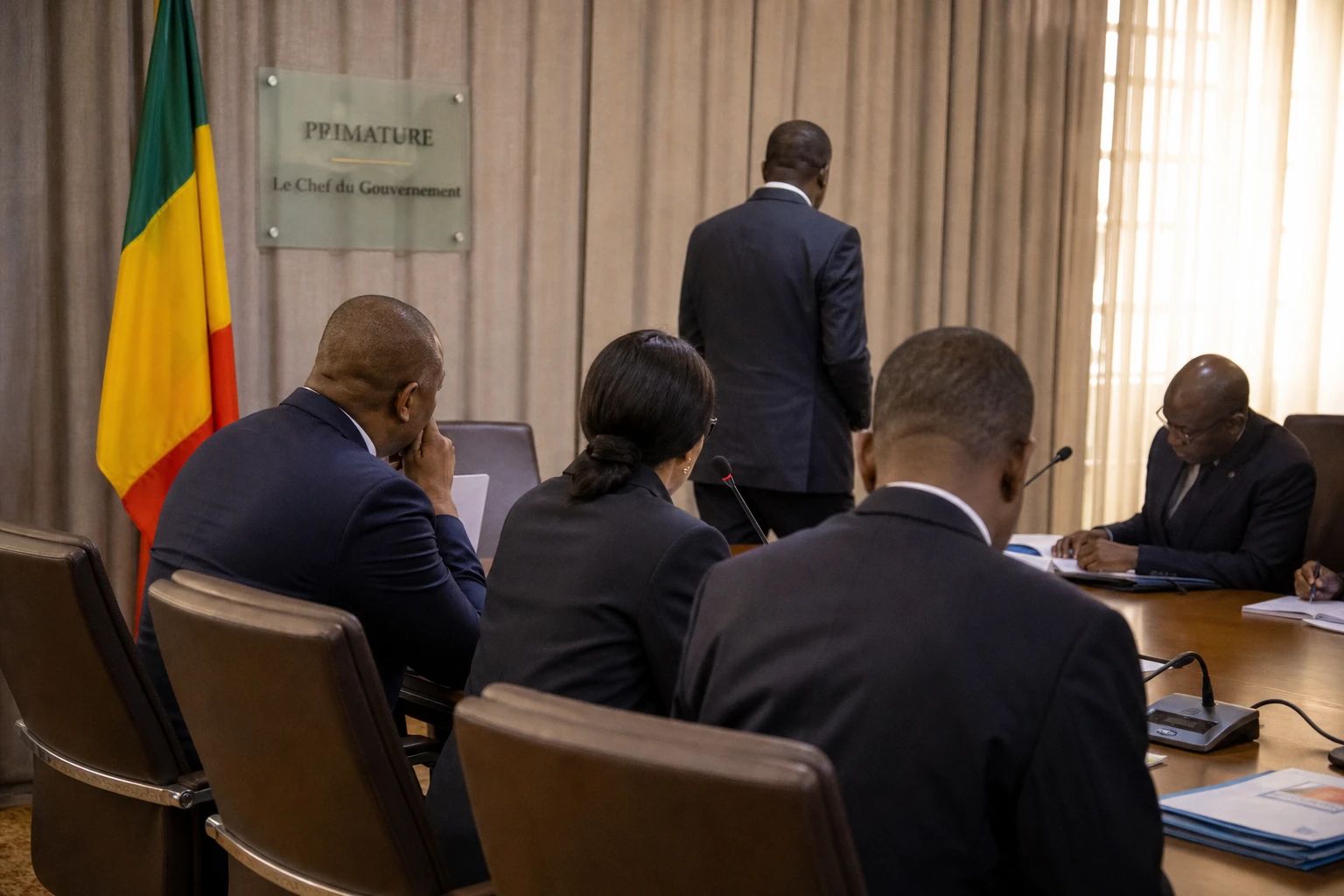
On 22 July 2026, at the Prime Minister’s Office, Prime Minister Abdoulaye Maïga chaired the signing of two agreements between the state and the Universal Access Fund Management Agency, AGEFAU. The first concerns the digitisation of public institutions. The second involves the Ministry of National Education and the ministry responsible for Entrepreneurship, Employment and Vocational Training.
The announced scheme is based on several measures. It provides for Universal Access Centres, Wi-Fi hotspots in schools, digital infrastructure for learning, and even equipment to be awarded to top pupils. The idea is simple: to make connectivity part of everyday school life, rather than reserving it for administrative offices or neighbourhoods that are already well covered.
But the public timetable is not entirely consistent. The government statement sets a target of connecting all secondary, technical and vocational schools by the end of 2026. AGEFAU, in its own communication, instead refers to an ambition extending to the end of 2027. This difference is worth noting, as it points either to a delay in implementation or to different descriptions of the same programme.
The funding is there, at least on paper. AGEFAU’s director-general says more than 17 billion CFA francs have already been invested in the education sector alone. For 2025, the agency says it mobilised 43.35 billion CFA francs for its universal access projects. The government, for its part, cites more than 13.5 billion CFA francs in projects under way in education and vocational training between 2025 and today.
These figures show a determination to scale up. They also point to the difficulty of the task. According to the World Bank, 37% of Mali’s population used the internet in 2024. According to the ITU, 30% of the population was not covered by 3G in 2023, while the 4G coverage gap remained large. In practice, school connectivity therefore still depends on an incomplete national network, with major disparities between Bamako, regional capitals and rural areas.
A political signal that goes beyond education
The programme is part of a broader political agenda. The Malian authorities have declared 2026-2027 the “Year of Education and Culture”, a policy regularly reiterated by government departments since February 2026. Digital learning is thus becoming a tool for rebuilding human capital, alongside education reforms and the promotion of culture.
This strategy affects urban and rural young people in different ways. In Bamako, where infrastructure is already more developed, the challenge is equipment and the quality of its use. In the regions, the first priorities may be a stable connection, electricity and suitable classrooms. For families, the impact could quickly be felt in access to educational resources. For the state, the promise is broader: to improve school management, the tracking of results and guidance towards technical courses, which are often crucial for employment.
The regional context also matters. Mali has no longer been a member of ECOWAS since 29 January 2025, when the country’s withdrawal, alongside Burkina Faso and Niger, took effect. At the same time, Bamako is relying more heavily on cooperation through the Alliance of Sahel States and on African frameworks for sectoral solidarity. In this context, school connectivity is not just an education issue. It is also a way to reduce external digital dependence and build national capacity.
Finally, the continent-wide significance should be considered. Many African countries face the same equation: how to train more young people, faster and better, in sectors capable of absorbing them. Access to digital learning is therefore no luxury for Mali. It is a test of governance, budgetary priorities and the ability to deliver. If Bamako succeeds in connecting schools, technical centres and employment, the country will have a strong argument in a debate that has become central across Africa: how to make schools a genuine engine of integration into the workforce, rather than simply places of education.