Algeria
 Egypt
 Libya
 Morocco
 Sudan
 Tunisia
 Benin
 Burkina Faso
 Cabo Verde
 Ghana
 Guinea
 Guinea-Bissau
 Liberia
 Mali
 Mauritania
 Niger
 Nigeria
 Senegal
 Sierra Leone
 The Gambia
 Togo
 Cameroon
 Central African Republic
 Chad
 DR Congo
 Equatorial Guinea
 Gabon
 Republic of the Congo
 São Tomé and Príncipe
 Burundi
 Comoros
 Djibouti
 Eritrea
 Ethiopia
 Kenya
 Madagascar
 Malawi
 Mauritius
 Mozambique
 Rwanda
 Seychelles
 Somalia
 South Sudan
 Tanzania
 Uganda
 Angola
 Botswana
 Eswatini
 Lesotho
 Namibia
 South Africa
 Zambia
 Zimbabwe
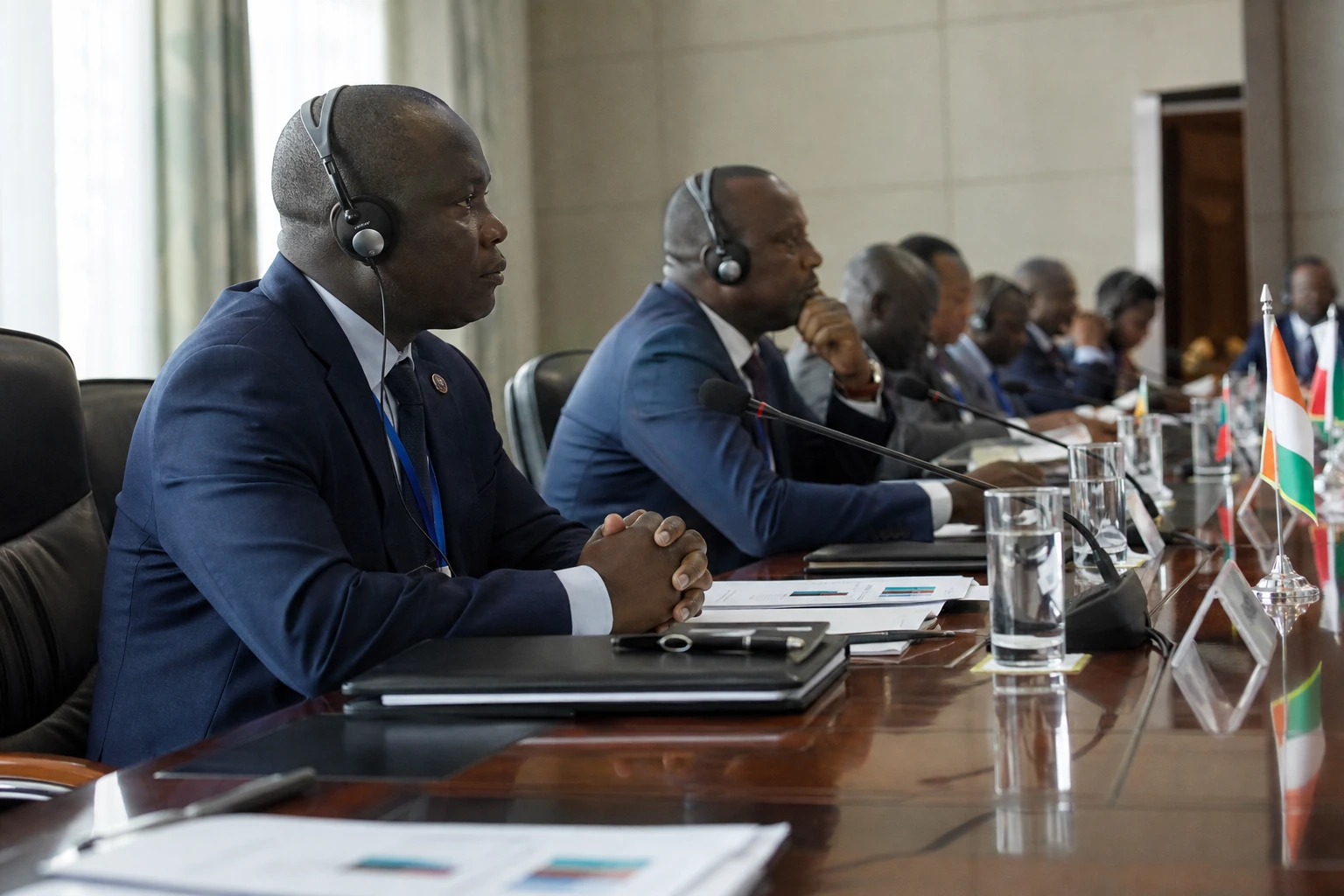
Training technicians, not just producing tonnes
In Côte d’Ivoire’s rubber sector, the real turning point is no longer just planting. It now lies in workshops, laboratories, maintenance and process management. When a country wants to sell its natural rubber at a higher price, it must also invest in the women and men able to process it, monitor its quality and innovate. In Côte d’Ivoire, this approach is taking shape in Ahouakro, in the department of Agboville, where work has begun on an academy dedicated to rubber-sector professions.
The issue goes beyond the construction of a training centre. It says something about the course of Ivorian agriculture, now shaped by the rise of export sectors and an openly stated ambition to capture more added value within the country. Natural rubber occupies a particular place: the authorities describe it as the leading agricultural export after cocoa, and Côte d’Ivoire as Africa’s largest producer and the world’s third largest.
A strategic sector changes course
The decision to launch the academy is part of a much broader context than that of a simple construction project. On 12 February 2025, the Ivorian government extended to coconut the regulatory framework already applied to the rubber and oil palm sectors. The decision above all confirms a more structured approach to managing industrial crops, with tighter rules on oversight, marketing and inter-professional organisation.
At the same time, the government has made a clear shift in direction: following the expansion of primary processing capacity, the priority must now be more advanced industrialisation. At the National Natural Rubber Days in October 2024, and then in official communications in 2026, the authorities stressed the need to develop further processing — the manufacture of more sophisticated products such as tyres, technical components and other industrial goods. The government also said Ivorian production had reached 1.6 million tonnes in 2023, before stating in 2026 that the country was consolidating its leadership in rubber.
The signal from the Conseil Hévéa-Palmier à Huile-Coco is consistent with this direction. In June 2025, it decided to grant no further permits for the installation or expansion of primary-processing plants, on the grounds that existing capacity was now sufficient to absorb domestic production. In other words, the sector is entering a phase of selection: fewer plants producing basic materials, and more expertise and value captured locally.
What the Rubber Academy is meant to change
The Ahouakro centre is designed as a tool for professional development. APROMAC, which is leading the project, aims to train a new generation of workers, promote employment for young people and women, and strengthen skills in processing, quality control, industrial maintenance and innovation. This is no marginal issue. In a sector where plantations, collection networks and factories are multiplying, a shortage of qualified workers can quickly become a barrier to moving up the value chain.
This momentum is not new, but it is accelerating. For several years, APROMAC has been running programmes to support training in rubber-sector professions. Local green schools have been used to train rubber tappers, and more recently young graduates have joined the sector through structured employment schemes. This shows one simple thing: Ivorian rubber is no longer seen solely as a cash crop. It is becoming a source of technical, rural and industrial jobs.
This shift has tangible effects for local communities. In production areas, it can stabilise incomes beyond the agricultural season alone, create opportunities for young people in rural areas and reduce dependence on precarious work. For industrial companies, it can improve the quality of inputs, reduce losses and secure production chains. For the state, it opens the way to a broader tax and industrial base in a country where agricultural exports remain a major pillar of the economy.
Moving up the value chain amid global competition
The timing is no accident. Côte d’Ivoire is seeking to consolidate its position in a highly competitive international market dominated by Thailand and Indonesia. Trade Map data cited by several sources point to exports of around 2 million tonnes in various forms and revenues of $3.3 billion in 2025. The figure should be treated with caution until it is published in a detailed national report, but it confirms the scale of the trade involved.
For growers, the stakes are twofold. On the one hand, the sector provides them with a regular income in many forested and peri-urban regions. On the other, pressure is mounting to meet stricter traceability and sustainability standards, particularly in European markets. Natural rubber is among the products covered by the European Union’s anti-deforestation rules, requiring exporters to document more thoroughly the origin of consignments and production conditions. For a country such as Côte d’Ivoire, this constraint is also an opportunity to modernise.
The regional significance is real. In West Africa, few agricultural sectors have reached such a level of organisation among producers, processors, inter-professional bodies and the state. Côte d’Ivoire could therefore serve as a model for other ECOWAS member countries also seeking to process more of their raw materials at home. The message is clear: exporting raw materials brings in revenue, but exporting expertise can bring in even more.
One decisive condition remains: transparency about the Academy’s funding, capacity and training content. For now, these details have not been fully made public, making it impossible to assess the project’s full scale. Yet this is where the credibility of this new phase will be decided: in the ability to link a training centre to an industry that is more integrated, more competitive and more firmly rooted in the Ivorian economy.