Algeria
 Egypt
 Libya
 Morocco
 Sudan
 Tunisia
 Benin
 Burkina Faso
 Cabo Verde
 Côte d'Ivoire
 Ghana
 Guinea
 Guinea-Bissau
 Liberia
 Mali
 Mauritania
 Niger
 Nigeria
 Sierra Leone
 The Gambia
 Togo
 Cameroon
 Central African Republic
 Chad
 DR Congo
 Equatorial Guinea
 Gabon
 Republic of the Congo
 São Tomé and Príncipe
 Burundi
 Comoros
 Djibouti
 Eritrea
 Ethiopia
 Kenya
 Madagascar
 Malawi
 Mauritius
 Mozambique
 Rwanda
 Seychelles
 Somalia
 South Sudan
 Tanzania
 Uganda
 Angola
 Botswana
 Eswatini
 Lesotho
 Namibia
 South Africa
 Zambia
 Zimbabwe
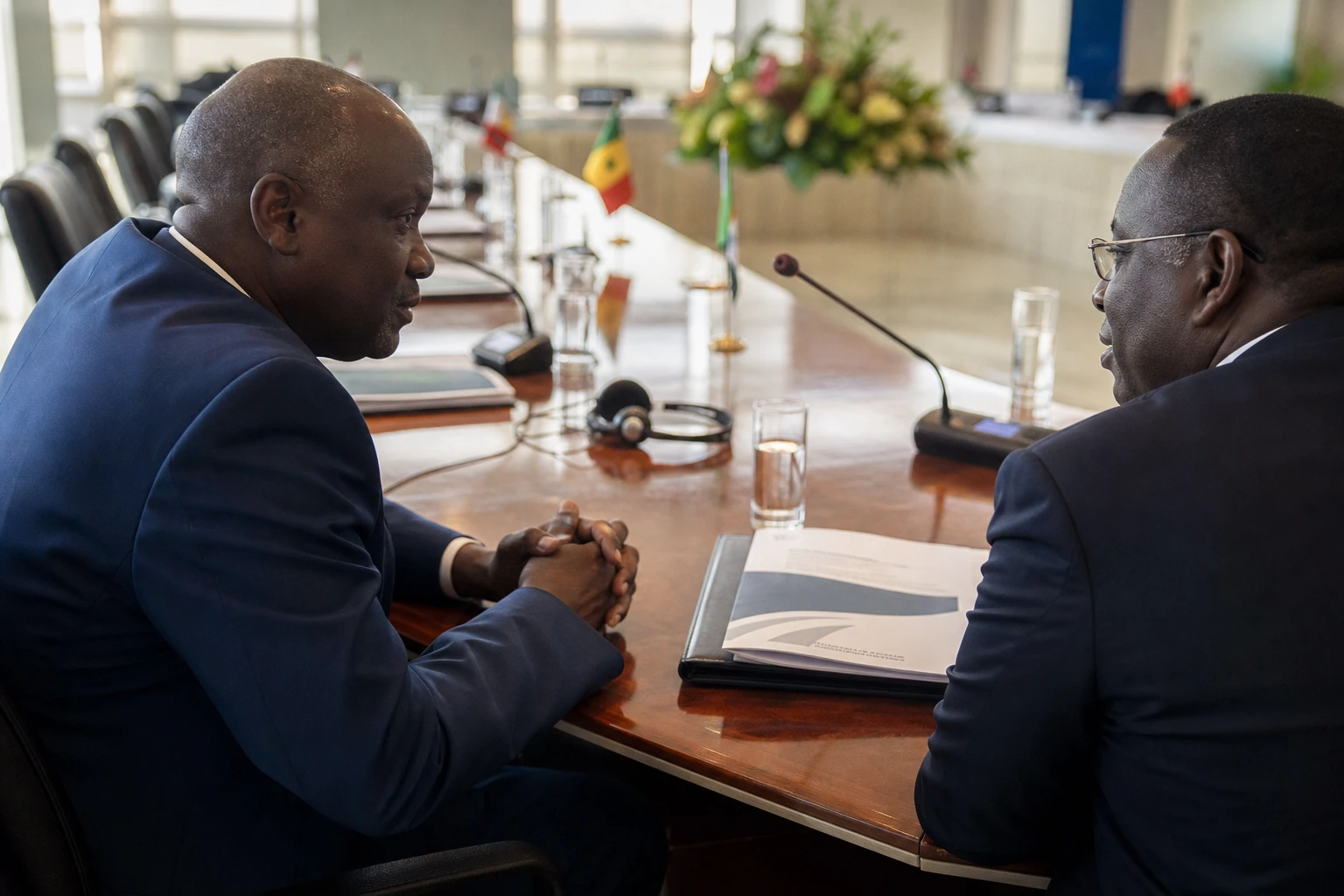
A majority taking on a new shape in Dakar
In Senegal, political realignments are no longer just about factional disputes. They also reveal how power is organised around a state under pressure, debt that needs clarifying and a political base seeking a new anchor. In this context, Bassirou Diomaye Faye’s creation of a party is not merely a symbolic gesture. It redraws the centre of gravity of the presidential majority in Dakar.
The institutional backdrop matters. Senegal remains a closely watched West African democracy and a member of ECOWAS, as the regional organisation prepares a new phase of its executive with the appointment of Senegalese General Birame Diop as head of its Commission from 1 September 2026. This coincidence is a reminder that in Dakar, domestic politics and regional ambitions often move forward together.
What Diomaye Faye launched in Dakar on Saturday
On Saturday 25 July 2026, Bassirou Diomaye Faye officially launched his own political party in Dakar, named KIIRAAY – The Republican Patriots. The move carries considerable weight. It formalises a break with the party structure that brought him to power in 2024, when he ran under the banner of Pastef, the party of his former ally Ousmane Sonko.
This break did not come out of nowhere. For several weeks, Pastef officials, including regional figures and youth members, had already left the party to join the presidential camp. Elected representatives from other backgrounds, including former members of the Alliance for the Republic, have also joined the new movement. KIIRAAY’s launch thus formalised a shift already under way on the political ground.
The core of the disagreement remains clear: relations between Bassirou Diomaye Faye and Ousmane Sonko have deteriorated over governance choices, particularly the strategy towards the International Monetary Fund amid high debt. At the end of June 2026, the IMF still said that the Senegalese authorities remained engaged with it to build a new programme, while budgetary and debt vulnerabilities remained acute.
Debt, political discipline and power dynamics
Domestically, the creation of a presidential party shifts several balances at once. First, it gives Diomaye Faye an organisation of his own, distinct from Pastef and the coalition that supported him in the 2024 election. Second, it forces allies to choose sides earlier than expected. Finally, it creates a space for direct competition with Ousmane Sonko, now president of the National Assembly and leader of a party that intends to remain central.
This development is all the more significant because Senegal is emerging from a period of political and institutional tensions marked by the issue of hidden debt, brought to light from 2024 onwards, followed by tough discussions with financial partners. In June 2026, the IMF confirmed that debt-related vulnerabilities remained high, even after budget indicators improved in 2025. In this context, the party battle is not just about positions. It also affects the country’s economic credibility.
For Senegalese people, the stakes are tangible. In the capital, political decisions quickly feed into debate over the cost of living, public-sector employment, relations with lenders and the place of young people in the labour market. In the regions, where local networks carry considerable weight, the movement of activists and elected representatives from one camp to another can change access to administrative contacts, nominations and development projects. Coalition politics therefore remains a means of managing the territory as much as an electoral tool.
A political sequence that goes beyond Senegal
The issue’s continental significance rests on two factors. The first is political: Senegal shows that a successful electoral transition does not put an end to internal realignments. On the contrary, coming to power often raises the question of majority discipline, a familiar issue in several West African states. The second is institutional: in a West Africa facing military transitions, budgetary pressures and doubts about regional integration, Senegal’s stability remains a closely watched indicator.
The calendar will now set the pace. The next local elections in 2027 will test the new presidential organisation, its municipal networks and its ability to endure. The 2029 presidential election, still some way off but already part of political strategists’ calculations, will offer a broader test. Until then, it is not just the name of a party that matters. It is the Senegalese government’s ability to turn an electoral victory into a stable political structure without losing sight of the economic issue that accelerated this rupture.