Algeria
 Egypt
 Libya
 Morocco
 Sudan
 Tunisia
 Benin
 Burkina Faso
 Cabo Verde
 Côte d'Ivoire
 Ghana
 Guinea
 Guinea-Bissau
 Liberia
 Mali
 Mauritania
 Niger
 Nigeria
 Sierra Leone
 The Gambia
 Togo
 Cameroon
 Central African Republic
 Chad
 DR Congo
 Equatorial Guinea
 Gabon
 Republic of the Congo
 São Tomé and Príncipe
 Burundi
 Comoros
 Djibouti
 Eritrea
 Ethiopia
 Kenya
 Madagascar
 Malawi
 Mauritius
 Mozambique
 Rwanda
 Seychelles
 Somalia
 South Sudan
 Tanzania
 Uganda
 Angola
 Botswana
 Eswatini
 Lesotho
 Namibia
 South Africa
 Zambia
 Zimbabwe
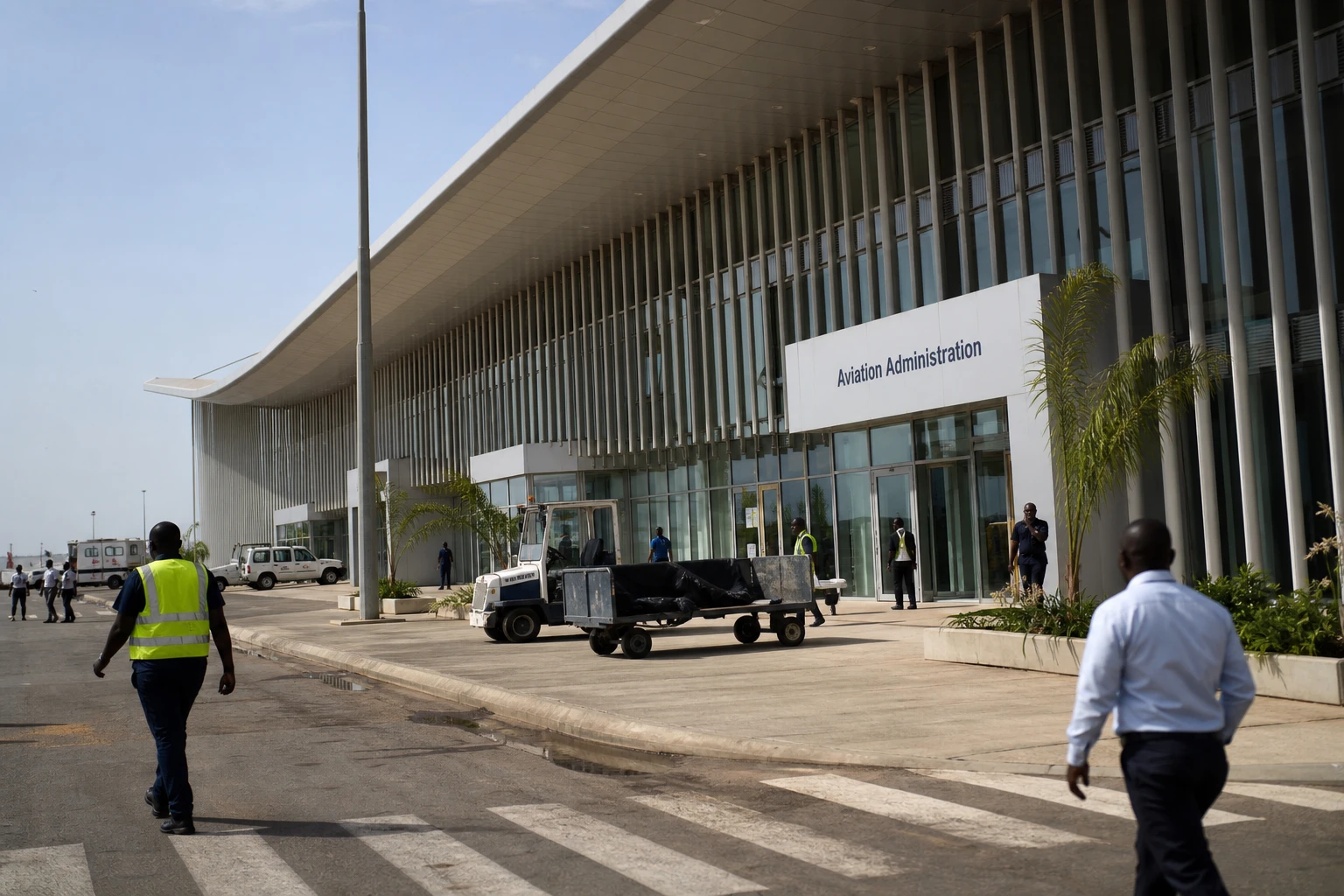
A terminal under pressure—and under scrutiny
In Dakar, the airport is more than a gateway. It is also a barometer of Senegalese mobility, foreign trade and the country’s place in West African air links. When traffic picks up, an entire chain starts moving again: airlines, freight forwarders, exporters and public services.
In Senegal, this takes on particular significance. Blaise Diagne International Airport, at Diass, is presented by its promoters as the future hub of a regional aviation hub by 2035, with a target capacity of 10 million passengers. The airport is also at the heart of a broader strategic environment, as Dakar has hosted the International Civil Aviation Organization’s West and Central Africa office since 1963, reinforcing its role as a regional aviation anchor.
Figures confirm a recovery, but 2025 still looms
In the first six months of 2026, AIBD handled 1,481,529 passengers, up 4.3% year on year. The breakdown matters: 687,305 arrivals, 720,840 departures and 73,384 transit passengers. These figures are consistent with trends in Senegal’s public statistics, which had already shown a total of 735,370 passengers in the first quarter of 2026, up 2.45% on the same period in 2025.
Cargo is following the same trajectory. The airport recorded 22.3 million kilograms of freight during the half-year, up 17.93%. According to published data, the increase was driven by a 26.57% rise in exports. Here too, official figures available early in the year pointed in the same direction, with cargo already trending upwards in the first quarter of 2026.
The signal is all the clearer because it follows an almost flat 2025. Available data showed 2.94 million passengers for the year as a whole, an increase of just 0.46%. Traffic was still being held back by a reduction in flight frequency and a contraction in air freight.
Europe ahead of Africa, but traffic flows are shifting
The first half of 2026 also confirmed the market hierarchy. Europe remains AIBD’s largest traffic market, with 693,468 passengers, up 7.62%. Africa follows with 581,971 passengers, an increase of 3.33%. This snapshot says something about the structure of Senegal’s trade: links with the Old Continent remain dominant, but intra-African flows retain substantial weight and clear economic value for business travellers, the diaspora and regional mobility.
This point should be viewed in a West African context. Senegal is not simply a country of departure and arrival; it is also seeking to consolidate its position as a connecting hub. That requires regular flights, greater operational reliability and cargo capacity able to handle higher-value exports. In practice, the benefits will not be the same for everyone: major logistics companies gain visibility, while small agri-food supply chains and exporters of fresh produce are chiefly looking for shorter lead times and more stable costs.
Senegal’s authorities are also working to a timetable that demands efficiency. AIBD is being mobilised for the Dakar 2026 Youth Olympic Games, with a commitment protocol signed on 8 July 2026 by airport stakeholders to streamline arrivals and departures and improve the visitor experience. This adds a practical constraint: service quality will be judged not only by the figures, but by the ability to handle traffic peaks without visible friction.
What the recovery says about Senegal—and what it does not yet say
This rebound in air traffic does not mean that all vulnerabilities have disappeared. Growth of 4.3% remains modest given the airport’s stated capacity and its ambition to become a hub. Above all, it points to a return of momentum after an uncertain 2025. For Senegalese travellers and exporting businesses alike, the real issue is consistency: fewer cancellations, fewer missed connections, and greater reliability in schedules and ground services.
Cargo, meanwhile, deserves particular attention. Double-digit growth can support the horticulture, fisheries and pharmaceutical sectors, provided infrastructure keeps pace. For now, the signal is positive, but it will be necessary to see whether the trend holds through the end of the year and whether it rests on a broad base or a few highly active segments. The question is not only one of volume. It is also about the value captured in Senegal, through jobs, services and logistics revenue.
In an ECOWAS region still marked by political tensions, restrictions on movement and the reshaping of air routes, the performance of a major hub such as AIBD goes beyond the national context. It reflects Senegal’s ability to remain connected to the continent and the rest of the world through stable corridors. In the coming months, it will also show whether Dakar can turn a technical recovery into a lasting advantage. The next milestones to watch are the end of 2026, operational readiness for the Dakar 2026 Youth Olympic Games, and developments in regional routes and export cargo.