Algeria
 Egypt
 Libya
 Morocco
 Sudan
 Tunisia
 Benin
 Burkina Faso
 Cabo Verde
 Côte d'Ivoire
 Ghana
 Guinea
 Guinea-Bissau
 Liberia
 Mali
 Mauritania
 Nigeria
 Senegal
 Sierra Leone
 The Gambia
 Togo
 Cameroon
 Central African Republic
 Chad
 DR Congo
 Equatorial Guinea
 Gabon
 Republic of the Congo
 São Tomé and Príncipe
 Burundi
 Comoros
 Djibouti
 Eritrea
 Ethiopia
 Kenya
 Madagascar
 Malawi
 Mauritius
 Mozambique
 Rwanda
 Seychelles
 Somalia
 South Sudan
 Tanzania
 Uganda
 Angola
 Botswana
 Eswatini
 Lesotho
 Namibia
 South Africa
 Zambia
 Zimbabwe
A case that is about more than detention
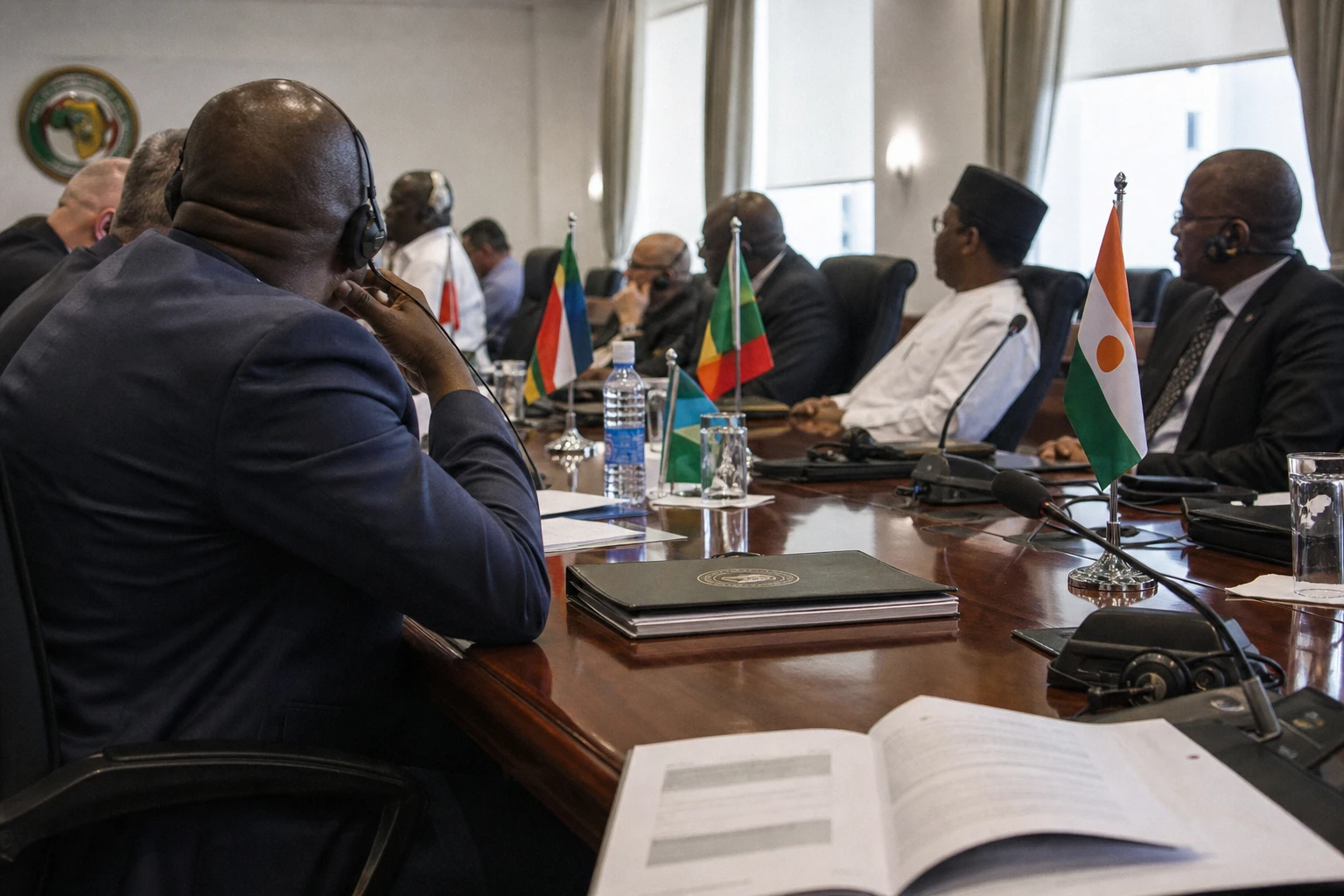
In Niamey, the Mohamed Bazoum case is more than a legal dispute. It also speaks to the fragility of a military transition, the role of regional institutions and Niger’s difficulty in closing the chapter opened by the coup of 26 July 2023. In a capital under the control of the transitional authorities, the former head of state remains detained with his wife, Hadiza, in a wing of the presidential palace.
The issue goes beyond the former president himself. It touches on the credibility of the constitutional order, the relationship between military rule and the justice system, and Niger’s ties with its neighbours and with ECOWAS, the Economic Community of West African States. Since January 2025, the country has formalised its withdrawal from the organisation, further reducing the scope for regional mediation.
What the facts show
Mohamed Bazoum’s lawyers have called for his immediate release, along with that of his wife, saying they have been living in near-total isolation for almost three years. The couple has been held within the presidential compound in Niamey since General Abdourahamane Tiani and his men seized power on 26 July 2023.
The legal issue has become central. In 2024, the UN Working Group on Arbitrary Detention ruled that the deprivation of liberty of Mohamed Bazoum and Hadiza Bazoum was arbitrary and called for their immediate release. It also called for them to be granted redress and for an independent investigation to be opened.
Politically, the situation remains deadlocked. In the aftermath of the coup, the transitional authorities had suggested that the former president could face proceedings for treason or endangering state security. But no credible information indicates that a trial has officially begun. Meanwhile, Bazoum’s presidential term ended in early April 2026, without him resuming his duties or relinquishing his status.
Niamey, justice and the regional balance of power
The case is part of a broader political trajectory. Since the 2023 coup, Niger has joined Mali and Burkina Faso in a security and diplomatic realignment in the Sahel. The three countries left ECOWAS on 29 January 2025, a rupture that has complicated the usual channels for regional engagement. ECOWAS has, however, retained some practical arrangements, such as the provisional recognition of passports and identity cards bearing its logo.
At stake is more than a humanitarian issue. The detention of a former president without clear public proceedings has fuelled criticism of the rule of law. It also weighs on the image of a government seeking to present itself as a restorer of sovereignty and stability. Conversely, a release could be seen as a conciliatory gesture, without settling the debate over responsibility for the coup or the ongoing transition.
Regional institutions have not backed down symbolically. In December 2025, ECOWAS leaders again reaffirmed their demand for the unconditional release of Mohamed Bazoum and their rejection of unconstitutional changes of government. The organisation also reiterated its zero-tolerance stance towards seizures of power by force.
Why the case matters beyond Niger
Across the Sahel, every military transition is watched as a precedent. The Niger case is therefore of interest to the region’s capitals and to the African Union, which continues to defend the principle of constitutional succession. The Bazoum case has in effect become a test of whether African organisations can still influence the resolution of crises, beyond statements of principle.
The security context reinforces this interpretation. In June 2026, the African Union condemned an attack on Niamey’s international airport, noting that Niger’s stability remains tied to the terrorist threat across the Sahel belt. Against this backdrop, the transitional government is seeking to maintain control on two fronts at once: domestic security and institutional legitimacy.
For Niger’s population, the case carries a less visible but very real cost. It prolongs political uncertainty, complicates relations with some neighbours and leaves a crucial chapter in the country’s institutional life unresolved. For economic actors, particularly in border areas and the informal trade sector, regional tensions continue to weigh on flows, even as bilateral discussions with Benin resumed in 2026 over a possible reopening of the border.
What happens next will depend less on statements than on a clear political choice: to open a credible judicial process, ease pressure on the former president, or prolong a status quo that fuels external criticism. For Niamey, the Bazoum question remains a defining marker. It will show whether the transition intends to move towards a clearer institutional framework or remain in a logic of force, in which detention becomes an instrument of government.