
 Algeria
 Egypt
 Libya
 Morocco
 Sudan
 Tunisia
 Benin
 Burkina Faso
 Cabo Verde
 Côte d'Ivoire
 Ghana
 Guinea
 Guinea-Bissau
 Liberia
 Mali
 Mauritania
 Niger
 Nigeria
 Senegal
 Sierra Leone
 The Gambia
 Togo
 Cameroon
 Central African Republic
 Chad
 DR Congo
 Equatorial Guinea
 Gabon
 Republic of the Congo
 São Tomé and Príncipe
 Burundi
 Comoros
 Djibouti
 Eritrea
 Ethiopia
 Kenya
 Madagascar
 Malawi
 Mauritius
 Mozambique
 Rwanda
 Seychelles
 Somalia
 South Sudan
 Tanzania
 Uganda
 Angola
 Botswana
 Eswatini
 Lesotho
 Namibia
 Zambia
 Zimbabwe
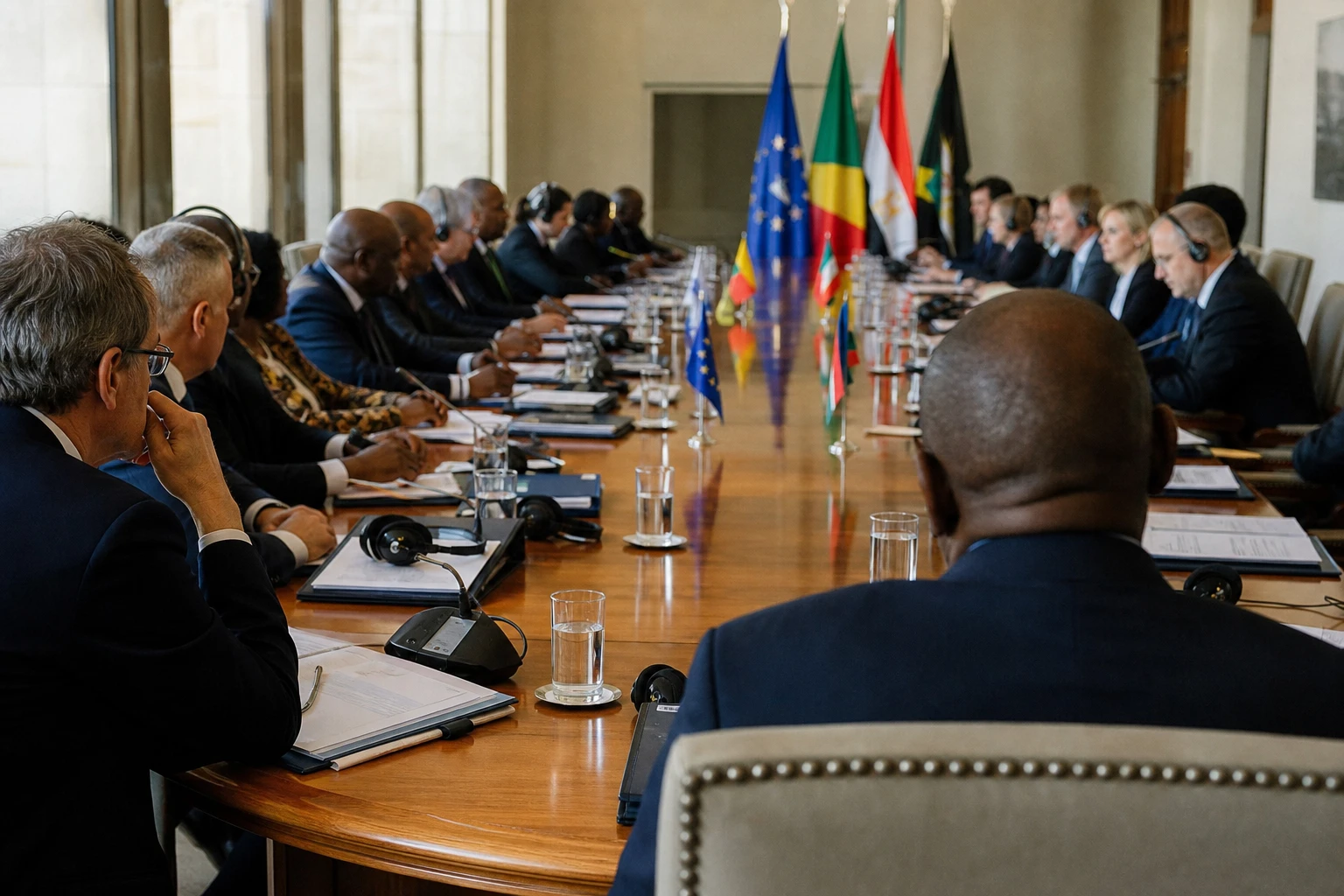
A dialogue that goes beyond a simple visit
In Pretoria, a diplomatic meeting can quickly take on a wider significance than a bilateral discussion. When the economy, the energy transition and the future of the G20 are on the same agenda, South Africa’s place in the global balance of power is at stake. For South African authorities, the challenge is clear: to turn significant diplomatic capital into concrete results for growth, investment and employment.
The visit by German Foreign Minister Johann Wadephul follows this logic. Berlin and Pretoria have maintained close relations for three decades, structured in particular by a binational commission established in 1996. Germany remains a major economic partner for South Africa and its second-largest bilateral trading partner, with trade exceeding €20 billion, according to the German Foreign Ministry. At the same time, South Africa, alongside the African Union, remains one of the continent’s gateways to major global governance forums.
Pretoria sets out its priorities plainly
Discussions on 23 July 2026 focused on economic growth and accelerating a just energy transition: the shift to cleaner energy without leaving workers and communities dependent on coal to bear the cost of change. This is a sensitive issue in South Africa, where energy security, power cuts and grid modernisation continue to weigh on industrial activity and daily life. The South African government says it wants to make the transition a driver of reindustrialisation, particularly in green hydrogen and battery value chains.
Cooperation with Germany is not starting from scratch. It forms part of the Just Energy Transition Partnership launched in 2021 with several Western partners, including Berlin, to support the country’s decarbonisation. Pretoria’s investment plan was valued at about $98 billion. Official documents also link German cooperation to funding for green hydrogen and batteries, with more than €270 million mobilised for these sectors under Global Gateway. In other words, bilateral relations are no longer limited to statements of principle; they are now targeting specific industrial sectors.
On the diplomatic front, Johann Wadephul also reaffirmed Germany’s support for a stronger African presence in global institutions. Berlin has advocated for the African Union to become a full member of the G20 and supported South Africa’s place at the table. This matters to Pretoria because it confirms that some of its European partners see the G20 as a vehicle for African representation, rather than a closed club of distant powers.
The G20: a symbol turned political test
The most political issue during the visit, however, remains the future of the G20. South Africa concluded its G20 presidency in 2025, the first held by an African country. In November 2025, Johannesburg hosted the G20 summit of heads of state and government. But the proceedings were overshadowed by the US boycott, followed a few days later by Donald Trump’s decision, announced at the time, not to invite South Africa to the 2026 G20 in Miami. Reuters and the Associated Press reported the announcement, which was justified by allegations of persecution of Afrikaners, claims that have been widely contested.
In Pretoria, Ronald Lamola posed the fundamental question: what is the point of a G20 that excludes one of its founding members? This is not merely a rhetorical question. It goes to the credibility of multilateralism, at a time when the African Union has secured a permanent seat in the G20 and South Africa still carries the legacy of its own presidency of the forum. If a member can be excluded for political reasons, the risk is twofold: undermining the group’s legitimacy and reducing Africa’s room for manoeuvre in discussions on debt, trade, climate and international financial reform.
South Africa’s position is also shaped by the regional context. In southern Africa, Pretoria remains the most influential diplomatic and economic power in SADC, the Southern African Development Community. When South Africa speaks about the G20, it also speaks for a region that depends heavily on trade flows, energy and foreign investment. A stand-off with Washington or a rift with a G7 partner therefore has different effects on diplomatic elites than on businesses, exporters, port workers or households under pressure from rising prices.
What this episode says about South Africa and the continent
The German visit first shows that South Africa remains a platform for dialogue between Europe and Africa. It also shows that a just energy transition is no longer a secondary issue. It is becoming a pillar of industrial policy, climate diplomacy and economic sovereignty. In a country where electricity, manufacturing jobs and social stability remain interlinked, the transition cannot be reduced to closing power stations or setting abstract decarbonisation targets. It must create local value chains, skilled jobs and sustainable revenue. This is precisely where the credibility of partnerships is at stake.
The second lesson concerns the continental level. The African Union now has a seat in the G20. This changes the balance of power, provided African countries genuinely coordinate their positions. South Africa, with its experience of holding the presidency in 2025, can help shape this role. But the continent also knows that a formal presence is not enough. It must champion shared priorities: reform of the international financial architecture, climate finance, industrialisation, food security and a stronger place for African value chains in global trade. The G20 matters to Africa only if it serves these goals.
Finally, the significance of this visit extends beyond the strictly German-South African relationship. It is a reminder that South Africa remains a pivotal actor in the Global South, at the crossroads of SADC, BRICS, the G20 and discussions on reforming global governance. In the coming months, attention will remain focused on how Washington handles the South African question at the G20 in Miami, as well as on Pretoria’s ability to turn its European and African alliances into tangible economic results. Ultimately, this is how the real weight of an African diplomacy that wants to count without giving up its dignity or its own interests will be measured.



