Algeria
 Egypt
 Libya
 Morocco
 Sudan
 Tunisia
 Benin
 Burkina Faso
 Cabo Verde
 Côte d'Ivoire
 Ghana
 Guinea
 Guinea-Bissau
 Liberia
 Mali
 Mauritania
 Niger
 Nigeria
 Senegal
 Sierra Leone
 The Gambia
 Togo
 Cameroon
 Chad
 DR Congo
 Equatorial Guinea
 Gabon
 Republic of the Congo
 São Tomé and Príncipe
 Burundi
 Comoros
 Djibouti
 Eritrea
 Ethiopia
 Kenya
 Madagascar
 Malawi
 Mauritius
 Mozambique
 Rwanda
 Seychelles
 Somalia
 South Sudan
 Tanzania
 Uganda
 Angola
 Botswana
 Eswatini
 Lesotho
 Namibia
 South Africa
 Zambia
 Zimbabwe
When land becomes a lever for stability
In Bangui, land is not used only to grow food. It is also becoming a space for economic recovery, dignity and independence for households facing irregular incomes and a fragile food market. In the Central African Republic, this is no abstract reality: it directly affects families, women traders, farmers and young people seeking sustainable work.
Josiane Tambassoua’s story illustrates this quiet but decisive shift. In a country where agriculture remains central to food and employment, women are taking on a growing role in production, processing and marketing chains. UN agencies and the African Development Bank also support several programmes explicitly targeting women and young people, a sign that the issue goes beyond the social sphere alone.
A country where feeding the population remains a national challenge
The Central African Republic continues to face acute food insecurity. The World Food Programme estimates that 31% of the population suffers from severe food insecurity, while the FAO says around 1.9 million people, or nearly 30% of the population assessed, are expected to face high levels of acute food insecurity between September 2025 and March 2026. These figures are a reminder that farming here is as much a matter of survival as an economic sector.
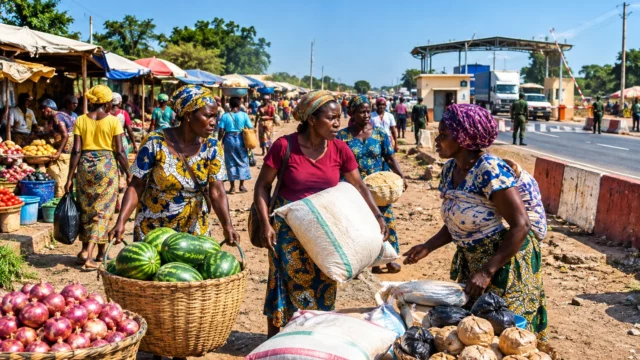
The national context also explains this pressure. Population displacement, difficulties accessing inputs, insecurity in some areas and poor infrastructure weigh on rural areas as well as urban markets. The rainy season further isolates several areas, driving up the cost of transporting food products to Bangui and other centres of consumption.
In this landscape, women are not merely helping their families. They are producers, traders and often managers of small farms. The UN system in the Central African Republic and UNDP launched initiatives for women’s economic empowerment in 2026, while the FAO stepped up training and equipment provision for women and young people in Bangui and other localities.
What a well-run farm can do
On Josiane Tambassoua’s farm, the tasks are easy to name but demanding day to day: weeding, maintenance, crop monitoring, seed preparation and organising work. Cassava, maize and groundnuts make up a diversified farming model, suited to local food needs and sales in markets. This diversity reduces risks and improves the chances of earning an income, especially when the harvest must feed both the family and the business.
Her account highlights a very practical approach: produce first to secure food on the table, then sell the surplus to cover household expenses. In a country where food prices remain sensitive to logistical disruptions, this balance between self-consumption and sales protects households from market fluctuations. It is also what gives small-scale farming its value, often underestimated in economic debates.
The views of agricultural workers confirm this. When a farm is productive, it supports a whole local network: labourers, transporters, resellers, neighbourhood markets and families buying goods at retail. The informal sector then absorbs some rural and peri-urban employment, making every harvest important far beyond the plot itself.
Women, an economic driver still underfunded
Josiane Tambassoua’s story is part of a broader trend: in the Central African Republic, recent programmes explicitly link agriculture, gender and recovery. The Ngangû Wali project, launched in Bangui in February 2026, aims to promote women’s sustainable economic empowerment over three years. Meanwhile, a project backed by the African Development Bank is focusing on regenerative agriculture and agroforestry to strengthen climate resilience, with particular attention to women and young people.
This approach makes sense. Women are responsible for a substantial share of food production, but they still have unequal access to land, finance, equipment and training. When these barriers recede, the effects extend beyond the farm itself: incomes become more stable, local processing expands and dependence on imports falls slightly.
Josiane Tambassoua wants to go further, with exports to countries in the sub-region and a training centre for women. The idea is strategic. In the CEMAC region, where agricultural trade is still too often held back by logistical costs and a lack of standardisation, local processing and skills development can create more reliable markets than selling unprocessed harvests alone.
An impact that extends beyond the farm
The Central African case speaks to all of Central Africa. It is a reminder that food security policy does not rely only on imports, emergency aid or major projects. It also depends on well-managed local farms, women’s genuine access to the means of production and a value chain linking fields to markets.
It also says something broader about the continent’s resilience. Where prolonged crises weaken households, the most sustainable solutions often come from activities rooted in everyday life: producing, processing, selling and training. In the Central African Republic, this path is already visible. It does not solve everything. But it is shaping a stronger basic economy, driven by women who are turning the land into a prospect of stability.