Algeria
 Egypt
 Libya
 Morocco
 Sudan
 Tunisia
 Benin
 Burkina Faso
 Cabo Verde
 Côte d'Ivoire
 Ghana
 Guinea-Bissau
 Liberia
 Mali
 Mauritania
 Niger
 Nigeria
 Senegal
 Sierra Leone
 The Gambia
 Togo
 Cameroon
 Central African Republic
 Chad
 DR Congo
 Equatorial Guinea
 Gabon
 Republic of the Congo
 São Tomé and Príncipe
 Burundi
 Comoros
 Djibouti
 Eritrea
 Ethiopia
 Kenya
 Madagascar
 Malawi
 Mauritius
 Mozambique
 Rwanda
 Seychelles
 Somalia
 South Sudan
 Tanzania
 Uganda
 Angola
 Botswana
 Eswatini
 Lesotho
 Namibia
 South Africa
 Zambia
 Zimbabwe
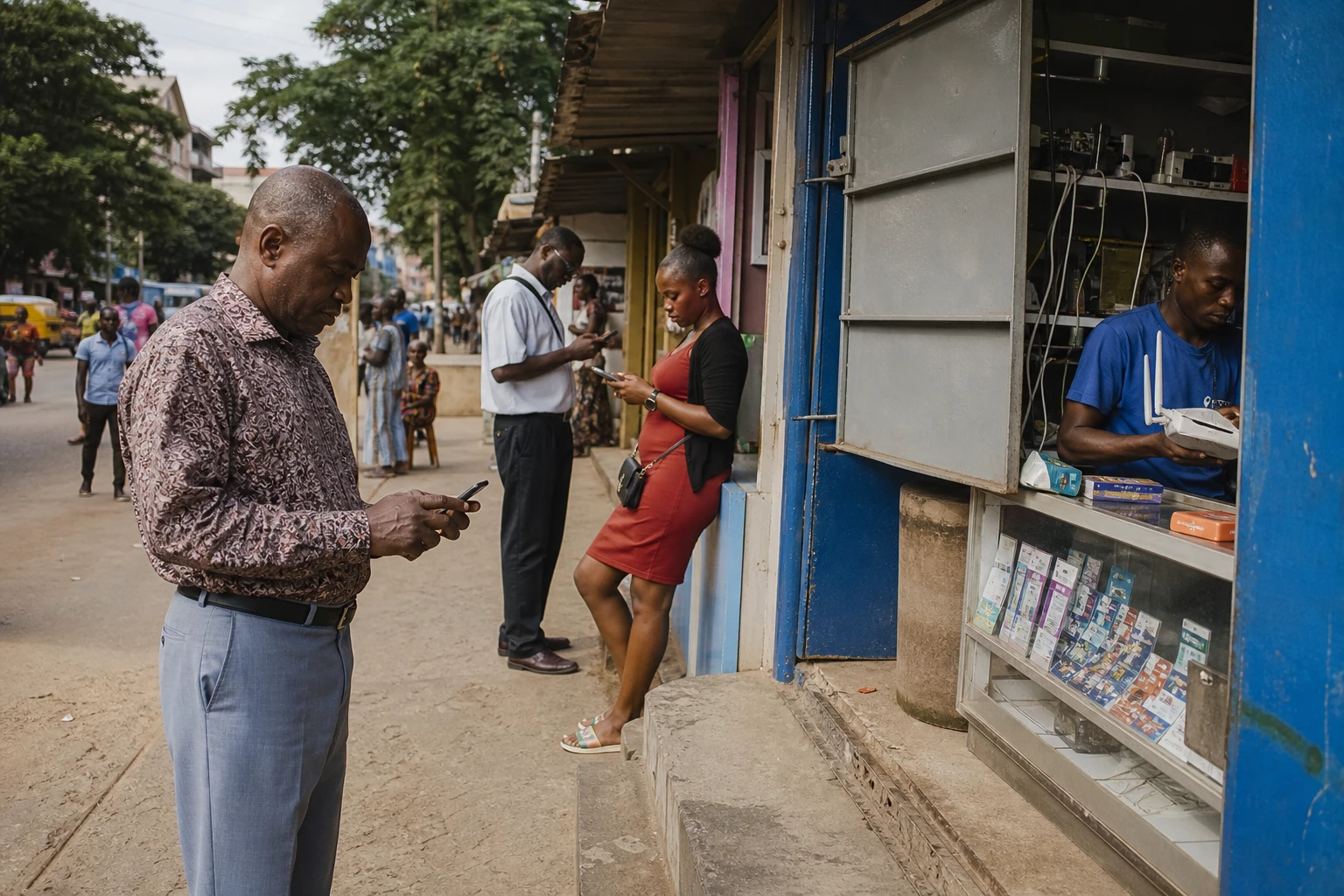
A telecoms market no longer defined by subscriber numbers alone
In Conakry, the digital battle is no longer just about network coverage. It also concerns jobs, operators’ finances and the Guinean state’s ability to make mobile phones a genuine driver of development. In this landscape, Cellcom’s situation matters beyond a single company: it says something about the health of Guinea’s telecoms market and, more broadly, the quality of services provided to users, businesses and the administration.
The ministry responsible for communication, digital affairs, posts and telecommunications has made this a closely monitored issue. The department led by Mourana Soumah has put digital transformation at the heart of its mission, with an agenda linked to modernising public action and the Simandou 2040 vision, which provides a framework for several of the country’s economic and technological projects.
Cellcom under pressure, between a stated recovery and persistent weaknesses
On 21 July 2026, Minister Mourana Soumah met Cellcom’s management to review the recovery measures launched by the operator, its technical difficulties and its infrastructure needs. The meeting was part of a series of consultations with sector players, following talks with Orange Guinea and internet service provider ETI. The minister’s public message remained firm: operators must invest more, improve service quality and extend their coverage.
Cellcom, for its part, says it has launched a transformation plan. In its April 2026 statement, the company confirmed organisational adjustment measures, including a targeted economic redundancy programme. It also cited the gradual renewal of its equipment and the deployment of new capacity, particularly 4G. The statement further acknowledged cash-flow pressures and occasional salary delays, while saying that these had not exceeded one month.
These explanations have not allayed every concern. In spring 2026, workers denounced what they described as unilateral redundancies, late payments and mismanagement. The Autonomous Telecommunications Trade Union Federation, FESATEL, even said it intended to petition the authorities for an audit of the company, or even temporary administration if the situation required it. In this kind of crisis, the social impact is immediate for employees, but also for subcontractors and informal incomes linked to the operator’s activities.
Falling market share sends a signal to the entire sector
Figures from the Postal and Telecommunications Regulatory Authority point to a long-standing decline, not merely a short-term setback. In its 2023 annual report, ARPT said Cellcom then held 6.3% of the mobile telephony market, compared with 69.5% for Orange and 24.2% for MTN. Cellcom’s share of mobile internet stood at 6%. Internet and traffic data confirm the already clear dominance of the two leading operators and Cellcom’s loss of momentum.
The trend worsened thereafter. ARPT’s Telecoms Observatory published a market report for the second quarter of 2025, posted online on 25 November 2025, showing that the regulator continues to track developments in the sector. Figures on Cellcom cited by the local press, and reproduced in the material to be reconstructed, show a fall to 2.4% of mobile subscriptions at the end of June 2025 and to 1.9% of mobile internet. Set against ARPT’s earlier data, this points to a sustained erosion of the operator’s subscriber base and economic weight.
The company is also financially vulnerable. Cellcom’s April 2026 statement refers to falling revenue and urgent investment needs. In a market where service quality depends heavily on infrastructure renewal, an operator that is slow to modernise its network quickly loses customers, then revenue, then its capacity to invest. It is a familiar vicious circle. For Guinean users, it means less competition, greater pressure on prices and, at times, uneven service quality between areas of Conakry and the regions inland.
What this recovery effort says about Guinea and West Africa
The issue goes beyond Cellcom. In Guinea, digital technology has become a central tool for government, financial services, businesses and regional connectivity. The ministry has also pointed to projects involving infrastructure, digital certification and modernisation, as part of a broader drive towards digital integration. In West Africa, where mobile use underpins a large part of the real economy, the strength of a private operator affects market competitiveness as much as citizens’ access to services.
What happens next will depend on two factors. First, Cellcom’s ability to finance its recovery without prolonging the social crisis. Second, the ability of the state and regulator to maintain a credible, clear and balanced framework for competition, service quality and job protection. In such a strategic sector, an operator’s recovery is measured not only by its balance sheets: it is measured by its ability to become useful to Guineans again, in Conakry and across the rest of the country, and to hold its own in an increasingly demanding regional market.