Algeria
 Egypt
 Libya
 Morocco
 Sudan
 Tunisia
 Benin
 Burkina Faso
 Cabo Verde
 Côte d'Ivoire
 Ghana
 Guinea
 Guinea-Bissau
 Liberia
 Mali
 Mauritania
 Niger
 Nigeria
 Senegal
 Sierra Leone
 The Gambia
 Togo
 Cameroon
 Central African Republic
 Chad
 Equatorial Guinea
 Gabon
 Republic of the Congo
 São Tomé and Príncipe
 Burundi
 Comoros
 Djibouti
 Eritrea
 Ethiopia
 Kenya
 Madagascar
 Malawi
 Mauritius
 Mozambique
 Rwanda
 Seychelles
 Somalia
 South Sudan
 Tanzania
 Uganda
 Angola
 Botswana
 Eswatini
 Lesotho
 Namibia
 South Africa
 Zambia
 Zimbabwe
A fragile lull in the Congolese debate
In the Democratic Republic of the Congo, a simple suspension of a march can sometimes say more than an official speech. In Kinshasa, the stand-off over possible constitutional reform has temporarily moved from the streets back to the negotiating table, but there is no sign yet that the political climate has truly eased.
The issue goes beyond an institutional dispute. It touches on trust between the government, the opposition and religious denominations in a country where churches often act as mediators when political channels are blocked. Once again, the National Episcopal Conference of Congo (CENCO) and the Church of Christ in Congo (ECC) have been placed at the centre of the process.
Religious mediation takes the lead again
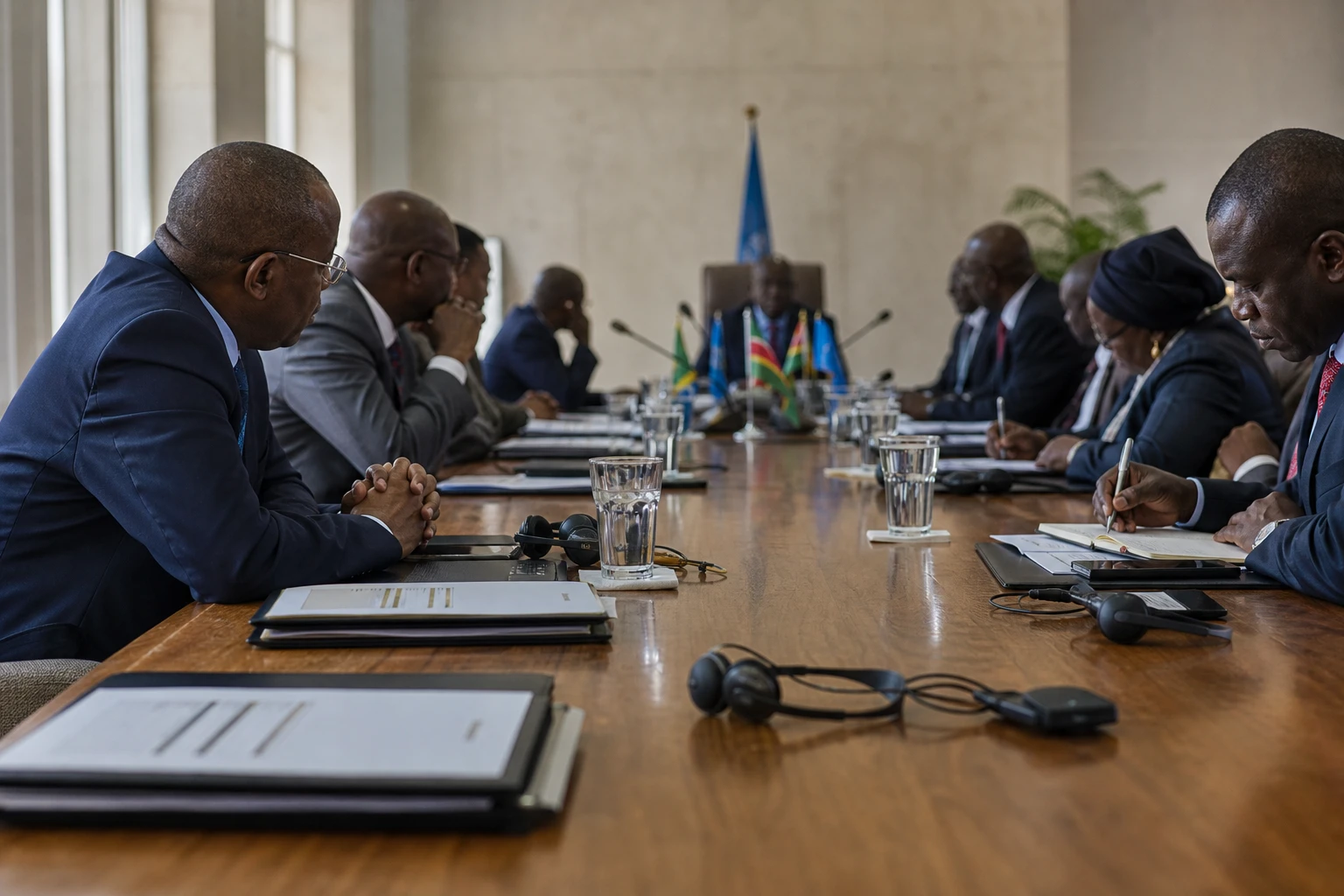
On Friday 17 July 2026, Félix Tshisekedi received a delegation of the main religious denominations in Kinshasa, at the Cité de l’Union africaine. After the meeting, Cardinal Fridolin Ambongo said the head of state had opted to organise an inclusive national dialogue, with the churches providing support. The presidency presented the initiative as a response to current tensions and as a framework intended to respect the institutions and the Constitution.
Two days later, CENCO and ECC leaders continued their consultations with the C64 opposition coalition, formed in May 2026 to oppose any constitutional revision seen as paving the way for a third term. The churches then asked the opposition to postpone the march planned for 22 July. The coalition eventually announced on Monday 20 July that it was postponing the mobilisation, and gave the government until 15 August to formally convene the dialogue.
This sequence confirms an important fact: in DR Congo, religious mediation is not merely a moral force. It also provides a framework for trust when parties no longer speak directly to one another. In 2016, and during other periods of political crisis, religious denominations have already occupied this transitional space.
The heart of the dispute: the Constitution and fear of setting a precedent
The current debate concerns the Constitution of 18 February 2006, a text born of the end of the war and designed as a national compromise. Several opposition figures believe that changing this fundamental law could weaken limits on executive power. The presidential camp, for its part, presents the debate as a broader institutional discussion about adapting the political framework. Ebuteli, the Congolese institute for research on politics, governance and violence, argued in March 2026 that the Constitution was neither exhausted nor the primary cause of institutional deadlock.
C64 was launched in Kinshasa on 19 May 2026. According to its spokespeople, it brings together several opposition figures around a shared position: preventing any reform that could circumvent the spirit of term limits. This view gained traction after the first demonstrations were held in June, at times amid tensions in the capital. On 12 June, clashes broke out in Kinshasa at a rally against the proposed constitutional change, which was dispersed by police.
The march announced for 22 July was therefore set to be a political test. Its postponement does not close the issue. Rather, it signals that neither camp wants to appear to be shutting the door on discussion. The opposition is maintaining pressure. The government, meanwhile, is seeking to turn a crisis of confidence into a period of consultation.
What this means for the Congolese
For the institutions, the challenge is clear: prevent the constitutional dispute from adding to an already difficult situation. DR Congo faces a build-up of tensions, particularly in the east, where the war with Rwanda-backed M23 continues to weigh on national security, public finances and perceptions of the government in Kinshasa. In this context, another political crisis would further weaken the state’s ability to govern day to day.
For the population, the question is more immediate. In the capital, any rise in tensions quickly brings traffic disruption, closures, possible arrests and a slowdown in the urban economy. In the provinces, where the informal economy often dominates, this kind of crisis mainly fuels uncertainty over prices, access to public services and citizens’ real place in political decision-making. Institutional debates then take on a very tangible dimension.
The religious denominations, for their part, are playing a delicate hand. Their credibility depends on their ability to speak to all camps without being drawn into any one of them. If they secure a credible dialogue format, they will strengthen their role as social arbiters. If the process fails, they risk being accused of serving as a screen for a political confrontation already under way.
A Congolese issue with regional resonance
This issue is not confined to DR Congo. In the Great Lakes region and Central Africa, Kinshasa’s institutional stability affects the region as a whole. Any political crisis in the country’s heartland has consequences for security balances, population movements and regional diplomacy. The East African Community (EAC) and the Southern African Development Community (SADC) are already closely monitoring security dynamics in eastern Congo.
At continental level, the issue also serves as a reminder of a point that is often underestimated: term limits, constitutions and peaceful transitions remain central questions in several African countries. DR Congo did not invent this debate, but its demographic weight, geopolitical centrality and the continuing role of religious mediators in public life give it particular significance. What happens next will depend on two dates: 15 August, the deadline set by C64 for the formal convening of the dialogue, and the government’s ability to turn an announcement into a clear political framework.