Algeria
 Egypt
 Libya
 Morocco
 Sudan
 Tunisia
 Benin
 Burkina Faso
 Cabo Verde
 Côte d'Ivoire
 Ghana
 Guinea
 Guinea-Bissau
 Liberia
 Mali
 Mauritania
 Niger
 Nigeria
 Senegal
 Sierra Leone
 The Gambia
 Togo
 Cameroon
 Central African Republic
 Chad
 Equatorial Guinea
 Gabon
 Republic of the Congo
 São Tomé and Príncipe
 Burundi
 Comoros
 Djibouti
 Eritrea
 Ethiopia
 Kenya
 Madagascar
 Malawi
 Mauritius
 Mozambique
 Rwanda
 Seychelles
 Somalia
 South Sudan
 Tanzania
 Uganda
 Angola
 Botswana
 Eswatini
 Lesotho
 Namibia
 South Africa
 Zambia
 Zimbabwe
A tactical truce, not lasting calm
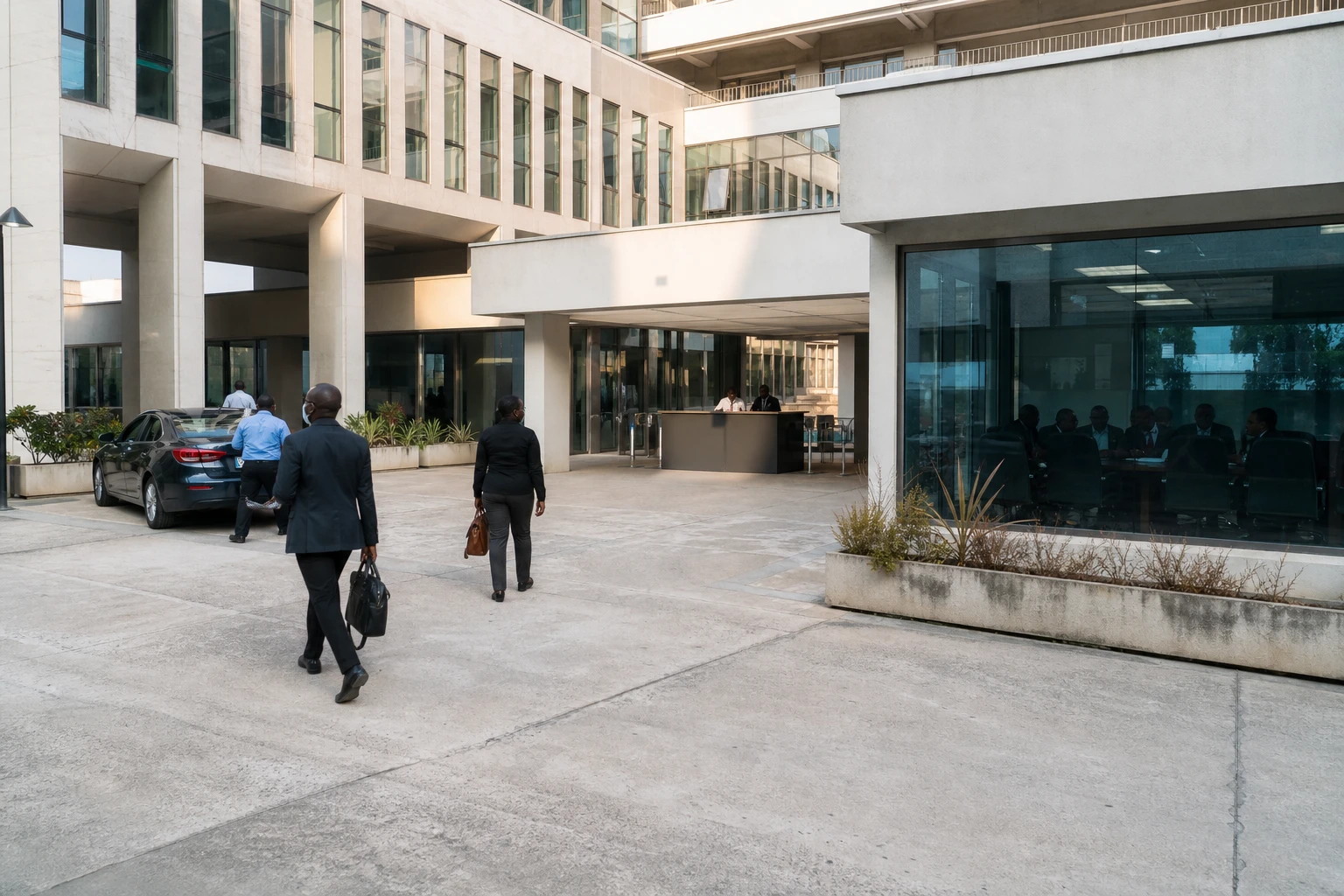
In Kinshasa, the streets were quiet on 22 July. But they have not disappeared from the political landscape. In the Democratic Republic of the Congo, postponing a march announced by the opposition resolves nothing: it merely shifts the balance of power, as the country waits to see whether the promised dialogue becomes a genuine framework or simply a signal of openness.
This moment comes in a country where the political scene, security in the east and institutional questions are constantly intertwined. The DRC remains part of the complex dynamics of Central Africa and the Great Lakes, where regional and continental mediation carries as much weight as decisions made in Kinshasa. On 17 July, the presidency presented the announcement of an inclusive national dialogue as a response to the country’s challenges, following a meeting with religious denominations.
What unfolded between the march and mediation
The Coalition Article 64, or C64, announced on 20 July that it was postponing the march scheduled for two days later towards the Palais de la Nation. The grouping brings together five well-known figures from the Congolese opposition: Martin Fayulu, Jean-Marc Kabund, Moïse Katumbi, Augustin Matata Ponyo and Delly Sesanga. The coalition presented this temporary retreat as an act of responsibility, while maintaining its uncompromising stance on defending the constitutional order.
The postponement did not happen in a vacuum. On 18 July, the National Episcopal Conference of Congo, CENCO, and the Church of Christ in Congo, ECC, had called on the opposition to give dialogue a chance. Two days earlier, President Félix Tshisekedi had met representatives of religious denominations and discussed organising an inclusive national dialogue, according to the presidency.
Religious mediation occupies a particular place in the DRC. For some in the political class and civil society, CENCO and the ECC remain channels capable of bringing together camps that no longer speak directly to one another. This time, their intervention was enough to halt the show of force announced in the capital. It did not, however, erase the fundamental disagreements.
The constitutional question remains unresolved
At the heart of the standoff is the Constitution. The C64 says it opposes any challenge to the limits on presidential terms and invokes Articles 70 and 220. The first sets a five-year term, renewable only once. The second safeguards several provisions, including those concerning the number and length of presidential terms, against any constitutional revision.
This is not a technical issue. It shapes political trust. In a country where transfers of power have often been contested and every institutional debate quickly takes on the dimensions of a struggle for political survival, the question of presidential terms becomes a test of credibility for both the authorities and the opposition. The C64 has therefore shifted the focus: it is no longer talking only about a march or the streets, but about the institutional framework and safeguards.
The coalition has also set a clear deadline: 15 August 2026. After that date, it says it reserves the right to draw «all the political consequences» and relaunch peaceful civic actions. This timetable matters. It allows the opposition to maintain a posture of vigilance while giving the presidency a short window to clarify the format, scope and participants of the announced dialogue.
What the postponement means for Kinshasa and the country
In the short term, the decision averts a street confrontation in the capital. Rallies by the presidential majority were also expected on 22 July, increasing the risk of incidents in Kinshasa. By stepping back, the opposition has eased the immediate pressure. But it retains the threat of mobilising again, keeping political tensions high.
For the presidency, the stakes are different. Félix Tshisekedi now has room to shape the religious initiative and show that the announced dialogue has a timetable, criteria and method. Without that, the word «inclusive» could quickly lose its political value. The July sequence therefore shows a presidency obliged to work with the churches, the opposition and its own supporters, without appearing to be buying time.
For the population, the stakes are even more tangible. In Kinshasa, mobilisations often bring disruption, security tensions and added strain on the informal economy. In the east, they are viewed through a different lens: that of a state expected to deliver peace, as fighting, humanitarian warnings and the presence of armed groups continue to affect daily lives. The United Nations continues to describe the situation in eastern Congo as fragile, with a ceasefire still to be consolidated and peace efforts under pressure.
A Congolese political episode with regional echoes
This issue goes beyond domestic politics. The Congolese presidency has recently framed its diplomacy around regional consultations, and turning to the churches adds another dimension to an environment in which neighbouring countries, the African Union and UN actors are closely monitoring the balance of forces in the DRC. In the Great Lakes region, every institutional crisis in Kinshasa sends ripples through security, cross-border movements and ongoing mediation efforts.
The signal sent by the C64 is therefore twofold. On the one hand, the opposition has agreed to suspend its show of force. On the other, it is maintaining strong political pressure by linking dialogue to the constitutional question and the crisis in the east. This combination shows that the battle is not being fought only in the streets, but also over the ability of Congolese actors to establish a framework for discussion that can withstand deadlines, ambitions and fears.
What happens next will depend on one simple question: will the presidency quickly spell out the content of the national dialogue, or let the initiative founder in consultations without a timetable? In the DRC, it is often the speed of implementation that turns a political announcement into real momentum. For now, there is a truce. A compromise, however, remains to be built.