
 Algeria
 Egypt
 Libya
 Sudan
 Tunisia
 Benin
 Burkina Faso
 Cabo Verde
 Côte d'Ivoire
 Ghana
 Guinea
 Guinea-Bissau
 Liberia
 Mali
 Mauritania
 Niger
 Nigeria
 Senegal
 Sierra Leone
 The Gambia
 Togo
 Cameroon
 Central African Republic
 Chad
 DR Congo
 Equatorial Guinea
 Gabon
 Republic of the Congo
 São Tomé and Príncipe
 Burundi
 Comoros
 Djibouti
 Eritrea
 Ethiopia
 Kenya
 Madagascar
 Malawi
 Mauritius
 Mozambique
 Rwanda
 Seychelles
 Somalia
 South Sudan
 Tanzania
 Uganda
 Angola
 Botswana
 Eswatini
 Lesotho
 Namibia
 South Africa
 Zambia
 Zimbabwe
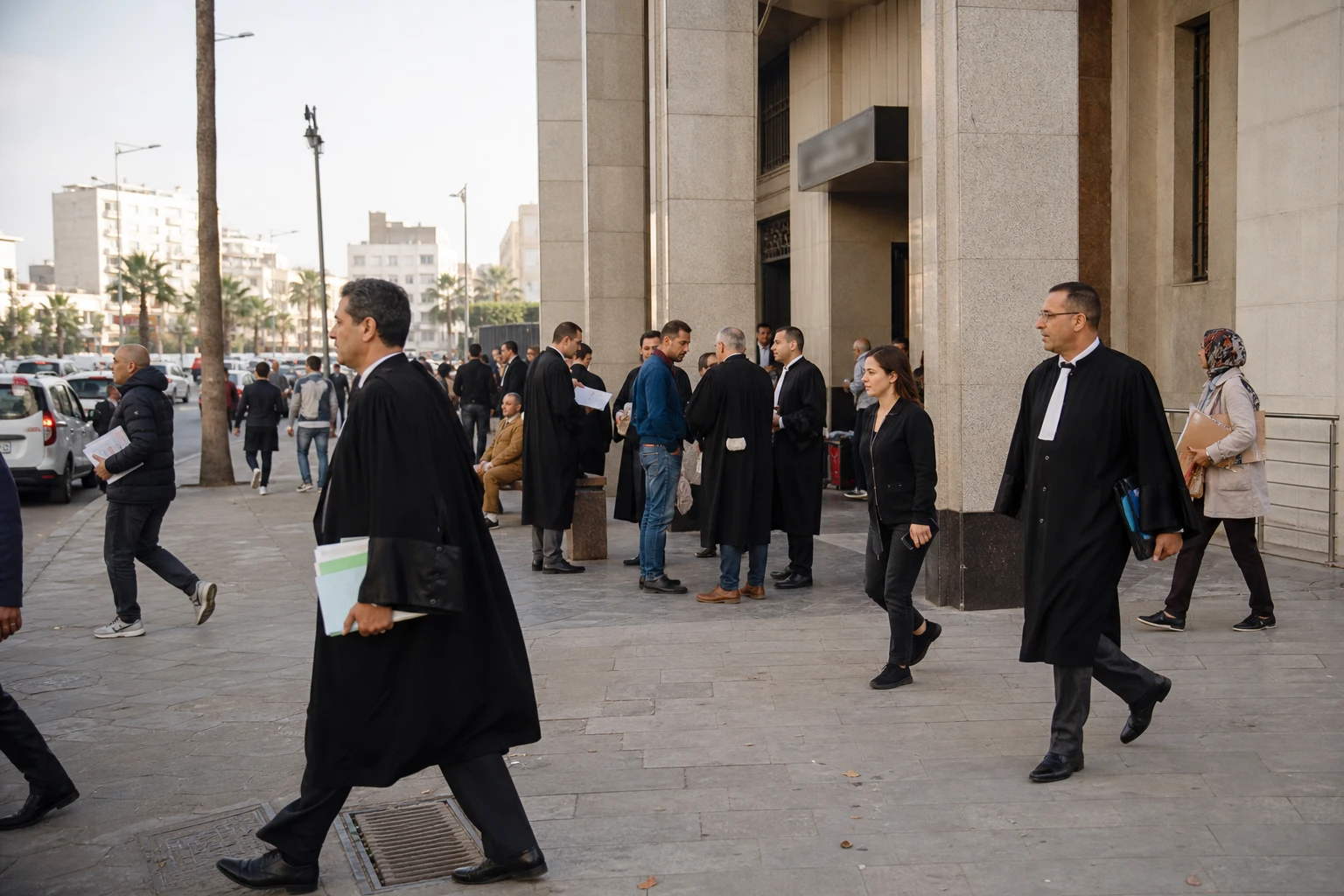
Moroccan justice slows, but the debate goes beyond the legal profession
A labour dispute in Rabat is now affecting the heart of Morocco’s judicial system. When lawyers suspend their services, it is not only their practices that slow down: hearings and cases are delayed, and sometimes the rights of litigants who have already been waiting for months are put on hold. In a country where access to legal defence remains a tangible measure of equality before the law, the tension extends beyond the profession itself.
The dispute forms part of a broader reform of Morocco’s justice system, pursued over recent months by the Ministry of Justice and Parliament. Draft Law No. 66.23 regulating the legal profession was presented to the House of Representatives in April 2026, then continued through the legislative process until its adoption by the House of Councillors in June. Meanwhile, the Constitutional Court, based in Rabat, has reiterated its role in reviewing whether laws comply with the Constitution before they enter into force, in cases provided for by the fundamental law.
Strike extended, services suspended and a clear dividing line
The Association of Bars of Morocco maintained its protest against the draft law on Monday 20 July 2026. According to information published that day, the organisation decided to extend the strike and continue the complete suspension of professional services, as well as legal aid, until further notice. The decision follows several rounds of mobilisation since the start of the year, including a new strike announced in June.
The source of the tension is clear. Lawyers accuse the authorities of pursuing the reform without what they consider adequate consultation and of seeking to redefine the profession’s internal balance. They say they fear a weakening of the autonomy of the bars and the independence of the defence. The Ministry of Justice, for its part, defends a bill presented as a step towards modernisation, with new rules for entry to the profession, more clearly defined regulation of the relationship between lawyer and client, and a revamped professional organisation.
The dispute is therefore about more than technical details. It concerns the lawyer’s place in the justice system. In Morocco, as in other Maghreb countries, the profession serves as a link between citizens and the courts. When the bars halt their activities, the impact is immediate for litigants, as well as for court clerks, judges and other legal professionals already working in a system that is often under pressure.
What lawyers oppose, and what the government wants to change
Justice Minister has presented Draft Law No. 66.23 as a reform intended to better organise the profession and bring it into line with the current demands of public justice services. The bill includes, in particular, an entrance examination, enhanced training, a greater obligation to formalise the mandate, and a more structured framework for disciplinary rules and the governance of the bars. The ministry argues that this update should strengthen transparency and efficiency.
The bars see the reform differently. They believe some articles risk limiting their scope to organise themselves and shifting the balance between public authority and the defence. In public statements, several representatives have stressed the need to preserve lawyers as independent actors, not merely as enforcers of an administrative framework. This view has fuelled sit-ins, work stoppages and calls to withdraw the bill rather than amend it.
Referral to the Constitutional Court has not ended the dispute. Under Moroccan law, when petitioned in the prescribed manner, the court reviews whether laws comply with the Constitution before promulgation. But for the lawyers taking part in the protest, this institutional review does not address their fundamental criticism: they object to the way the bill was drafted as much as to its content. In other words, the question is not only whether the law is constitutional, but whether it was drawn up with those it governs.
A professional standoff with tangible consequences for citizens
In the major cities, the suspension of legal aid is first creating an institutional bottleneck. The poorest people, who depend on legal aid, are the first to face delays. In the courts of Rabat, Casablanca, Fez, Tangier and Marrakesh, the strike is more than a professional protest: it can extend delays that are already significant in civil, criminal and family cases.
For lawyers, the mobilisation is also a test of internal solidarity. The bars across the Kingdom have not all responded in the same way. Divisions have emerged between cities, with some bodies continuing their work while others have joined the stoppage. This diversity points to a vibrant professional sphere, but one also shaped by distinct interests and bar cultures. In Rabat, the administrative and judicial capital, the tone of the protest is often more forceful, because decisions are more visible and more political there.
Beyond the profession, the debate raises a familiar but decisive question: how can justice be reformed without weakening those who defend citizens? The government is seeking to modernise an essential sector. Lawyers, meanwhile, want to prevent a poorly calibrated modernisation from turning the organisation of the profession into an instrument of control. Between these two views, Rabat’s role as a centre of decision-making is crucial, as Parliament, the Ministry of Justice and the Constitutional Court all converge there.
A Moroccan dispute, but a signal watched well beyond Rabat
This dispute reaches beyond Morocco because it touches on an issue shared across the continent: the balance between state reform, the independence of legal professions and trust in the judicial system. In several African countries, justice reforms face the same difficulty. They promise greater efficiency but often prompt suspicions of recentralisation or a weakening of checks and balances. Morocco, which has spent years seeking to strengthen its image as a country pursuing institutional reform, knows that the process matters as much as the substance.
What happens next will depend on the pace of the institutions. If the Constitutional Court upholds the bill, political tensions with the bars will not necessarily disappear. If it raises objections, Parliament will have to revisit the text. Either way, this episode will say something important about Morocco’s ability to advance sensitive reforms without breaking dialogue with its intermediary bodies. For now, lawyers are maintaining the pressure, and the Moroccan justice system continues to operate with some of its participants on the sidelines.



