
 Algeria
 Egypt
 Libya
 Morocco
 Sudan
 Tunisia
 Benin
 Burkina Faso
 Cabo Verde
 Côte d'Ivoire
 Ghana
 Guinea
 Guinea-Bissau
 Liberia
 Mali
 Mauritania
 Niger
 Nigeria
 Senegal
 Sierra Leone
 The Gambia
 Togo
 Cameroon
 Central African Republic
 Chad
 Equatorial Guinea
 Gabon
 Republic of the Congo
 São Tomé and Príncipe
 Burundi
 Comoros
 Djibouti
 Eritrea
 Ethiopia
 Kenya
 Madagascar
 Malawi
 Mauritius
 Mozambique
 Rwanda
 Seychelles
 Somalia
 South Sudan
 Tanzania
 Uganda
 Angola
 Botswana
 Eswatini
 Lesotho
 Namibia
 South Africa
 Zambia
 Zimbabwe
In Kinshasa, the government puts peace back at the centre of politics
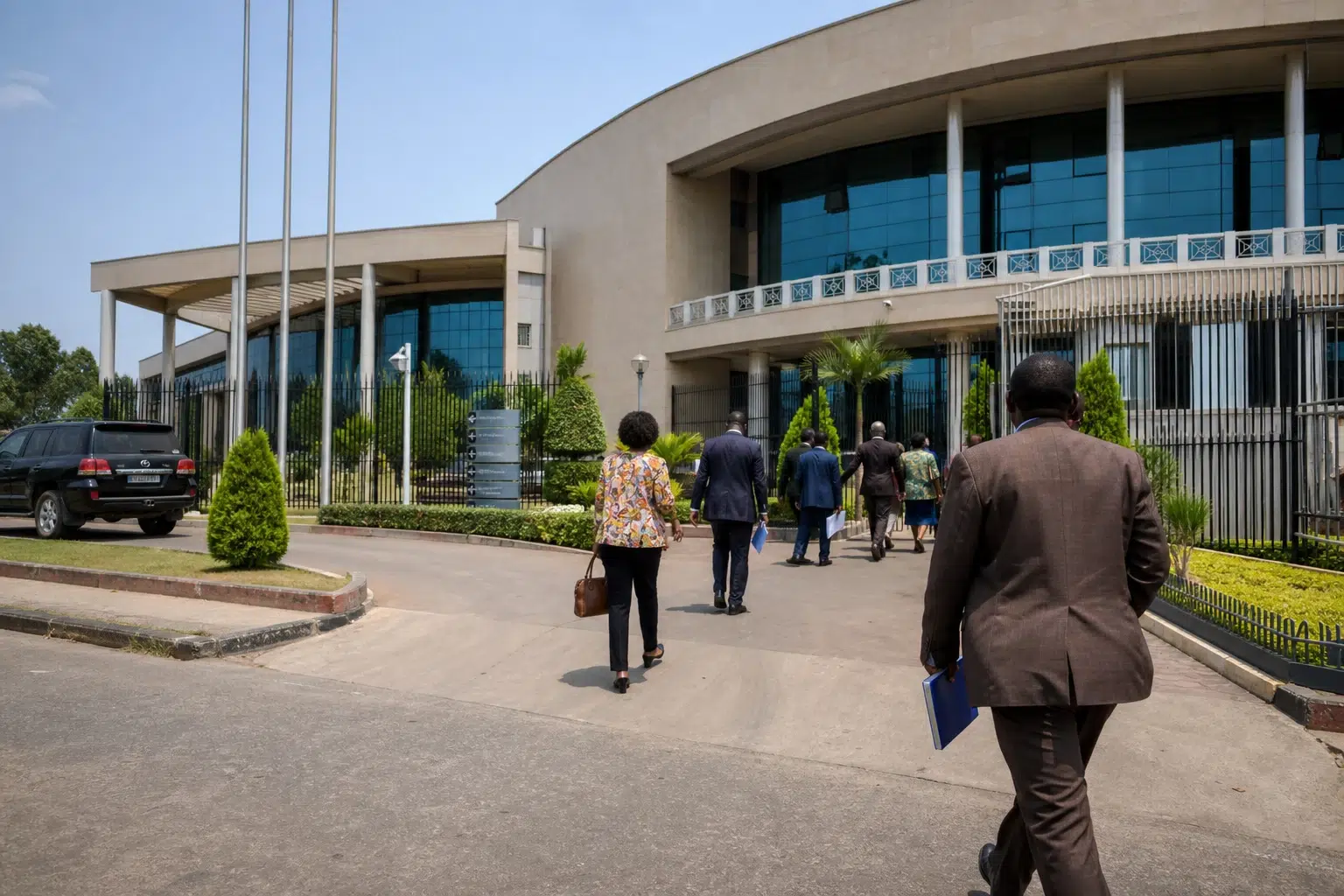
In the Democratic Republic of the Congo, the question is no longer simply who speaks on behalf of the country. It is how the country can prevent the political crisis, the war in the east and distrust between rival camps from further isolating Congolese people within the same state. It was in this context that Félix Tshisekedi announced the launch of an inclusive national dialogue, following a meeting with representatives of religious groups at the Cité de l’Union africaine in Kinshasa.
This development did not come out of nowhere. For months, the Catholic and Protestant churches, brought together through the National Episcopal Conference of Congo and the Church of Christ in Congo, had been pushing for the idea of a social pact for peace and living together. They were not alone. Calls for a framework for dialogue have also featured in statements by the UN, which urges the protection of civic space and the pursuit of consensus on the terms of such discussions.
A political announcement, but also a regional signal
The DRC is not facing an internal crisis alone. It remains caught in a security tangle affecting the entire Great Lakes region. In the east, the war between Kinshasa and the AFC/M23 continues to weigh on the provinces of North Kivu and South Kivu. In April 2026, the UN again reported fragile progress in the Montreux talks, held under the Doha process with facilitation by Qatar, the United States and the African Union.
At the same time, the regional dimension has grown stronger. The DRC is also working towards closer integration into the Southern African Development Community, SADC, which held high-level meetings in Kinshasa in late April 2026 to support Congolese accession to the regional free-trade area. In other words, Kinshasa is seeking to secure the country while anchoring it more firmly in the continent’s southern economic and political networks.
What Félix Tshisekedi announced, and what remains to be clarified
According to the Congolese presidency, the head of state has decided to launch an “inclusive, peaceful and resolutely republican national dialogue”. The statement says the dialogue is intended to help consolidate national cohesion, in accordance with the institutions and the Constitution. Cardinal Fridolin Ambongo, who led the religious delegation, confirmed that the announcement responded to the challenges of the moment and to steps already taken by the president.
Religious groups have agreed to support the initiative. They include the Catholic and Protestant churches, Islam, Pentecostal churches and other religious communities present in the country. But the process has yet to be defined. The date, format, list of participants, agenda and political guarantees all remain to be clarified. This lack of detail is already prompting questions about the exercise’s real significance.
At this stage, the government says the dialogue will circumvent neither the institutions nor the Constitution. At the end of June, Félix Tshisekedi had already said he was open to dialogue, while warning that it must not serve to challenge the popular will or bypass the rules of the republican system. This political stance explains the presidential palace’s caution: it is willing to open talks, but not to yield on institutional legitimacy.
What is at stake for Congolese people, from the seat of power to the provinces
For the leaders, the objective is clear: to prevent the crisis in the east from becoming a regime crisis. Dialogue could help rebuild a minimum level of trust between the governing majority, opposition, churches and civil society. But it could also become a battleground, especially if some opposition figures believe the conditions for free discussion are not in place. According to accounts from Kinshasa, some opposition figures are still demanding the release of political prisoners, an end to prosecutions they consider arbitrary, and a freeze on any constitutional reform before talks begin.
For the population, the question is more tangible. In Kinshasa, political polarisation is visible in the streets, churches, universities and on social media. In the eastern provinces, the priorities remain civilian security, humanitarian access, freedom of movement and the revival of economic life. Diplomatic talks only matter if they improve daily life. Otherwise, dialogue becomes yet another symbol in a country already saturated with announcements.
The role of religious groups is worth noting here. In the DRC, they are not merely moral authorities. They often act as intermediaries when political channels are blocked. Once again, they have agreed to carry the initiative forward. They hope to bring political actors together around a minimum common ground: peace, cohesion and respect for the institutions. This mediation role carries considerable weight, especially in a country where trust in party structures remains fragile.
What this development says about the DRC and Central Africa
The Congolese issue extends beyond national borders. In Central Africa, the DRC’s stability shapes some of the region’s security, humanitarian and trade balances. A credible political dialogue could ease pressure in the eastern provinces, support ongoing diplomatic efforts and give greater coherence to regional initiatives. Conversely, a process that is too closed could fuel distrust, complicate mediation and prolong the population’s hardship.
The continental implications are similar: the DRC stands at the crossroads of peace, economic integration and institutional sovereignty agendas. The African Union, SADC and mechanisms linked to the Great Lakes are closely monitoring developments. What happens next will depend on three simple steps that are easy to announce but difficult to deliver: a clear framework for dialogue, participants recognised by a broad cross-section of the country, and sufficient guarantees to ensure the talks are not merely a political moment but a genuine instrument for resolving the crisis.



