Algeria
 Egypt
 Libya
 Morocco
 Sudan
 Tunisia
 Benin
 Burkina Faso
 Cabo Verde
 Côte d'Ivoire
 Ghana
 Guinea
 Guinea-Bissau
 Liberia
 Mali
 Mauritania
 Niger
 Nigeria
 Senegal
 Sierra Leone
 The Gambia
 Togo
 Cameroon
 Central African Republic
 Chad
 DR Congo
 Equatorial Guinea
 Gabon
 Republic of the Congo
 São Tomé and Príncipe
 Burundi
 Comoros
 Djibouti
 Eritrea
 Ethiopia
 Kenya
 Malawi
 Mauritius
 Mozambique
 Rwanda
 Seychelles
 Somalia
 South Sudan
 Tanzania
 Uganda
 Angola
 Botswana
 Eswatini
 Lesotho
 Namibia
 South Africa
 Zambia
 Zimbabwe
In Antananarivo, energy is about more than prices
In Madagascar, filling a vehicle, delivering rice or running a hospital for a day often depends on the same factor: fuel availability. When supplies tighten, the whole day-to-day economy slows, from the capital, Antananarivo, to ports on the east coast.
The Malagasy government therefore decided on 17 July 2026 to reinstate the energy emergency across the country. The move comes in a country where security of supply remains a sensitive issue, because a significant share of electricity still depends on imported fuels and is therefore exposed to external shocks. In such a system, the global oil bill is quickly felt on the streets of Antananarivo, as well as in secondary urban centres and the most isolated areas.
A decision taken within a familiar framework
The measure is not institutionally new. In April 2026, a special cabinet meeting had already declared an energy emergency, after an initial period of pressure on supplies and pump prices. The Prime Minister’s Office website records that episode, with a report dated 8 April and a special cabinet meeting on 7 April 2026.
On the regulatory front, the Malagasy Hydrocarbons Office subsequently published the pump prices applicable from 5 January 2026, followed by successive revisions to the automatic adjustment mechanism. This framework explains why the issue is not merely a matter of government communications. It affects the import and distribution chains, the room for manoeuvre in the budget, and the balance between subsidies and market prices.
On 3 July 2026, local media were already reporting the return of the automatic price adjustment mechanism, with diesel held at 4,860 ariary per litre after a period of price freezes and acute pressure. This figure is consistent with levels recorded in the spring, when the OMH listed diesel at 4,660 ariary on 5 March 2026, after 4,670 ariary on 5 January 2026. In other words, the market had not returned to normal. It remained fragile and under close watch.
What an energy emergency allows
In practice, an energy emergency gives the executive exceptional powers. The state can ration fuel at the pump, cap or freeze prices, and take measures by decree without immediately going through parliament. Such a tool is intended to prevent a sudden breakdown in supply, but it also reflects the extent of the country’s vulnerability to international markets.
The authorities’ reasoning is clear: contain the pressure before it turns into a wider crisis. Tensions in the Middle East pushed crude prices higher again in mid-July 2026, according to international news reports. For Madagascar, a net importer of petroleum products, this raises the cost of transport, electricity generation and some logistics. The shock therefore affects more than motorists. It also hits households buying goods delivered by lorry, small businesses, transport operators and public services.
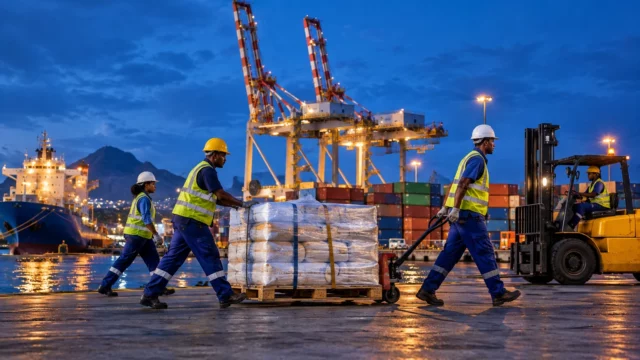
The government is nevertheless seeking to avoid panic. During previous episodes, queues at petrol stations disrupted urban life in Antananarivo and Toamasina, the country’s economic capital and main port gateway. Power cuts also worsened, affecting hospitals, government offices and essential services. In an economy where a large share of trade remains informal, even a brief fuel shortage immediately cuts daily earnings.
On 1 July 2026, the reinstatement of automatic pump-price adjustments confirmed this shift. The approach ends part of the implicit subsidy and brings local prices closer to import costs. In the short term, this protects the state budget. In the medium term, it passes some of the shock on to consumers. That is the heart of Madagascar’s dilemma: stabilising public finances without undermining purchasing power.
An issue that extends beyond Madagascar
The situation in Madagascar is also part of a wider regional picture. Madagascar has been a member of SADC, the Southern African Development Community, since 2005. The organisation closely monitors the political and economic balance of its member states, and recently reaffirmed its support for the country amid a still-sensitive institutional context. Energy is also a central SADC priority, and in 2025 the organisation adopted a theme focused on industrialisation, agricultural transformation and the energy transition.
The issue therefore goes well beyond a rise in the price of a litre of diesel. It raises questions about Madagascar’s place in regional transport chains, the organisation of coastal shipping in the Indian Ocean, and the ability of island states to absorb shocks originating far away. It also highlights a point that is often underestimated: Southern Africa is not only talking about trade corridors or a customs union. It is also talking about electricity, fuel and logistical security—in other words, the practical mechanics of development.
For Madagascar, the immediate priority remains continuity of supply. But the political stakes are just as clear: to show that the state can prevent shortages without triggering a fresh spiral of discontent. The next phase to watch will play out in the implementation of pump prices, the pace of imports and the government’s ability to project stability while global markets remain volatile.